
Operational Assessment
See the work as it really happens—and identify what is preventing better performance
An Operational Assessment is a focused, evidence-based examination of how your organization actually creates and delivers value.
Over one to two weeks, Nigel Thurlow works directly with leaders, managers, frontline teams, and the people closest to the work to study the operation as a complete system. The purpose is not to impose a generic improvement program or arrive with a predetermined solution. It is to reveal how work truly flows, where capacity is being lost, what is creating variation and delay, and which changes will produce the greatest operational benefit.
The assessment concludes with a clear set of practical recommendations designed to reduce non-value-adding activity, improve flow, increase throughput, stabilize performance, support production growth, and strengthen the organization’s ability to solve its own problems.
Nigel’s approach draws upon his experience as the first Chief of Agile at Toyota, his work in Lean thinking and organizational design, and his development of The Flow System. It combines direct observation at the gemba with value-stream analysis, operational data, structured conversations, and a wider examination of leadership, decision-making, information flow, team design, and organizational constraints.
Understand what is really limiting your operation
Bring Nigel into your organization for an independent assessment of how work flows, where capacity is being lost, and what must change to improve performance and support sustainable growth. Book a Meeting Today.
What an operational assessment examines
Most operational problems are not confined to an individual workstation, department, team, or process. They are produced by the interactions between different parts of the organization.
A department may appear efficient while the overall value stream remains slow, expensive, and unreliable. Local productivity can increase while inventory, queues, waiting, rework, and customer lead time become worse. For this reason, the assessment looks beyond isolated activities and examines the complete system through which value is created and delivered.
The areas studied may include:
The flow of work
Nigel examines how materials, products, services, decisions, requests, and information move through the operation from initial demand to delivery.
This includes identifying:
- Waiting and queue time
- Bottlenecks and constraints
- Excessive handoffs
- Delays in approvals and decisions
- Work accumulating between processes
- Interrupted or irregular flow
- Large batches
- Unnecessary movement and transportation
- Breakdowns in the flow of information
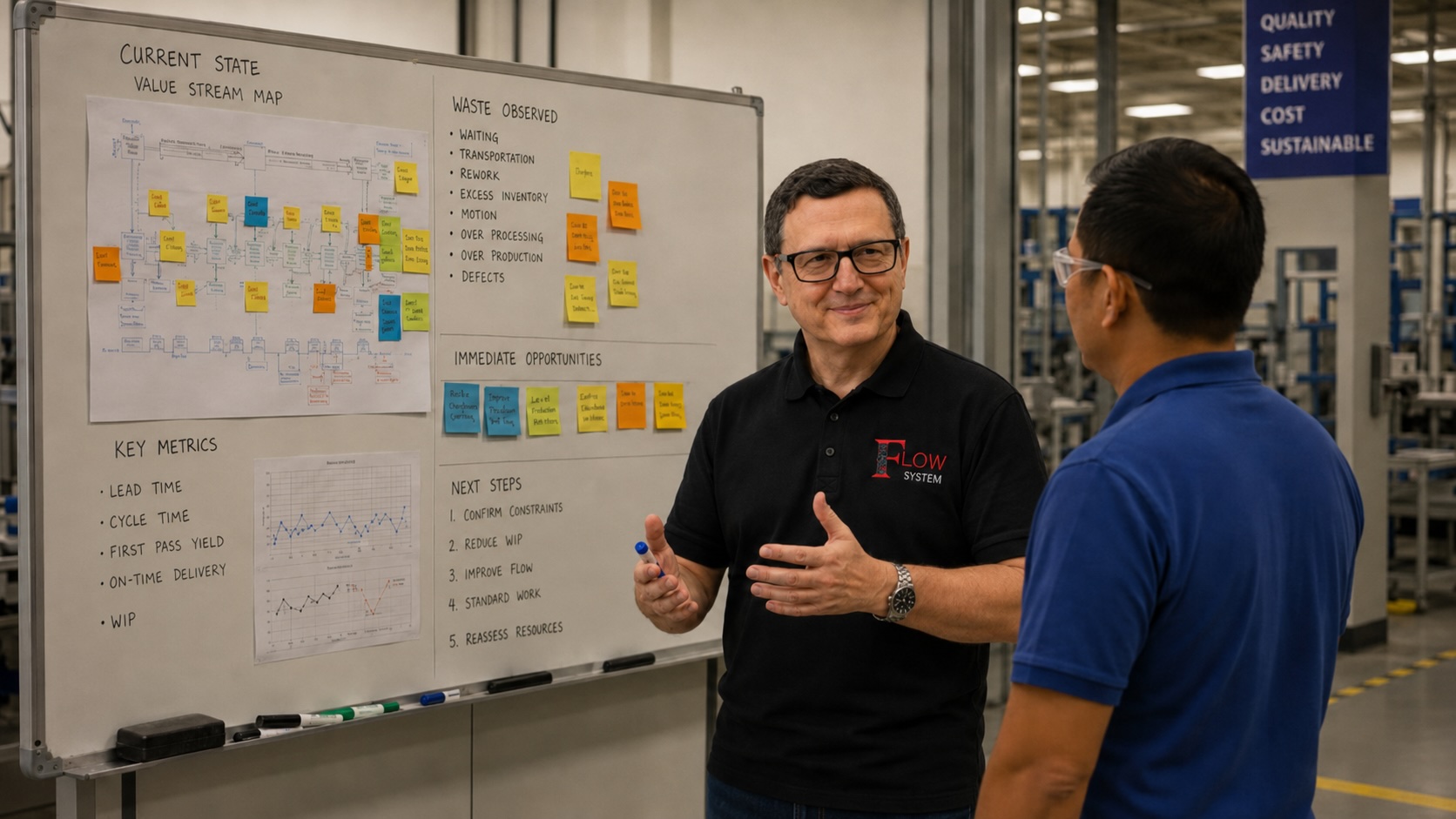
Value Stream Mapping may be used to make the current system visible across people, products, processes, and information. Nigel’s approach treats the wider organization—including functions such as procurement, compliance, technology, legal, vendors, and leadership—as part of the value stream rather than as separate supporting activities.
Value-adding and non-value-adding activity
The assessment distinguishes between the work that directly contributes to customer value and the activity that consumes time, capacity, and cost without improving the outcome.
Examples may include:
- Waiting for materials, information, approvals, or decisions
- Rework and correction
- Duplicate entry and reporting
- Unnecessary meetings
- Excessive checking or inspection
- Searching for tools, documents, or information
- Overproduction
- Unnecessary inventory
- Work created to satisfy internal bureaucracy rather than customer need
- Tasks caused by poorly designed processes or unclear responsibilities
Waiting is made particularly visible because it is often one of the largest and most readily addressable forms of waste. Nigel distinguishes between process time, value-creating time, waiting time, and total customer lead time so the organization can see where its capacity is actually being consumed.
Variation and operational stability
Variation creates unpredictability. It affects quality, output, staffing, scheduling, lead time, inventory, customer service, and the ability to scale.
The assessment looks for variation in areas such as:
- Cycle times
- Demand
- Production volumes
- Quality and defect rates
- Changeover times
- Equipment performance
- Work methods
- Staffing and skills
- Supplier performance
- Information quality
- Decision times
- Priorities and scheduling
The objective is not simply to demand greater consistency from people. It is to understand whether variation is being created by the design of the system, unstable processes, changing inputs, conflicting priorities, equipment problems, supplier issues, or management intervention.
This helps distinguish recurring systemic conditions from unusual events, preventing leaders from reacting to every fluctuation and inadvertently making performance less stable.
Capacity, constraints, and scalability
Organizations frequently attempt to increase output by adding people, equipment, overtime, or technology before understanding what is actually limiting production.
The assessment evaluates:
- The true constraint within the value stream
- Capacity at each significant process
- Demand versus available capability
- Work-in-process and queue growth
- Throughput
- Batch size
- Changeover and setup losses
- Resource imbalance
- Dependency on scarce specialists
- Equipment availability and reliability
- The consequences of proposed production increases
This creates a more reliable basis for scaling. Rather than increasing cost throughout the organization, investment can be directed toward the few constraints that genuinely limit output.
Quality, defects, and rework
Defects rarely represent only the cost of repairing an item. They also consume capacity, interrupt flow, create additional handling, delay customers, distort schedules, and increase operational variation.
Nigel examines:
- Where defects originate
- Where they are detected
- How long they remain hidden
- The amount of rework being performed
- Repeated failure patterns
- Inspection and containment processes
- Feedback loops
- Standardized work
- Escalation and Andon mechanisms
- Whether teams can stop, signal, and resolve problems at source
The emphasis is on improving the system so that problems become visible earlier and are addressed closer to the point of occurrence.
Organizational design and decision flow
Operational performance is shaped as much by organizational design as it is by the technical production process.
The assessment therefore considers:
- Decision-making authority
- Management layers
- Escalation routes
- Functional silos
- Team composition
- Dependencies between departments
- Competing priorities
- Committee and meeting structures
- Communication pathways
- Availability of customer feedback
- Psychological safety
- The ability of frontline teams to identify and resolve problems
Nigel’s previous assessments have exposed problems such as deep hierarchies, excessive dependencies, meeting overload, context switching, slow decision-making, disengaged customers, and large amounts of work that did not contribute to the outcome. In one major Toyota program, the findings supported a substantial redesign of the operation, after which small focused teams delivered a working system within 90 days following years of unsuccessful effort. (Rescuing a Major Toyota Program)
Measures and management information
An organization cannot improve what it cannot see, but inappropriate measures can encourage the wrong behavior.
The assessment reviews whether existing data provides an accurate picture of operational performance. Relevant measures may include:
- Customer lead time
- Process lead time
- Cycle time
- Waiting time
- Value-adding time
- Process Cycle Efficiency
- Throughput
- Work in process
- First-pass yield
- Defects and rework
- Schedule stability
- On-time delivery
- Capacity utilization
- Demand and production variation
The intention is not to create arbitrary benchmarks or performance targets. It is to establish meaningful baselines and observe improvement over time. Nigel emphasizes contextual measures and system performance rather than isolated utilization or output figures that may encourage local optimization. (Learn about Lean Metrics)
How the operational assessment is conducted
The exact structure is adapted to the nature of the operation, but a typical assessment includes four connected activities.
1. Understand the business context
The work begins by clarifying:
- Customer demand and expectations
- Products or services delivered
- Current performance concerns
- Growth ambitions
- Production and financial objectives
- Known operational risks
- Previous improvement efforts
- Constraints identified by leadership
This establishes the purpose of the assessment without assuming that the originally stated problem is necessarily the real problem.
2. Observe the actual work
Nigel spends time where the work happens—the gemba—observing processes, following products or requests, speaking with the people performing the work, and examining the conditions that influence their performance.
This is not an audit of individuals. It is an examination of the system in which people are expected to succeed.
Direct observation helps reveal the difference between:
- The documented process and the actual process
- What leaders believe happens and what really happens
- Scheduled time and productive time
- Reported performance and customer experience
- Apparent capacity and usable capacity
3. Map and analyze the system
Evidence is brought together to show how the operation currently behaves.
Depending on the context, this may include:
- Current-state value-stream mapping
- Process observation
- Flow and dependency mapping
- Capacity analysis
- Constraint identification
- Review of operational measures
- Demand and variation analysis
- Team and decision-flow analysis
- Examination of quality and rework
- Review of work-in-process and inventory
- Structured interviews or facilitated group sessions
Nigel uses a method-agnostic approach. Techniques are selected because they fit the context, not because the organization is being sold a branded transformation or predetermined methodology. His wider work combines Lean, Flow, complexity-informed practice, distributed leadership, and team science.
4. Present findings and recommendations
At the end of the assessment, leaders receive a clear explanation of:
- What was observed
- Where performance is being lost
- Which problems are systemic
- What is limiting flow and throughput
- Where variation originates
- Which activities do not add value
- What prevents the operation from scaling
- Which actions should be taken first
- What should be measured
- What risks must be considered
Recommendations are prioritized rather than presented as an unmanageable catalogue of ideas.
They may be organized into:
- Immediate actions
- Near-term operational improvements
- Structural or organizational changes
- Longer-term capability development
Typical deliverables
The engagement can produce:
- An executive findings presentation
- A written operational assessment report
- A current-state value-stream map
- Identification of major constraints and sources of delay
- Analysis of non-value-adding activity
- Baseline measures for lead time, throughput, waiting, quality, and efficiency
- A prioritized improvement roadmap
- Recommendations for increasing production capacity
- Recommendations for reducing variation and improving stability
- Opportunities to simplify organizational structure and decision-making
- Identified risks, dependencies, and barriers to implementation
- Suggested next experiments or improvement cycles
The deliverables are designed to support action, not merely document observations.
The value of an Operational Assessment
See the whole system
Operational problems are often addressed one department at a time. This can produce local improvements while making the overall system worse.
An independent assessment reveals the end-to-end value stream and shows how decisions in one area affect performance elsewhere.
Recover hidden capacity
Many organizations already possess more capacity than they realize. It is trapped in waiting, rework, poor coordination, large batches, interruptions, unnecessary reporting, and avoidable decision delays.
Removing these losses may create significant additional output before capital expenditure or recruitment is required.
Scale with greater confidence
Growth exposes weaknesses that lower volumes can conceal. A process that appears adequate today may become unstable when demand increases.
The assessment identifies the changes needed to scale output without proportionally scaling cost, inventory, complexity, management overhead, or defects.
Reduce cost without arbitrary cuts
Cost reduction is more sustainable when it comes from removing waste and redesigning work rather than cutting resources indiscriminately.
The assessment focuses on eliminating activity that consumes money but does not improve customer value.
Improve lead time and delivery reliability
Reducing queues, interruptions, handoffs, dependencies, and decision delays shortens the time between demand and delivery.
Greater stability also makes delivery performance more predictable.
Improve quality at the source
By identifying where defects and variation originate, the organization can move from inspection and correction toward prevention, rapid feedback, and problem-solving at the point of work.
Direct investment toward the real constraint
The assessment provides evidence for deciding where additional people, equipment, automation, or technology will genuinely improve throughput—and where such investment would simply create more inventory or unused capacity.
Create a practical improvement agenda
Leadership teams often know that performance must improve but disagree about the causes or where to begin.
The assessment creates a shared, evidence-based understanding of the current condition and a prioritized course of action.
Who this service is for
An Operational Assessment is particularly valuable when an organization is:
- Preparing to increase production or service capacity
- Experiencing long or unpredictable lead times
- Missing delivery commitments
- Carrying excessive inventory or work in process
- Suffering recurring quality problems or rework
- Adding people without seeing proportional improvement
- Struggling with inconsistent operational performance
- Introducing new technology or automation
- Integrating acquired operations
- Redesigning an operating model
- Facing increasing demand, cost pressure, or customer dissatisfaction
- Unsure where its true bottleneck exists
- Frustrated by previous improvement initiatives that failed to create lasting results
And conducting operational due diligence before a merger or acquisition, or assessing integration risks and improvement opportunities after the transaction including, operational capability, risk, scalability.
Independent, evidence-based, and focused on action
This is not a generic maturity assessment, a compliance audit, or the beginning of a prolonged consulting dependency.
It is a concentrated investigation intended to provide leaders with an honest view of their operation, a clearer understanding of the system influencing performance, and practical recommendations that can be acted upon.
The goal is not to make the organization dependent upon an external expert. It is to expose the conditions preventing effective performance and help its people become more capable problem solvers.