The Transformation Leaders Want—and the Change They Avoid
Are We Selling You the Wrong Product—or Are You Asking for the Wrong Thing?
Organizations buy transformation as though it were a treatment that can be administered, completed and declared successful. But sustainable improvement is not a temporary intervention. It requires a lasting change in how the organization is led, and asks leaders to alter the very system that rewards, protects and validates them.
This article examines why organizations repeatedly purchase transformation programs that create visible activity without changing the conditions that produced the problem.
It explores the roles of leadership, power, short-term incentives and the consulting industry, and argues that Lean, flow and continuous improvement are not products to be installed, but a different way of leading and operating that must become part of everyday organizational life.
It also examines if you actually need a transformation or just an intervention. My conclusion is leaders want a different organization, but not a different system.
This is the third in a series or articles that began with Organizational Blindness and part two Why Everything Takes Longer
Estimated reading time: 30–35 minutes
Key Takeaways for Leaders
- Transformation is not emergency treatment. Rapid intervention may stabilize costs, quality, delivery or engagement, but treating symptoms is not the same as removing the systemic conditions that created them.
- The consultant is a plumber, not the CEO. Their role is to identify blockages, repair what is broken and help restore the flow of value. They can support change, but they cannot own it. Any lasting transformation must be led and sustained by the organization itself.
- The real product is a different way of leading. Lean, flow and continuous improvement require leaders to change how priorities are set, authority is exercised, problems are handled and people participate in improving the work.
- Consultants can become part of the dysfunction. Consultants who sell elaborate roadmaps, endless workstreams and PowerPoint presentations without confronting leadership behavior are selling the appearance of treatment rather than systemic change.
- You cannot demand different results while preserving the same system. Leaders cannot credibly ask for empowerment while retaining every important decision, transparency while punishing bad news, or long-term capability while optimizing only for the next quarter.
- Power insulates leaders from organizational dysfunction. The people most affected by broken systems usually lack the authority to change them, while those with the greatest authority are often increasingly protected from their consequences.
- Success can turn reformers into defenders of the status quo. Thurlow’s Law describes how people may seek power to change the system, only to become rewarded, protected and validated by it once they acquire authority.
- Highly paid leaders may not personally experience an organizational problem. An organization can be dysfunctional for employees, customers, suppliers and long-term shareholders while continuing to reward its senior leaders extremely well.
- Fully participatory leadership does not abolish hierarchy. It means leaders participate directly in understanding the work, learning from those who perform it, removing systemic constraints and examining their own contribution to dysfunction.
- Improvement must become part of how the organization operates. The initiative should eventually disappear, the consultants should leave and special transformation governance should become unnecessary. The discipline of learning and improvement must remain.
- Both buyer and seller must tell the truth. Leaders must decide whether they genuinely want systemic change or merely short-term symptom relief. Experts must decide whether to sell the difficult product the organization needs or the comfortable product its leaders want to buy.
Table Of Contents
1. Constancy of Purpose
For years, organizations have hired experts in Lean, continuous improvement, operational excellence, agility and organizational transformation. They have studied Toyota, admired the rise of Japanese industry and listened to the lessons of Shewhart, Deming, Ohno, Wheeler, Drucker and many others who warned that enduring performance cannot be created through slogans, targets, reorganizations or the isolated application of tools.
The message has been repeated so often that it should now be impossible to misunderstand.
“Create constancy of purpose toward improvement of product and service, with the aim to become competitive and to stay in business, and to provide jobs.”
— W. Edwards Deming, Out of the Crisis, MIT Press, 1986
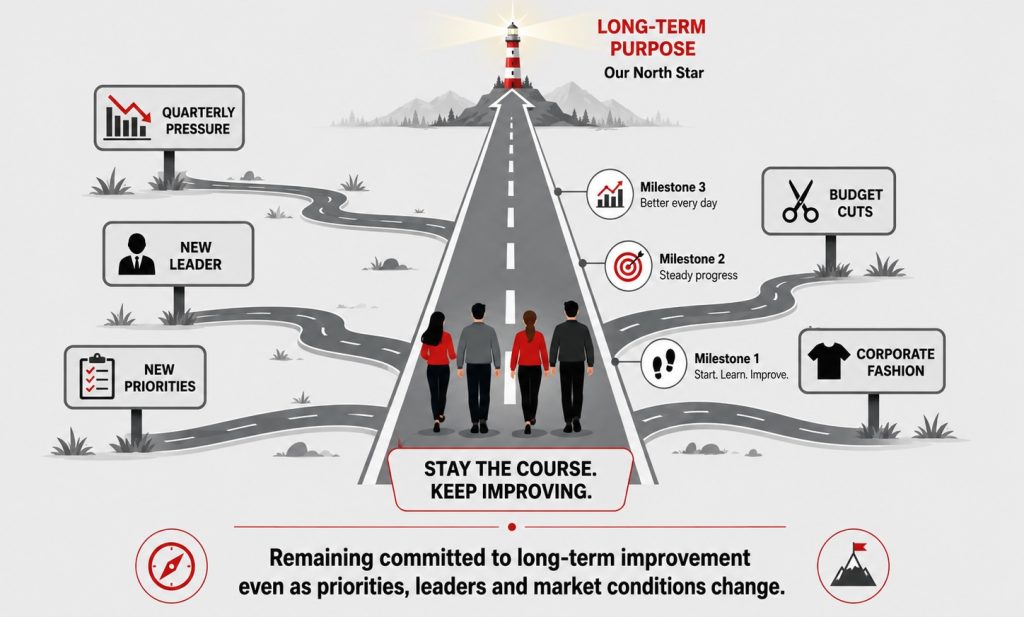
Constancy of purpose means more than maintaining a transformation program for several years. It means remaining committed to improving the organization’s ability to create value, develop people and serve its customers long after the excitement of the initial initiative has disappeared.
It requires leaders who understand the work, remain connected to the people doing it and examine the organization as a whole system. It requires them to accept responsibility for the conditions that system creates rather than treating its failures as problems belonging to employees, middle managers or individual functions.
It also requires patience. People must develop judgment. Teams must learn how to work together. Leaders must understand how value and information move through the organization. Measures, incentives and governance mechanisms must be changed carefully because altering one part of a system often produces consequences elsewhere.
The Familiar Transformation Model
None of this fits comfortably within the familiar transformation model. Organizations continue to purchase Lean transformations, Agile transformations, digital transformations and cultural transformations as though they were defined products that could be installed, deployed and completed. They establish a program office, appoint a transformation leader and send employees for training, where many bask in the glory of their latest certifications.
- New terminology appears.
- Governance structures are created.
- Maturity assessments are completed.
- Dashboards multiply.
- Consultants arrive in considerable numbers.
- Calendars fill with meetings.
- PowerPoint decks grow longer.
- Roadmaps stretch across walls and screens.
- Leaders announce that the organization is beginning an important new journey.
The Illusion of Change
For a while, the organization appears to be moving. Then the executive sponsor leaves.
- The market changes.
- A new priority is announced.
- Budgets tighten. The consultants depart.
- The transformation office is reduced or dismantled.
- Visual boards become wallpaper.
- The new language slowly disappears.
The organization returns to many of the behaviors that made the transformation necessary in the first place, and the usual conclusion is that the transformation failed. But, like buses in London, another one will be along soon, usually with the next leader, a new consulting firm and a different collection of fashionable language.
Change Without Constancy
The deeper failure is the absence of constancy. The initiative may have had sponsorship, but it did not have stewardship. It may have generated activity, but it did not change how the organization was managed. It may have introduced new tools, structures and language, but it never became inseparable from the everyday work of leadership.
Sustainable improvement cannot depend upon the continued presence of a particular executive, consultant or transformation office. It must become part of how priorities are established, how problems are exposed, how decisions are made, how people are developed and how the organization learns.
That is why Lean and continuous improvement cannot be treated as temporary programs. They demand a continuing philosophy of management and a constancy of purpose that survives leadership transitions, market disruptions and the inevitable arrival of the next corporate fashion. Yet this is rarely the product organizations believe they are buying. More often, transformation is purchased as an urgent intervention: stop the deterioration, restore confidence and return the organization to normal.
The problem, of course, is that normal may be what caused the emergency in the first place.
2. Transformation as Emergency Treatment
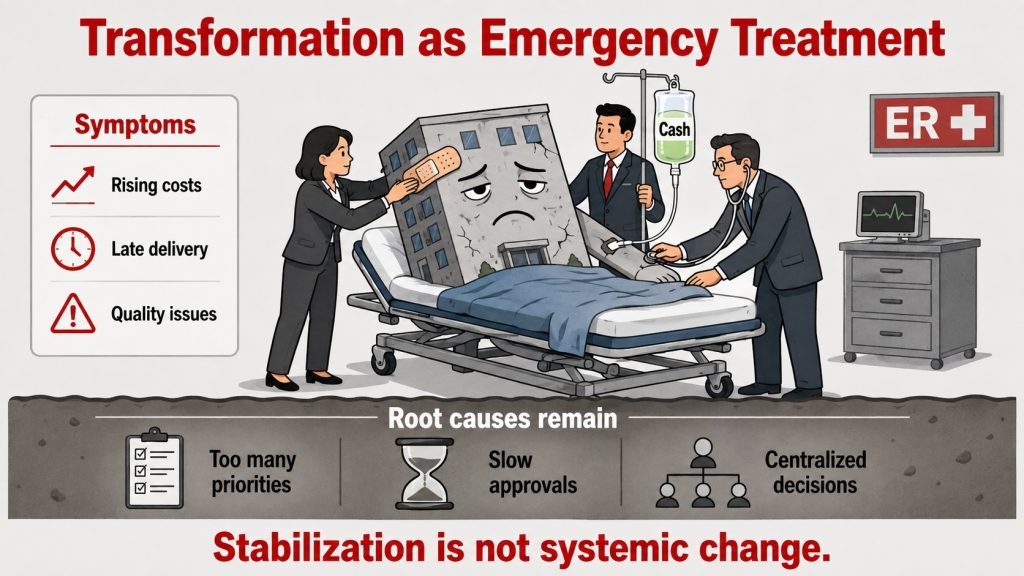
Organizations often purchase transformation as though they were calling the emergency services: stabilize the patient, relieve the immediate symptoms and restore normal operations as quickly as possible.
- Costs are rising.
- Delivery is deteriorating.
- Quality is declining.
- Customers are complaining.
- Employees are exhausted or disengaged.
- Innovation has stalled.
- A major program is late.
- A new competitor or technological shift has exposed weaknesses that were previously easier to ignore.
Action is Demanded
The board is demanding action so the organizational equivalent of an emergency call is made.
The organizational ambulance is called, but the request is often much simpler than the language surrounding it: “Let’s just fix my problems and get us back to normal.”
Experts are brought in to stop the bleeding, restore the vital signs and reassure everyone that the patient is receiving treatment.
- A recovery program is launched.
- Resources are redirected.
- Processes are mapped.
- Projects are reprioritized.
- Temporary governance is established.
- Leaders become more visible and decisions that previously took weeks are suddenly made in hours.
There is nothing inherently wrong with this kind of intervention. Emergency medical services exist for good reason. They act rapidly, preserve life and stabilize the patient.
An organization facing a severe quality failure, collapsing delivery performance or an immediate financial threat may also require urgent containment and concentrated leadership attention. This is what is known as the Turnaround Business in restructuring. It’s meant to be temporary and rapid.
But stabilization is not the same as diagnosis, recovery, rehabilitation or prevention.
Stopping the bleeding does not explain why the patient became ill. Restoring the vital signs does not remove the conditions that caused the emergency. It’s the difference between repeatedly taking a pill for a recurring headache and discovering why the headache keeps returning.
Long-Term Health
The danger begins when the emergency treatment is mistaken for a long-term health system. Lean, flow and continuous improvement are not emergency treatments. They cannot be reduced to temporary interventions designed to restore the organization to what it was before the crisis. In many cases, what the organization was before the crisis is precisely what produced it.
The visible symptoms may be poor delivery, rising costs, declining quality or low morale. The deeper causes may lie in how authority is exercised, how work is funded, how priorities are set, how performance is measured, how information is filtered and how decisions are made.
They may be found in the distance between senior leadership and the real work. They may arise from incentives that reward local performance at the expense of the whole, governance systems that create delay without improving decisions, or a culture that speaks of empowerment while retaining control at the top.
These conditions cannot be repaired through a workshop, a tool, a reorganization or a new operating model presented in a polished deck. They require sustained changes in how the organization is led and managed. A new framework will not yield a new culture. Culture is an emergent property.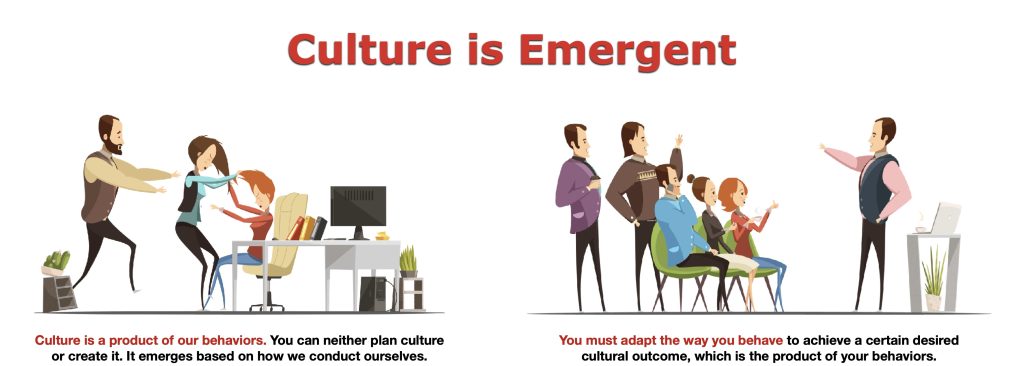
Emergency Interventions
Emergency intervention can nevertheless produce impressive short-term results. During a crisis, leaders intervene personally.
- Additional resources become available.
- Normal rules are suspended.
- Escalations receive immediate attention.
Priorities are reduced because the emergency makes it impossible to pretend that everything is equally important.
- Queues shrink.
- Decisions accelerate.
- Problems become visible.
- Some unnecessary work is removed.
And for a time, the organization behaves differently.
The Illusion of Recovery
That temporary improvement can be deceptive. Leaders may conclude that the intervention solved the problem when the organization has merely concentrated exceptional effort on suppressing its symptoms.
People work longer. Senior leaders remain intensely involved. Extra capacity is provided. Problems that once waited in a queue receive immediate attention. And the immediate danger passes.
- Leadership attention moves elsewhere.
- The additional resources disappear.
- The old targets return.
- The old approval structures remain.
- Functions resume protecting their own interests.
- Leaders begin adding priorities again.
- Improvement work is pushed aside by the next urgent delivery demand.
The patient has been stabilized and returned to the lifestyle that made the intervention necessary.
The Cycle Repeats
Sooner or later, the symptoms reappear. Another transformation is announced, another consulting firm is engaged and a new leader promises that this time the organization will change permanently. The previous firm or leader is blamed, the terminology is refreshed and the cycle begins again.
- The organization treats poor delivery without examining excessive demand.
- It treats low engagement without examining how people are managed.
- It treats slow decision-making without confronting the concentration of authority.
- It treats quality failures without addressing incentives that reward output over learning.
- It treats siloed behavior without changing functional targets.
In doing so, the treatment can preserve the disease. It relieves enough pressure for the organization to continue without confronting the deeper conditions that repeatedly produce the crisis. The organization feels better. Leaders declare progress. The emergency is over. The lifestyle remains unchanged.
This may be an effective recovery program, but it’s not transformation.
Sustainable transformation begins only when the organization stops asking how to return to normal and starts examining why its normal way of operating produced the emergency.
3. What Leaders Believe They Are Buying
Most organizations do not begin by asking for a fundamentally different philosophy of management. They begin by asking for outcomes.
- lower costs,
- shorter lead times,
- improved quality,
- greater productivity,
- faster decisions,
- stronger innovation,
- higher employee engagement,
- better customer experiences.
- silos removed,
- accountability increased, and
- resources used more effectively.
They want an organization capable of adapting quickly without descending into chaos, and these are entirely reasonable ambitions.
The problem begins when leaders assume that these outcomes can be purchased separately from the leadership system that produces them.
They ask for improved flow while continuing to load the organization with more work than it can complete. They ask for greater speed while retaining layers of approval, governance forums and centralized decision-making. They ask for innovation while punishing unsuccessful experiments. They ask for transparency and then react defensively when the information revealed is uncomfortable.
They want employees to take ownership but deny them the authority, information or resources required to act. They ask for collaboration while continuing to reward individual, departmental and functional performance. They demand greater customer focus while measuring internal activity. They call for continuous improvement while preserving targets and incentives that encourage people to conceal problems, manipulate numbers and protect their own part of the organization.
They ask for learning but demand certainty. They ask for adaptability but insist that the future conform to a predefined plan. They ask the organization to become Lean while preserving almost everything that prevents Lean from taking root.
Internally Contradictory
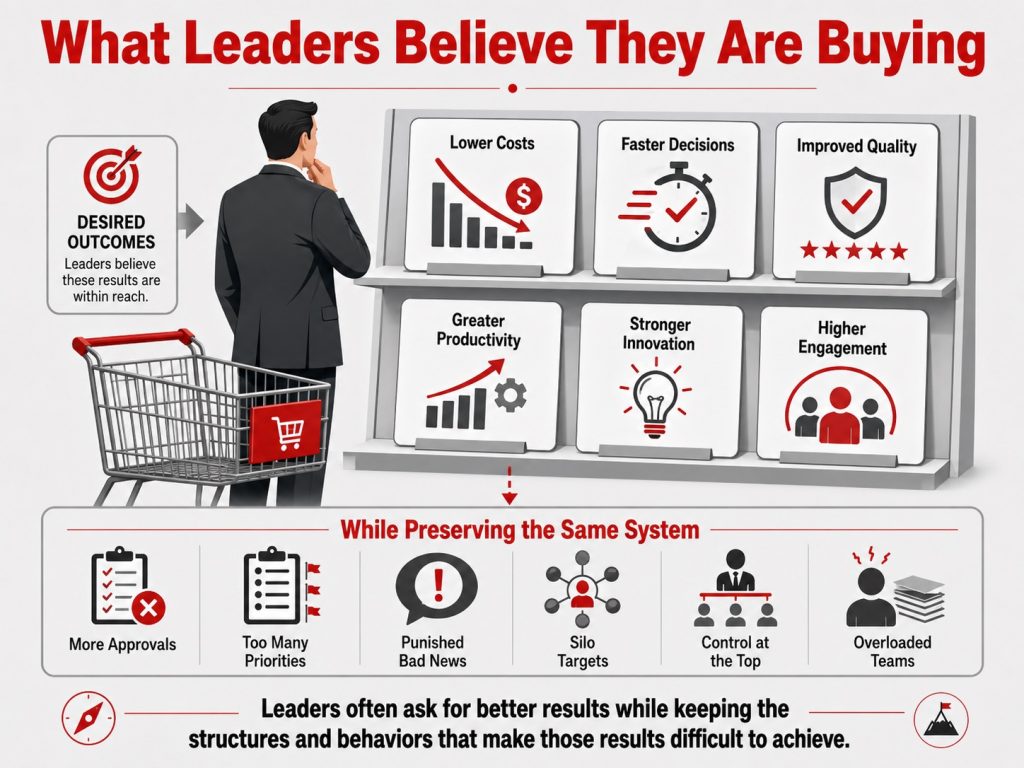
Leaders want the benefits associated with a high-performing system while retaining many of the behaviors, structures and privileges of the existing one. They want the organization to change without disturbing the arrangements through which authority is exercised, performance is judged and executive control is maintained.
The Appeal of Tools
Transformation programs so often begin with tools. Tools are visible. They can be taught, purchased, counted and deployed. Their introduction creates evidence of activity. An organization can report how many people have been trained, how many value-stream maps have been completed, how many improvement events have taken place and how many teams are using visual boards.
It can count Agile teams, certified practitioners, transformation workstreams, maturity assessments and completed training modules. These measures are easy to present and provide the appearance of progress. Even in Toyota I had to challenged a leader who insisted on measuring an agile transformation by how many teams had a “kanban board”!
Tools say very little about whether the organization is becoming more capable of creating and delivering value.
- A value-stream map does not improve flow merely because it exists.
- A kanban board does not reduce work in progress if leaders continue adding priorities.
- An Obeya does not improve decision-making if the people in the room cannot challenge authority.
- A daily meeting does not create teamwork when individual incentives encourage competition and self-protection.
- A retrospective does not create learning when people know that exposing failure may damage their careers.
- A suggestion system does not create participation when employees have repeatedly learned that their suggestions will be ignored.
The tools are not necessarily defective. The system surrounding them prevents them from performing their intended function.
Yet when the promised results do not appear, the organization rarely concludes that leadership behavior, governance, measures and incentives remain fundamentally incompatible with the methods it has introduced.
We Need Greater Adoption
Leaders are told that adoption is insufficient.
- Employees need more training.
- Managers need more coaching.
- The methodology must be scaled.
- The transformation requires another phase.
- The organization needs a new framework, a revised operating model, or a stronger change-management plan.
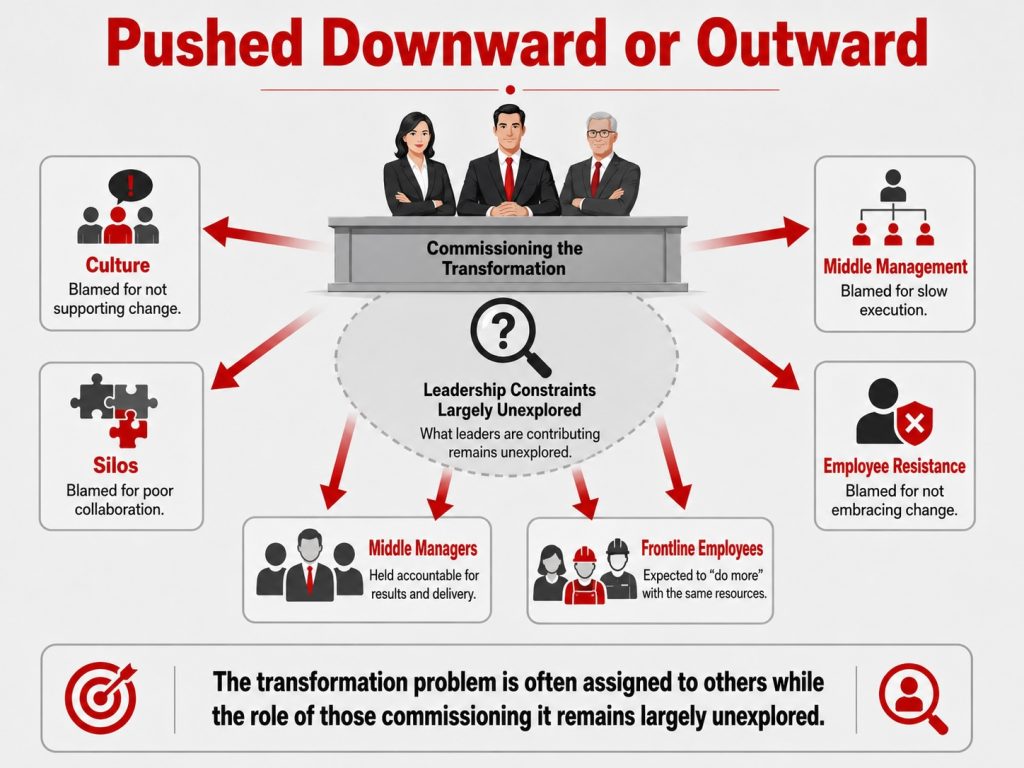
The problem is pushed downward or outward. The possibility that the transformation is being constrained by those commissioning it remains largely unexplored.
Why the Problem Is Pushed Elsewhere
This is not accidental. It’s far easier to tell thousands of employees that they must change than to tell a small number of senior leaders that the organization is accurately reflecting their priorities, behaviors and use of power.
It’s easier to redesign the organization chart than to challenge the assumptions of those sitting at its summit. It’s easier to produce a new roadmap than to ask whether the destination remains desirable. It’s easier to describe employees as resistant than to consider whether their resistance is an intelligent response to another temporary initiative that contradicts everything else they are expected to do.
Many employees have seen these programs before. They have watched new executives arrive with new language, new consultants and renewed declarations that this transformation will be different. They have attended workshops, completed assessments, adopted terminology and participated in launch events.
They have also watched priorities change, sponsors leave and promised changes quietly disappear.
Organizational Memory, Not Resistance
What leaders interpret as resistance may therefore be organizational memory. People have learned that enthusiasm is risky when leadership commitment is temporary. The safest response is often to comply visibly while continuing to work around the system privately.
The transformation then becomes another layer of work placed on top of the existing organization rather than a means of changing how it operates.
- The old meetings remain, and new meetings are added.
- The old reports remain, and new dashboards are created.
- The old targets remain, and new measures appear alongside them.
- The old hierarchy remains, but teams are told they are now empowered.
- The old approval processes remain, but the organization declares itself agile.
Nothing has truly been replaced. The organization has simply accumulated more machinery. This is not transformation.
It is bureaucratic sediment.
Each initiative leaves behind another layer of terminology, reporting, governance and expectation. Over time, the organization becomes harder to navigate, slower to change and increasingly detached from the work through which value is actually created.
Leaders may believe they have purchased improvement. What they have often purchased is additional complexity disguised as progress.
4. The Product They Actually Need
The product required to create sustainable improvement is much less convenient than the one organizations usually ask to buy. It cannot be installed by a project team, completed according to a predetermined implementation schedule, or delegated to a transformation office while the executive team continues leading exactly as it did before.
It’s not a temporary structure placed beside the business. It’s a different way of running the business.
The real product is a long-term, participatory management system through which leaders and employees continually learn how value is created, expose what prevents it from flowing and act together to improve the whole.
It requires far more than a collection of Lean tools, a new operating model or a set of branded methods wrapped in a framework sold by a consultant. It requires an understanding of flow because value is rarely created within the boundaries of a single team or function. It moves through networks of people, decisions, technologies, suppliers, policies and organizational dependencies.
Improving one part of that network may simply move the delay, cost or risk somewhere else.
- A department may increase its utilization while creating queues for everyone downstream.
- A procurement function may reduce the unit cost of a purchase while increasing total delay and operational risk.
- A finance process may increase the appearance of control while slowing decisions and obscuring responsibility.
- A sales function may exceed its target by committing the organization to work it has neither the capacity nor the capability to deliver.
Each part can appear successful while the whole becomes progressively less effective.
Flow therefore forces leaders to look beyond local optimization and examine how the complete system creates value. It asks whether work is moving, whether decisions are arriving when needed, whether demand exceeds capacity and whether measures are improving the whole or merely making individual functions appear successful.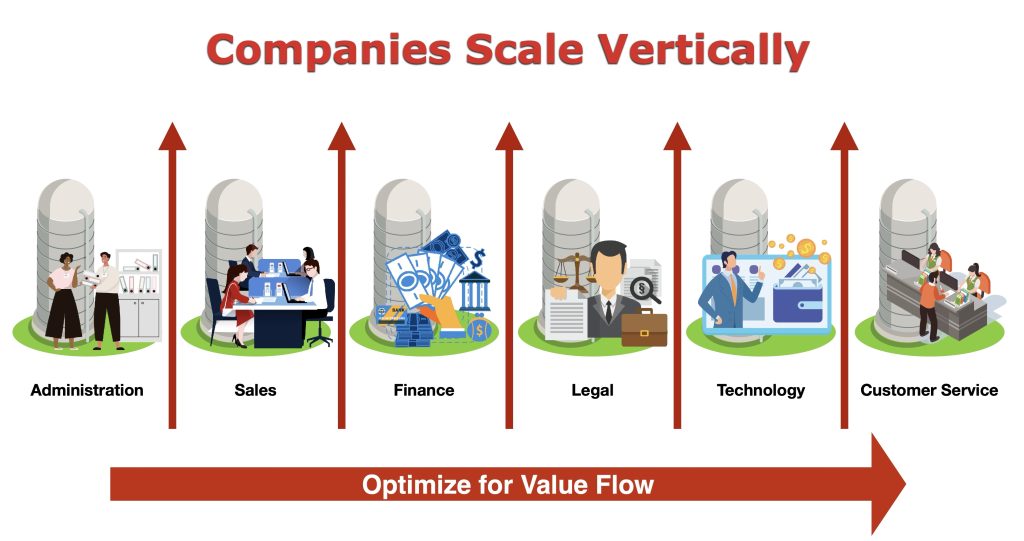
Embracing Complexity
Organizations are not complicated machines whose future behavior can be predicted if enough experts produce a sufficiently detailed plan. They are complex social systems populated by people who interpret, adapt, resist, cooperate, learn and respond to incentives. Cause and effect may be separated by time but actions produce unintended consequences. Solutions alter the conditions they were designed to address as people change their behavior when measures are introduced. What worked in one context may fail in another. This is what we call a complex adaptive system.
This does not mean leaders should abandon planning, expertise or accountability. It means they must recognize the limits of prediction and replace false certainty with disciplined learning. Instead of assuming that a small group of experts can design the future organization in advance, leaders must establish direction, create appropriate constraints, enable experimentation and learn from what actually happens.
The product therefore includes a different relationship with uncertainty.
Leaders must be prepared to act without pretending they can predict every consequence. They must test assumptions, compare expected outcomes with actual results and adapt as the system responds. Plans remain useful, but they become hypotheses to be examined rather than promises to be defended.
Distributed Leadership
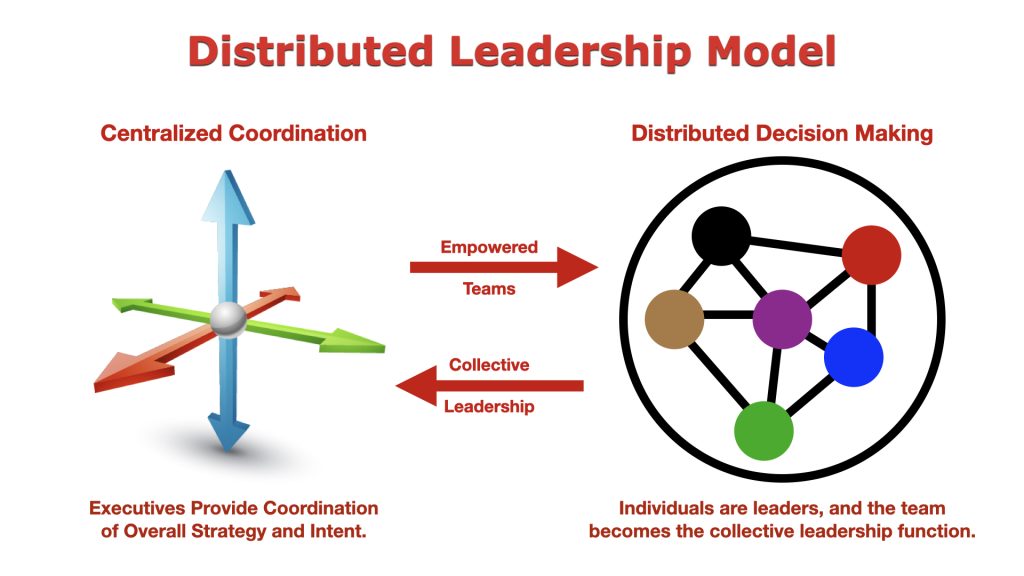
Distributed leadership does not mean hierarchy disappears, and accountability is abandoned, or every decision becomes democratic. Some decisions properly remain centralized. Others should be made by teams, specialists or individuals closer to the work and its consequences.
Leadership cannot be treated as the exclusive property of position because knowledge is distributed throughout the organization.
The person closest to the work may possess information unavailable to an executive. A frontline employee may understand a customer problem that has been sanitized by the time it reaches senior leadership. A team may detect a weak signal long before it becomes visible on a dashboard.
The Adaptive Organization
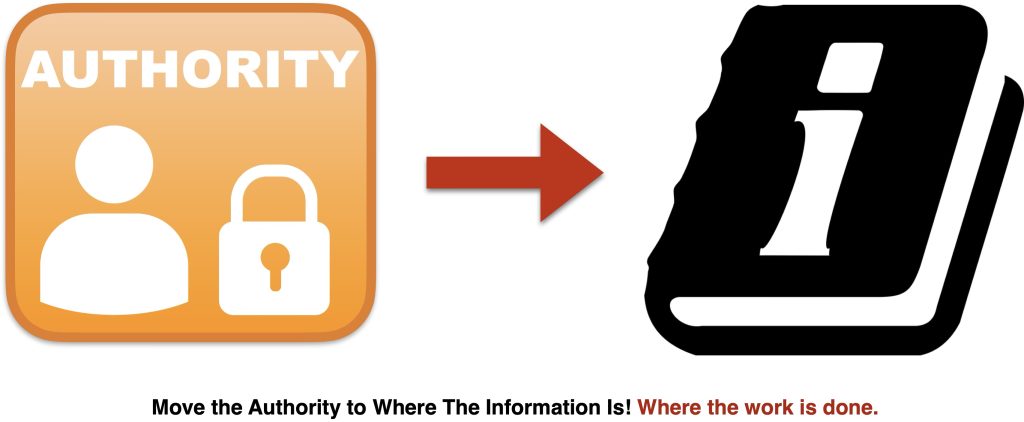
An adaptive organization must allow decisions and leadership to move toward relevant knowledge.
The central question is not whether authority should exist. It’s whether decisions are being made where the necessary knowledge, responsibility and consequences can be brought together most effectively. Closest to the work.
This requires deliberate choices about decision rights, and leaders must distinguish between decisions that genuinely require centralized authority, and those retained at the top merely because senior people are accustomed to making them.
Team Science
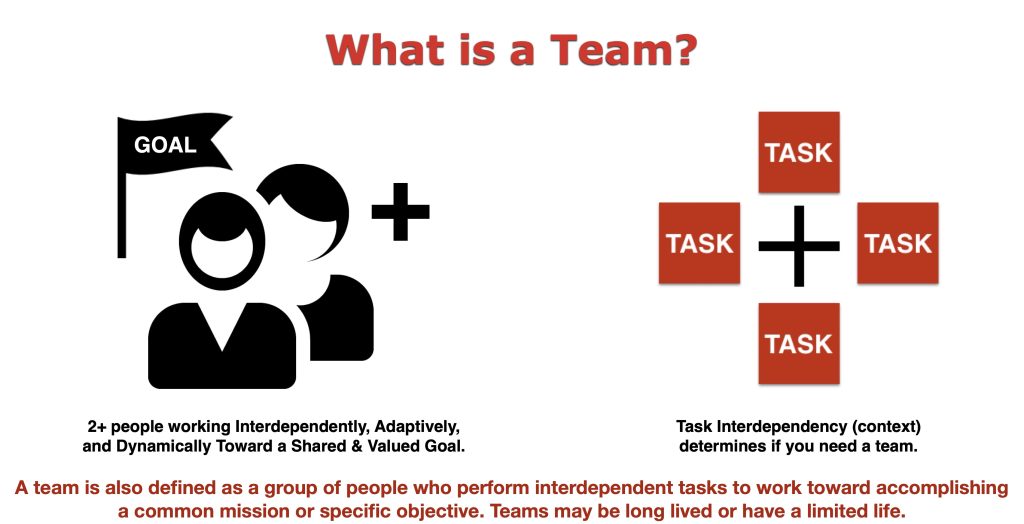
Organizations frequently speak about teamwork while managing people as collections of individuals. They assemble groups, assign objectives and assume teamwork will follow. But effective teams require far more than proximity, shared reporting lines or attendance at the same meetings. They need shared purpose, clarity, mutual trust, coordination, psychological safety, appropriate diversity, effective communication and the ability to learn together.
A team may contain highly capable individuals and still perform poorly because the surrounding system fragments their attention, overloads their capacity, rewards internal competition or prevents honest communication. Team performance is therefore not simply a matter of hiring better people. It’s a consequence of how the team is designed, supported and connected to the wider organization.
Culture Before Framework
Frameworks do not create adaptability. They work only when the culture, purpose, product and workforce make experimentation, participation and change psychologically and practically possible.
It’s why the same framework can appear effective in one organization and fail almost completely in another. The difference may lie less in the framework than in the culture and working conditions into which it is introduced.
There may be an important relationship between the nature of an organization’s product, the people attracted to creating it and the culture that develops around the work. Companies such as Riot Games, LEGO and Valve produce games, toys and entertainment products that invite creativity, experimentation and a close emotional connection with the customer. Their employees are often drawn to the organization because they care deeply about the product and identify personally with the experience it creates.
That does not make these companies immune from dysfunction, nor does it mean that every employee is young, energetic or naturally receptive to change. It does, however, create conditions in which experimentation and improvement can feel closely connected to the work itself.
When employees can see the product, understand the user and feel pride in what they are creating, change may be experienced as an opportunity to make something better. The feedback is often immediate. The customer is visible. The work attracts people who want to create, test and improve.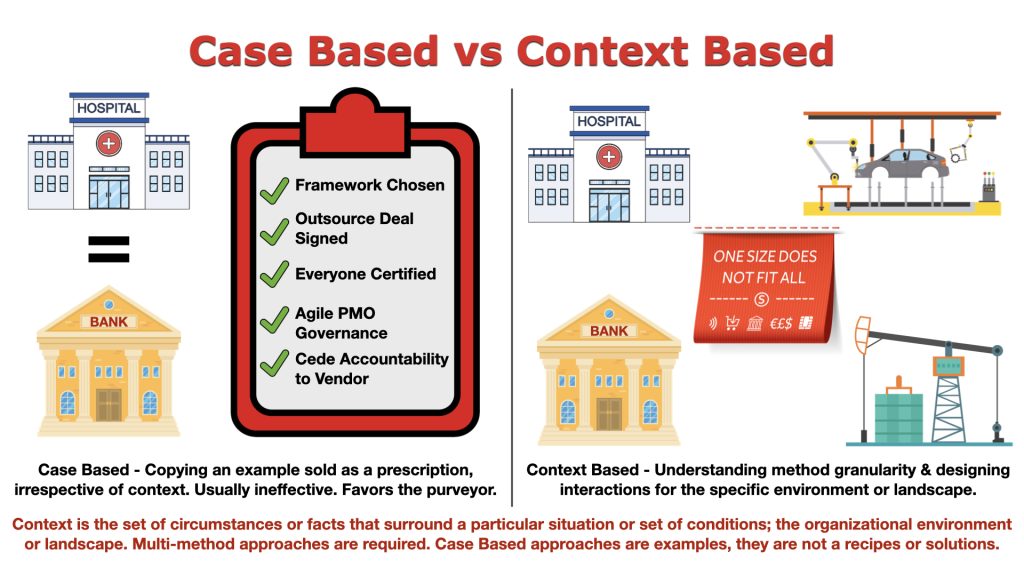
Resisting Change in Large Corporations
The conditions are very different inside a large, anonymous corporation containing thousands of highly specialized or repetitive roles. Many employees may have little direct connection with the final customer or product. The purpose of the organization may feel remote, while change is experienced mainly through reorganizations, revised targets, new systems, additional reporting and repeated demands to work differently.
In that environment, resistance should not be treated simply as a natural human dislike of change. People rarely resist all change. They resist changes that appear pointless, threatening, exhausting or disconnected from the purpose of their work. They resist when previous initiatives have created disruption without improvement and when change is repeatedly imposed upon them by people who will not experience its consequences.
A framework introduced into an energetic, product-focused culture may therefore appear remarkably effective. The same framework introduced into a fatigued, fragmented and distrustful organization may appear to fail.
The difference may have less to do with the framework than with the conditions into which it was introduced.
This is why copying visible practices from admired organizations is so unreliable. An organization may reproduce the structures, terminology and routines, but it cannot copy the history, purpose, workforce, relationships and cultural conditions that gave those practices meaning.
This is the difference between applying a case-based solution through copy and paste and taking a context-based approach. The former treats an example as a prescription, regardless of the environment into which it is introduced. It is also the preferred territory of large consulting firms because standardized solutions are easier to package, sell and scale.
Culture also does not make improvement automatic, and an attractive product does not guarantee a healthy workplace. But the character of the work can make participation, experimentation and learning feel either natural or imposed.
The task of leadership is therefore not simply to select the right framework. It’s to create the conditions in which people can care about the work, see its purpose, influence how it’s performed and believe that improvement will make their working lives and the customer’s experience better.
The Triple Helix
Flow, complexity thinking, distributed leadership and team science are not separate improvement products. They are mutually reinforcing perspectives that form what we describe in The Flow System as the Triple Helix. The helix metaphor matters because these elements cannot be separated without weakening the whole.
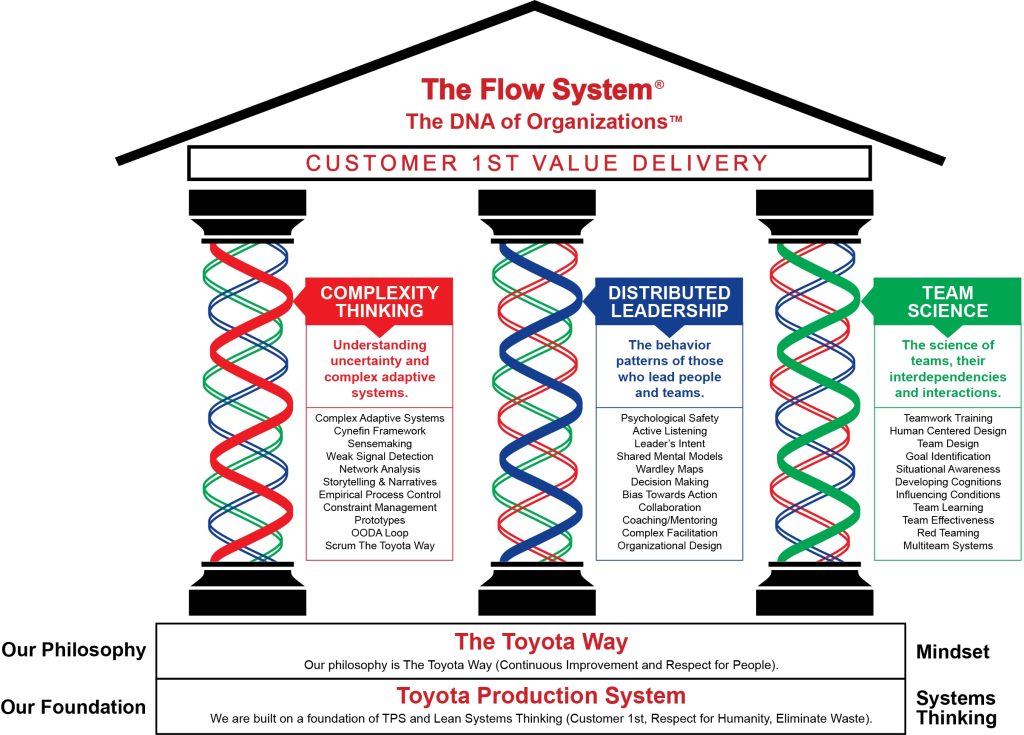
- Flow reveals how value and information move through the system.
- Complexity thinking prevents leaders from reducing the organization to a predictable machine.
- Distributed leadership enables decisions and initiative to move toward relevant knowledge.
- Team science develops the human systems through which coordinated action becomes possible.
- Lean and continuous improvement provide the discipline of identifying problems, testing ideas, developing capability and improving the work.
This is not another framework to be copied and installed. It is a way of examining the organization as a living system and deciding which methods, constraints and forms of leadership are appropriate to its particular context.
Together, these ideas describe something far more demanding than a transformation program. They describe a management philosophy. That philosophy cannot be handed over as a completed product because its value emerges through continued use. It must be practiced by leaders and employees as they encounter real work, real constraints and real uncertainty.
The organization does not need another layer of transformation machinery placed on top of its existing management system. It needs a management system capable of learning and improving itself.
5. The Price Is Leadership
Organizations often assume that the price of transformation is financial. They calculate consulting fees, technology investments, training costs and the salaries of those assigned to the program. Those costs may be considerable, but they are not the real price.
Leaders Must Change
Sustainable improvement requires leaders to change how they use their time, authority and attention. It requires them to become participants in the organization’s system of learning rather than remote sponsors of other people’s improvement work.
Leaders must understand the work closely enough to recognize when reports conceal more than they reveal. They must listen to people whose status may be lower but whose knowledge may be greater. They must tolerate challenge without treating disagreement as disloyalty and make problems visible without punishing those who expose them.
Leaders must stop demanding certainty where certainty cannot exist. They must remove priorities rather than continually adding them. They must examine whether their own targets, incentives and interventions are creating the behaviors they later criticize.
Doing vs. Supporting
This is not a matter of leaders becoming more supportive in the abstract. It requires changes in what they actually do.
They may need to distribute authority they previously controlled. They may need to abandon measures they have used to demonstrate success. They may need to admit that decisions they sponsored produced unintended harm. They may need to invest in capability whose greatest benefits will emerge after they have left the role.
These are not minor adjustments to leadership style. They alter the way power is exercised and the way the organization responds to that power.
Participatory Leadership
Fully participatory leadership does not mean leaders surrender responsibility or submit every decision to a vote. It does not abolish hierarchy or imply that everyone possesses equal authority in every situation. It means leaders do not stand outside the improvement system.
They participate in understanding the work, learning from those who perform it, removing systemic constraints and changing their own behavior as part of the process. They remain accountable, but they stop confusing accountability with the need to control every important decision.
They do not merely ask other people to become Lean or Agile. They accept the discipline required to make lean and agility possible.
They do not simply sponsor a transformation. They accept that they are among the people being transformed, and this is the part of the product description that is most often omitted.
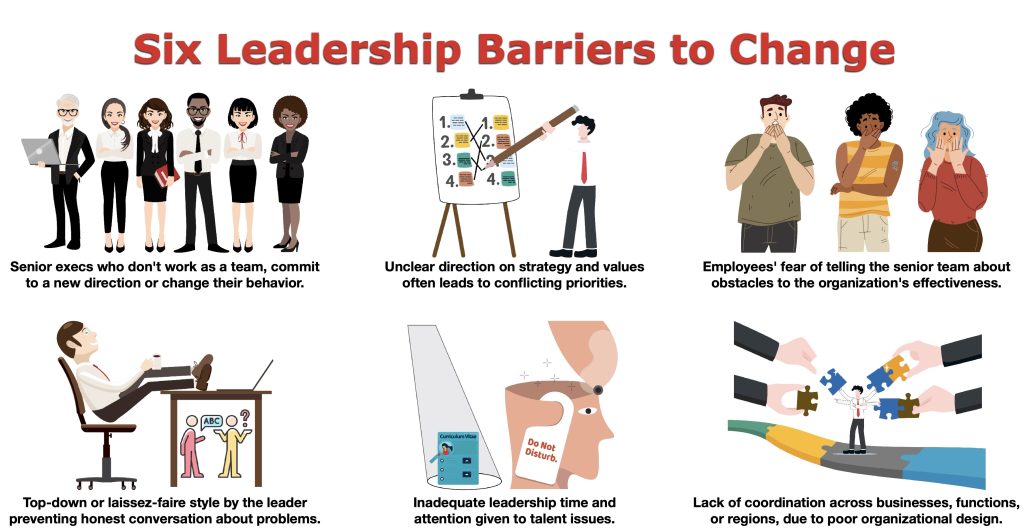
Leaders are told that the organization must become more agile, more Lean, more customer-focused or more innovative. They are less frequently told that achieving those outcomes may require them to relinquish familiar forms of control, reconsider how they define performance and expose themselves to information they may not enjoy receiving.
The transformation is presented as something leaders will direct rather than something they must personally undergo, and that omission makes the product easier to sell, but it also makes failure far more likely.
- A leader can purchase training for employees.
- A leader can commission an assessment.
- A leader can approve a new operating model.
- A leader can appoint a transformation executive.
- A leader authorize an extensive portfolio of work.
None of those actions demonstrates that the leader is willing to change how the organization is led.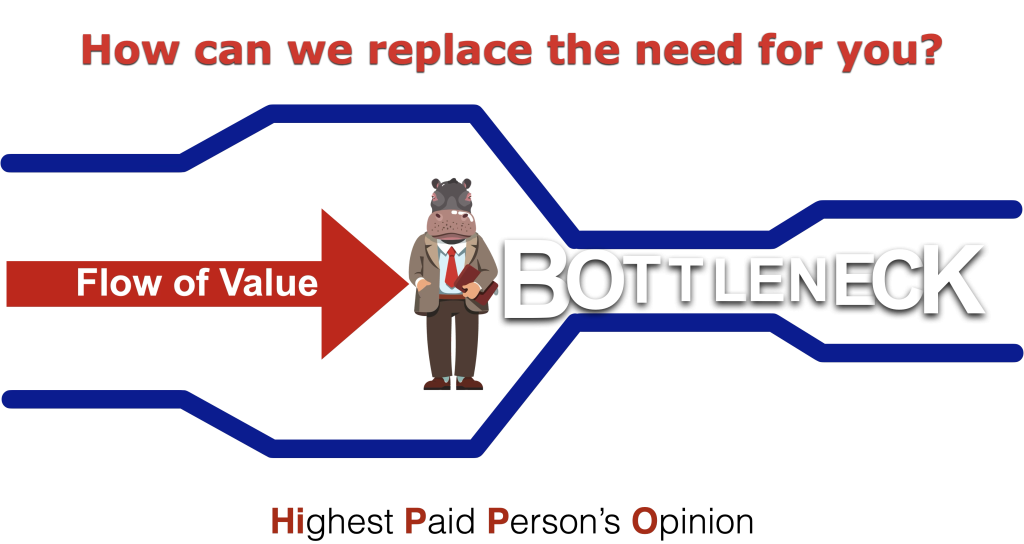
Executive Sponsorship is Insufficient
One of the most damaging ideas in modern transformation practice is that senior leaders need only approve resources, attend launch meetings, repeat key messages and periodically review progress. These activities may be useful, but they do not constitute leadership of the change. Note: The Scaled Agile Framework embraces this.
A leader cannot sponsor their way out of a system they help create every day.
- Their priorities shape demand.
- Their questions direct attention.
- Their reactions determine whether bad news travels.
- Their measures influence behavior.
- Their appointments signal what the organization values.
- Their tolerance of unnecessary work allows bureaucracy to grow.
- Their use of authority teaches others how authority should be used.
The organization pays far more attention to what leaders repeatedly do than to what they occasionally say.
- A leader who speaks of empowerment but intervenes whenever a team chooses differently teaches dependence.
- A leader who speaks of learning but demands explanations for every failed experiment teaches concealment.
- A leader who speaks of focus but continually introduces new priorities teaches overload.
- A leader who speaks of respect but dismisses frontline knowledge teaches status.
- A leader who speaks of flow but rewards functional optimization teaches fragmentation.
The system is not confused by these contradictions. It learns from the behavior that carries consequences.
This is why leadership participation must extend beyond executive briefings, steering committees and visits arranged by a transformation office. Leaders must enter the learning system. They must encounter the consequences of their decisions and become willing to change their behavior in response to what they discover.
Without that participation, transformation remains something being done to the organization by leaders who consider themselves outside its scope.
That is not transformation. It’s delegation.
The most important question is therefore not whether leadership supports the transformation. It’s whether leadership is willing to be transformed by it.
6. The Power Paradox and Thurlow’s Law
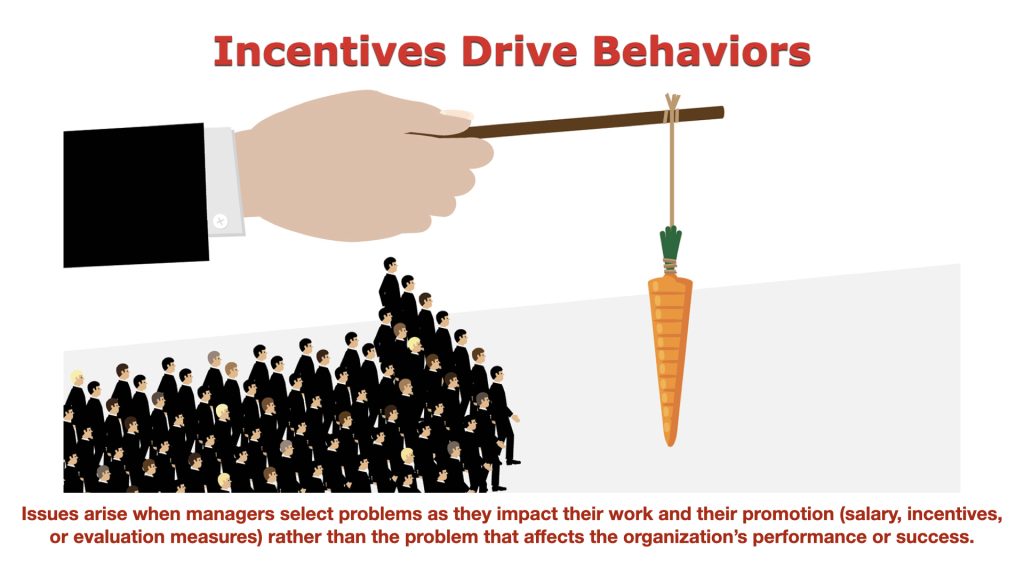
The people who understand organizational dysfunction most clearly are often those with the least authority to change it. They experience the consequences directly.
- They wait for approvals that add no value.
- They work around systems that do not support the work.
- They reconcile conflicting priorities, compensate for poor decisions and absorb the frustration of customers.
- They see where information is lost, where handoffs fail and where targets encourage behavior that damages the wider organization.
- They know which processes exist only because nobody has had the authority or courage to remove them.
- They know which reports are constructed to satisfy senior management rather than illuminate reality.
- They know when the official description of the work bears little resemblance to how the work is actually performed.
Yet knowledge does not automatically produce influence.
An employee may see the problem clearly but lack the authority to change the policy causing it. A team may understand the constraint but be unable to alter a decision made several levels above. A middle manager may recognize that the targets are incompatible while remaining accountable for delivering all of them.
Those closest to the consequences are therefore expected to solve problems whose causes lie outside their control.
The Aspiration to Lead Differently
This creates a familiar aspiration. People seek promotion because they believe greater authority will finally allow them to correct what they can already see. They tell themselves that once they become a senior manager, director, vice president or chief executive, they will remove the bureaucracy, challenge irrational targets and lead differently from those above them.
Many are entirely sincere. They do not lack conviction. They lack power.
But acquiring power changes the conditions under which that conviction was formed. The new role brings greater authority, but it also brings greater reward, status and insulation. The person who previously experienced the dysfunction directly becomes increasingly protected from it.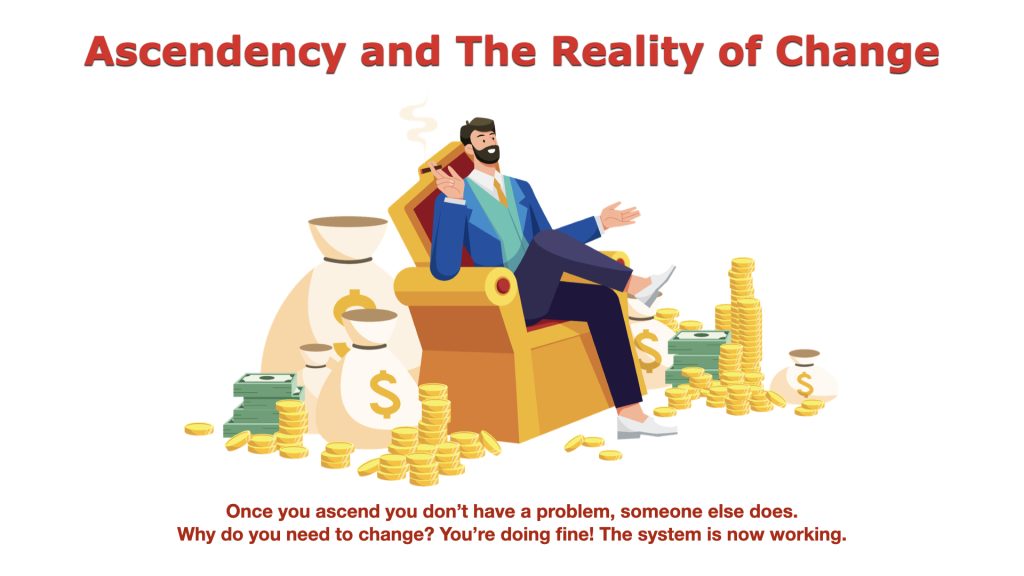 Administrative support removes everyday inconvenience. Greater income reduces personal vulnerability. Organizational deference makes challenge less frequent. Information arrives through summaries, dashboards and prepared presentations. Problems are filtered by people who understand that delivering unwelcome news to a powerful leader may carry consequences.
The leader’s experience of the organization begins to diverge from that of almost everyone else. The problems remain, but the leader no longer encounters them in the same way.
A delayed decision that causes weeks of frustration for a team may appear to the executive as a single red item on a dashboard. A customer failure that forces employees to spend days recovering the relationship may appear as a percentage point in a quarterly report. A broken process that exhausts hundreds of people may remain invisible if the organization continues meeting its headline numbers.
Authority has increased, but direct exposure to the system has diminished.
This is The Power Paradox
The people most affected by organizational dysfunction usually lack the power to change it. The people with the power to change it are increasingly protected from its effects.
The consequences of the system are not distributed equally. Those at the frontline experience the friction. Those in the middle are forced to reconcile the contradictions. Those at the top often receive an abstracted version of reality from which much of the pain has been removed.
The organization may therefore be failing operationally while continuing to work extremely well for those who hold the greatest authority within it.
Many highly paid leaders do not personally have an organizational problem.
The organization may be slow, wasteful, frustrating, politically distorted and increasingly incapable of serving its customers. It may exhaust employees, undermine suppliers and consume enormous effort in activities that create no value. Yet it may continue to reward its senior leaders extremely well.
- Their compensation remains high.
- Their status remains intact.
- Their influence expands.
Their failures may be attributed to market conditions, legacy systems, cultural resistance or the shortcomings of people below them. If performance deteriorates severely enough, some will leave with substantial severance, move to another organization or describe their departure as the successful completion of a transformation phase.
The Dysfunction is Real
But it does not fall equally upon everyone.
- It belongs to employees who must live with the system every day.
- It belongs to customers who receive poor service, delayed products or declining value.
- It belongs to suppliers required to absorb inconsistency and administrative burden.
- It belongs to long-term shareholders and to whoever inherits the consequences after the current leader has moved on.
This is not merely a question of individual ethics. It’s a question of system design.
A leader may benefit personally from decisions that weaken the organization over time. Cost reductions may improve short-term financial results while removing essential capability. Headcount cuts may produce an immediate market response while increasing workload, risk and dependence on external contractors.
Aggressive targets may create the appearance of performance while encouraging gaming, concealment and the deferral of necessary investment. A large transformation program may create a compelling narrative for the board even though little has changed in the real work.
The leader can succeed according to the measures applied to the leader while the organization becomes progressively less capable of serving its purpose. The system teaches leaders what matters and then rewards them for responding accordingly.
Thurlow’s Law
This is where what I call Thurlow’s Law becomes central:
Leaders seek change until they acquire the power to create it; thereafter, they often become the strongest defenders of the conditions they once opposed.
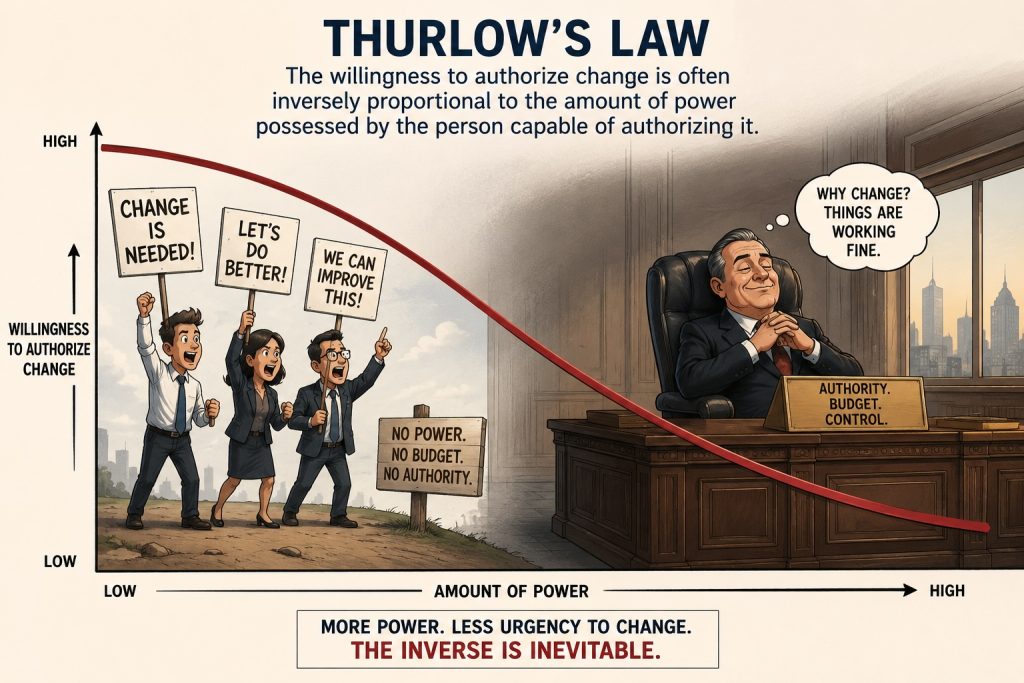
This is an observation, not a claim that every leader becomes corrupt, cynical or indifferent. It describes a recurring pattern in which the acquisition of power changes the leader’s relationship with the system.
Before gaining authority, the individual experiences the organization from below. They encounter the bureaucracy, delays, irrational decisions and imposed constraints. They understand the frustration because it affects them personally. They may speak passionately about reform, challenge and the need for a different form of leadership.
After gaining authority, the same system begins to confer benefits.
It provides status, access, income, control, recognition and institutional support. The person is no longer merely constrained by the hierarchy. They have become one of its beneficiaries.
- The conditions they once opposed now contribute to their authority.
- The system that once frustrated them has become the system that validates them.
- The desire to change can therefore weaken at precisely the moment the capacity to change is greatest.
The Success Trap of Ascendant Leadership.
The individual rises by navigating the existing system successfully. Promotion confirms that their behavior, judgment and political instincts have been rewarded. They may then conclude that the system cannot be entirely defective because it selected them.
The higher they rise, the harder it becomes to separate personal achievement from the legitimacy of the structure that produced it.
- To challenge the system may require them to challenge the basis of their own success.
- To distribute authority may require them to surrender privileges they spent years acquiring.
- To expose dysfunction may call into question decisions for which they were previously responsible.
- To acknowledge the intelligence of those below them may weaken the mythology of executive superiority.
- To create genuine transparency may reveal matters that have remained safely concealed.
The status quo therefore becomes increasingly comfortable, not necessarily because the leader has consciously abandoned all desire for change, but because the costs of change now fall closer to the leader while the costs of inaction fall further away.
Power does not merely enable change. It alters the incentives, perceptions and dependencies of the person who holds it.
- The aspiring reformer becomes the incumbent.
- The critic becomes the custodian.
- The person who once demanded that leaders listen now controls who is heard.
- The person who once opposed bureaucracy now presides over governance structures constructed in their name.
- The person who once condemned executive distance now receives information through the same filters.
The person has not necessarily become a different human being. They occupy a different position in the system, and the system now exerts a different force upon them.
This is why sustainable improvement cannot depend solely upon finding better leaders or waiting for the right person to reach the top. The system must continually reconnect authority with reality, make the consequences of decisions visible and prevent power from insulating leaders from the organization they are responsible for governing.
Without those disciplines, the people who acquire the greatest capacity to change the system may gradually become the people with the strongest incentives to preserve it.
7. Short-Termism and Transformation Theater
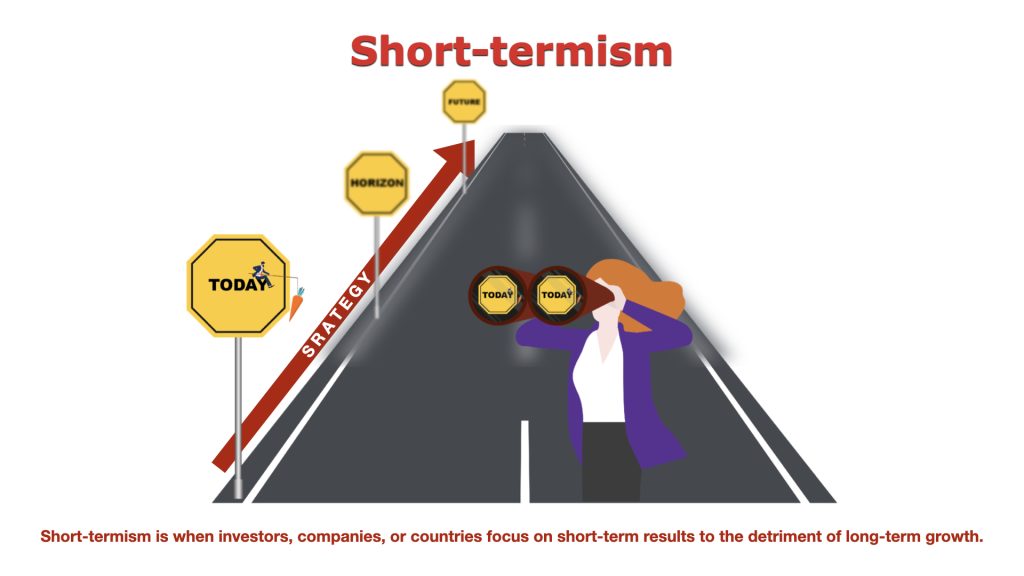 Sustainable improvement requires a longer horizon than many leaders are encouraged to adopt.
- Developing people takes time.
- Building trust takes time.
- Understanding how work actually flows takes time.
- Changing measures and incentives without creating new distortions takes time.
- Developing capable teams, supplier relationships and institutional knowledge takes time.
Creating a management system that can survive individual leaders may take many years. Yet leaders often operate within much shorter horizons.
The relevant horizon may be the next quarter, the next budget cycle, the next board meeting, the next bonus calculation, the next promotion or the next attractive role elsewhere. This creates a structural conflict between organizational stewardship and executive mobility.
The organization needs leaders to invest in capabilities that may mature over a decade. The leader is often rewarded for producing visible movement within eighteen months.
- The organization needs continuity. The leader needs a compelling narrative of personal impact.
- The organization needs patient learning. The leader needs measurable achievements that can be reported, rewarded and carried into the next role.
- The organization needs unnecessary initiatives to be removed. The leader may gain greater recognition by launching another one.
Short-termism does not necessarily mean that leaders consciously disregard the future. It means that the near future is weighted so heavily that distant consequences become easier to discount.
The costs of underinvestment, weakened capability, eroded trust and organizational exhaustion may not become fully visible during the leader’s tenure. By the time they do, responsibility may have moved elsewhere.
Corporate Theater
- Reorganizations can be announced quickly.
- Headcount reductions can produce immediate financial effects.
- Technology purchases can be described as modernization.
- Targets can be tightened.
- Governance can be expanded.
- Consultants can be engaged.
- Transformation programs can demonstrate that action is underway.
These interventions produce visible evidence that leadership is doing something. What they do not necessarily produce is a healthier organization. The appearance of decisive action may be more valuable to a transient leader than the slow development of capability that will primarily benefit a successor.
This is one reason sustainable improvement so often collapses when the sponsor moves on. The work was attached to the leader rather than embedded in the organization.
- The initiative had visibility, but not constancy of purpose.
- It had sponsorship, but not stewardship.
- It had momentum, but not permanence.
Transformation can then become a form of personal theater. It creates a stage upon which leaders perform decisiveness. There are launch events, vision statements, executive videos and carefully chosen slogans. The organization is told that the future will be radically different. The leader becomes associated with modernization, innovation or renewal.
Personal Ambition
The performance may be entirely sincere, but it can also serve personal ambition.
A transformation creates a story. It allows a leader to claim that they inherited an outdated organization and set it on a new course. It produces material for board presentations, annual reports, conference speeches and future interviews. The story begins with dysfunction inherited from the past. It proceeds through bold intervention and concludes with the leader as the architect of renewal.
But transformation rarely unfolds as cleanly as the story requires.
The work is uncertain. Results are mixed. Some interventions succeed, others fail and many produce consequences nobody predicted. Progress is uneven and the organization frequently learns that its original diagnosis was incomplete. That reality is inconvenient when a leader’s reputation has become attached to the transformation narrative.
When the Story Matters More Than Reality
The story can gradually become more important than the work. Once that happens, contradictory information becomes dangerous. Evidence that the transformation is producing little value threatens not merely the program but the leader’s identity, judgment and reputation.
- Bad news is softened.
- Metrics are selected to demonstrate progress.
- Activity is presented as impact.
- Uncertainty is removed from presentations.
- Dissenters are labeled resistant.
The organization becomes more committed to defending the transformation narrative than to discovering whether the transformation is actually working.
In time, the leader may demand the same public loyalty and private compliance from subordinates that a political leader expects from a cabinet. People remain free to challenge the transformation in theory, provided their challenge does not threaten the official story.
This is particularly damaging in Lean and continuous improvement because learning depends upon exposing the gap between expectation and reality. An experiment is valuable not because it confirms that leaders were correct, but because it reveals something the organization did not previously understand. A problem is valuable not because it can be quickly closed and turned green on a dashboard, but because it exposes a weakness in the system. Bad news is valuable because it provides an opportunity to learn before the consequences become more severe.
Confirmation Bias
When leaders require confirmation that their strategy is succeeding, the organization learns to produce confirmation.
- The dashboards improve.
- The presentations become more confident.
- The milestones remain green.
- The official story grows stronger.
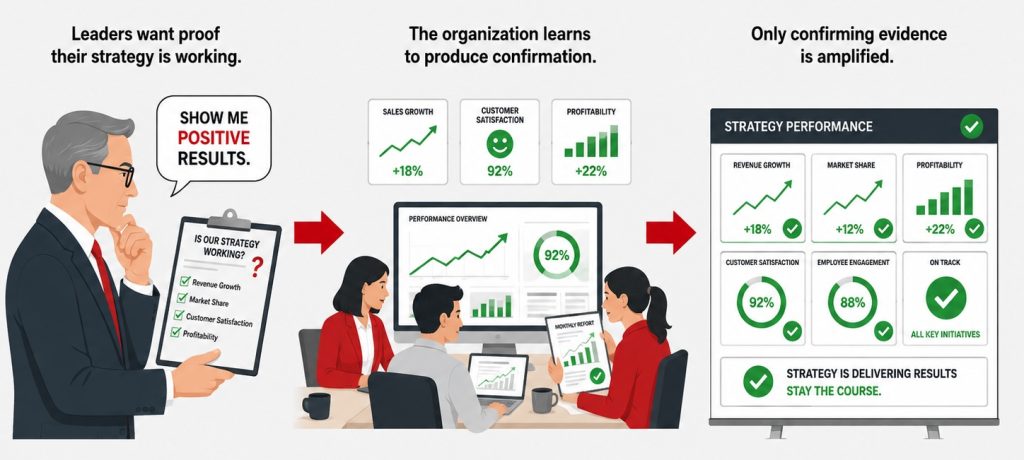
Meanwhile, the real work may remain largely unchanged.
Employees still navigate the same approval processes. Teams still carry too much work. Functions still optimize their own targets. Decisions still accumulate at the top. Customers still wait. The organization has improved the representation of itself more rapidly than it has improved itself.
This is how transformation theater survives. It does not depend upon everyone believing that the transformation is working. It depends upon enough people understanding that their safety, status or future prospects are connected to maintaining the appearance that it is.
The Machinery of Reassurance
The theater is reinforced by the organization’s reporting systems. Transformation activity is converted into milestones, workstreams, dashboards and status reports. These provide leaders with a coherent account of progress, but they also filter out much of the ambiguity, contradiction and operational reality through which genuine learning occurs.
By the time the information reaches the top, difficult realities have often been translated into reassuring language.
- Failures become dependencies.
- Resistance becomes a change-management issue.
- Overload becomes a capacity challenge.
- Conflicting executive demands become an alignment opportunity.
- The language becomes calmer as the underlying problem becomes less visible.
This does not mean that reporting, planning or governance are inherently wrong. Leaders need information and transformation work requires coordination. The danger arises when the mechanisms created to support learning become mechanisms for protecting the narrative.
- A dashboard should help leaders see reality.
- A review should enable challenge.
- A milestone should create an opportunity to compare prediction with outcome.
- A presentation should expose uncertainty rather than remove it.
When these mechanisms instead become instruments of reassurance, the transformation begins to serve the leader’s story rather than the organization’s purpose. The result is a peculiar form of success.
- The operating model is approved.
- The workstreams are launched.
- The training is completed.
- The technology is deployed.
- The governance forums are established.
- The agreed deliverables are produced.
The transformation may therefore be declared successful even though the organization has not become more capable of creating value, learning or adapting.
The program has succeeded according to the measures applied to the program. The leader has succeeded according to the narrative applied to the leader. The organization may still be failing according to the experience of its employees and customers.
Short-termism and transformation theater are therefore closely connected. A short leadership horizon creates demand for rapid, visible evidence of movement. Transformation theater supplies it. It offers announcements rather than constancy, activity rather than capability and a persuasive story in place of the slower, less glamorous work of changing how the organization is actually led.
The more valuable the story becomes to the leader, the more dangerous reality becomes to the transformation.
8. The Consulting Industry’s Role
It would be convenient for Lean experts, transformation practitioners and organizational consultants to blame leaders for buying the wrong product. It would also be untrue.
Transformation Theater
The consulting industry has played a central role in creating, packaging and sustaining the market for transformation theater.
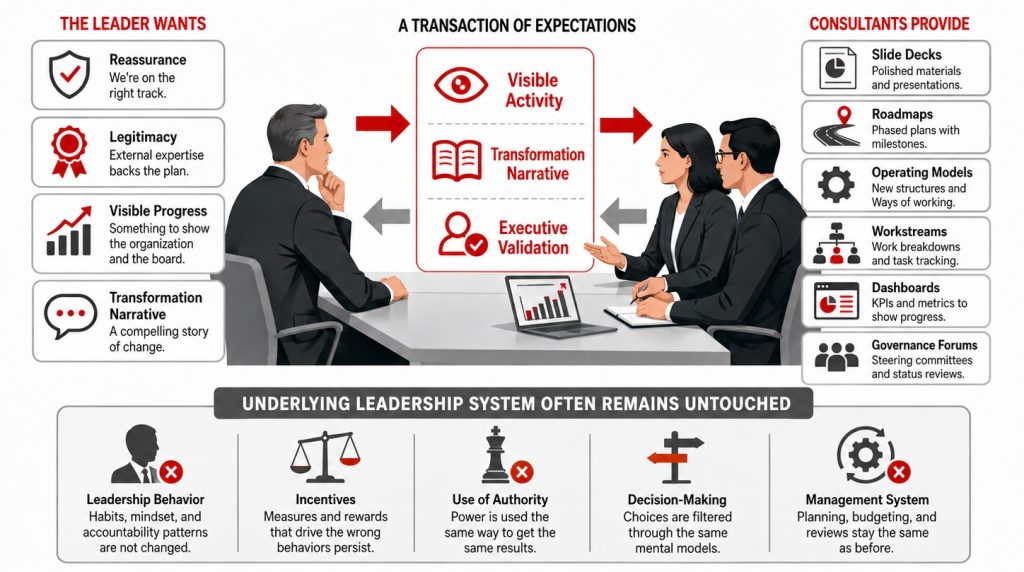
Many large firms have become exceptionally skilled at selling leaders what they are already predisposed to buy: reassurance, legitimacy, visible activity, fashionable language and the appearance of decisive change.
The product is rarely presented in those terms. It’s described as strategic transformation, operating-model redesign, enterprise agility, organizational modernization, digital reinvention or culture change.
The language is polished. The frameworks are proprietary. The diagrams are immaculate. The presentations are sufficiently complex to imply that something profound must be taking place.
Easy Money
Beneath the terminology, however, the same transaction is often being repeated.
Senior leaders want evidence that they are responding to a serious problem. Consultants want a substantial and expandable engagement approved by those same leaders. Neither party has a strong incentive to begin by declaring that the leadership system itself may be the principal cause of the dysfunction.
That conversation is commercially dangerous.
The person whose decisions and behavior may need to be challenged is also the person authorizing the work, controlling access and approving the invoices. This creates an obvious conflict.
A consultant who tells the executive team what it wants to hear may be described as pragmatic, commercially aware and easy to work with. A consultant who argues that leadership behavior, incentive design, governance and the concentration of authority are obstructing improvement may be described as difficult, academic, culturally insensitive or insufficiently aligned. I have frequently found myself placed in that latter category.
Honesty is Costly
The market therefore rewards a particular kind of honesty: truths that are challenging enough to sound valuable but not so challenging that they threaten the purchaser.
Consultants are permitted to criticize culture, capability, structure and middle management. They can identify poor communication, insufficient accountability, inadequate skills, functional silos and employee resistance.
They are far less likely to say plainly:
The organization is behaving exactly as its leaders have designed, rewarded and tolerated it to behave.
That conclusion may be the most important one. It is also among the hardest to sell.
The consulting relationship therefore contains a structural tension. The consultant is expected to diagnose the organization honestly while remaining acceptable to those who commissioned the diagnosis. Challenge must be strong enough to justify the engagement but restrained enough to preserve the relationship.
This does not mean that every consultant is knowingly dishonest or that every engagement is designed to protect senior leadership. Many consultants act with integrity, provide valuable expertise and challenge their clients directly.
The problem lies in the economics of the relationship.
- The client selects the consultant.
- The client controls access.
- The client defines success.
- The client approves payment.
The consultant therefore has a powerful incentive to preserve the client’s confidence in both the engagement and the consulting team.
At the same time, the executive becomes both patient and customer. A patient needs an accurate diagnosis. A customer also wants to feel competent, decisive and in control. The consulting firm must somehow satisfy both demands. This is where the relationship can become corrupted.
The consultant learns to challenge the organization without challenging the leader too directly. The transformation is framed as an enterprise problem rather than as a consequence of executive choices.
- Responsibility becomes diffuse.
- The organization lacks maturity.
- The culture resists change.
- The middle layer is frozen.
- Employees need a different mindset.
- Functions remain siloed.
These statements may contain truth.
They may also protect those at the top from examining how their own behavior sustains every one of those conditions.
- A culture does not act independently of leadership. It learns from what leaders reward, tolerate and punish.
- Middle managers do not operate in a vacuum. They reconcile the priorities, targets and contradictions imposed upon them.
- Functions do not become siloed by accident. They respond to structures, incentives and measures that encourage them to protect their own performance.
- Employees do not simply possess the wrong mindset. They adapt to the consequences created by the system in which they work.
When these conditions are described as organization-wide deficiencies, the leadership team can remain positioned above the transformation rather than within it. The leaders become the sponsors. Everyone else becomes the subject of change.
The consultant may then provide something even more valuable than analysis: executive validation.
Executive Validation
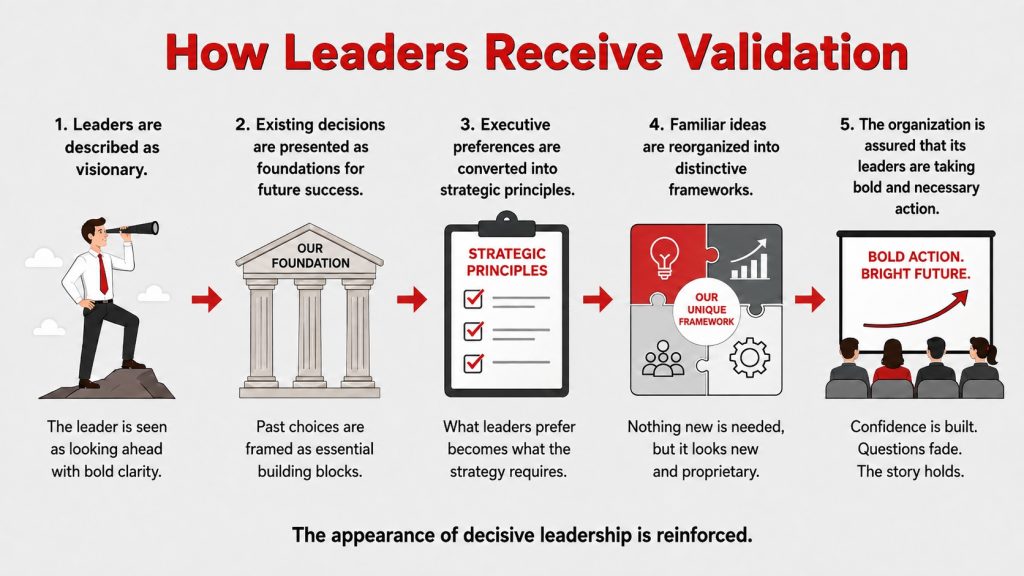
This is not always deliberate flattery. It can emerge naturally from the relationship.
The client wants to believe that the problem is serious but not fundamentally theirs. The consultant wants to retain access, confidence and commercial momentum. The transformation is therefore constructed around the leader as the hero of the story rather than as one of its principal subjects.
- The leader inherited the dysfunction.
- The leader recognized the need for change.
- The leader commissioned the diagnosis.
- The leader launched the transformation.
- The leader is now courageously guiding the organization toward a better future.
This narrative may be partly true. It may also obscure the extent to which the leader’s own priorities, measures, interventions and use of authority continue reproducing the conditions the transformation is supposed to remove.
Mutual Benefits
The arrangement persists because it benefits both buyer and seller.
The customer obtains visible evidence of action, external validation, a compelling narrative for the board and a structure through which responsibility can be delegated. The consultant obtains a substantial engagement, access to senior leaders, opportunities to expand the scope and continued revenue tied to the transformation.
- Both parties can claim progress.
- Leaders can say they are transforming.
- Consultants can say they are enabling transformation.
- Employees can be told that change is underway.
- Boards can be shown milestones.
- Markets can be given a modernization story.
All of this can occur while the fundamental patterns of authority, measurement, incentives and behavior remain largely untouched.
The transformation may even be declared successful because the agreed deliverables were completed.
- The assessment was delivered.
- The operating model was approved.
- The workstreams were launched.
- The training was completed.
- The governance forums were established.
- The technology was deployed.
- The contract was fulfilled.
Whether the organization has become more capable of creating value, learning and adapting is treated as a separate question. Sometimes it is never asked.
Judging The Industry
The consulting industry should not be judged by how much material it produces, how many people it deploys or how long its consultants remain. It should be judged by whether the organization becomes increasingly capable of seeing, understanding and improving its own system without them.
External experts can provide knowledge, experience, challenge and perspective. They can help leaders see patterns that insiders have normalized. They can teach methods, facilitate diagnosis, design experiments and develop internal capability.
They can also ask questions that hierarchy has made difficult to ask, but what they cannot do is adopt a new way of leading on behalf of the leaders.
- They cannot create psychological safety while executives punish bad news.
- They cannot distribute authority while senior leaders repeatedly reclaim decisions.
- They cannot establish focus while the executive team continues adding priorities.
- They cannot create flow while functions remain rewarded for local optimization.
- They cannot build long-term capability while leadership seeks short-term theater.
- They cannot transform an organization whose leaders have exempted themselves from transformation.
The best consultants help an organization learn how to change itself. Anything that leaves the organization permanently dependent upon the consultant should be treated with suspicion.
The real measure of a consulting engagement is not how impressive the diagnosis appears or how extensive the roadmap becomes. It is whether the organization is more capable when the consultants leave than it was when they arrived.
9. How Complexity Becomes the Product
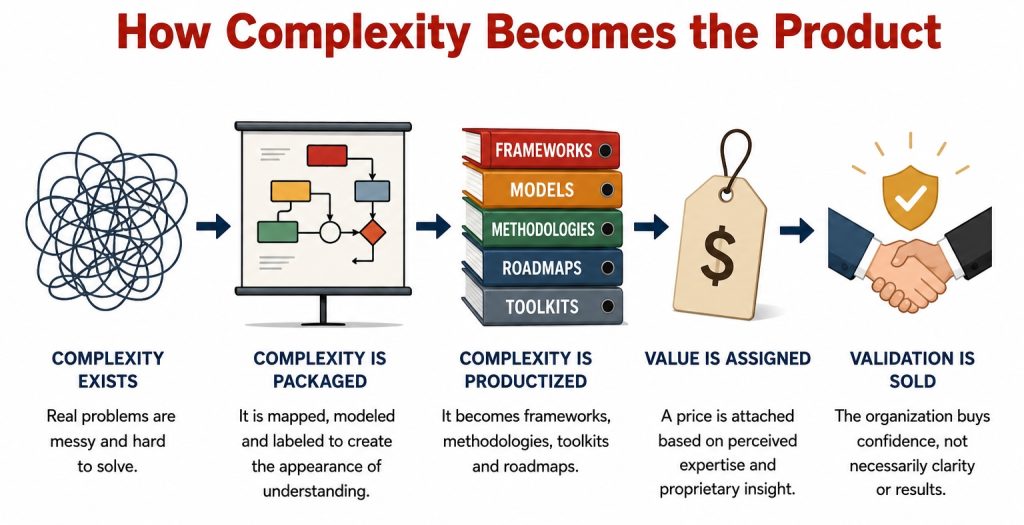
Consulting firms need offerings they can describe, price, sell and deliver. A genuine management philosophy is commercially awkward because it depends upon context, changes as the organization learns and requires leaders to participate directly. It cannot be fully designed in advance or installed by outsiders as a finished system.
The Transformation Program
A transformation program is much easier to sell. It has phases, deliverables, staffing requirements, milestones and completion criteria. It can be attached to a budget, governed through familiar procurement processes and presented to the board as a controlled investment.
The product therefore conforms to the customer’s purchasing system rather than to the nature of the problem.
Systemic improvement is not a conventional project. A project assumes a definable outcome, a planned route and an endpoint. Continuous improvement assumes that the organization must continue learning because its work, environment and operating conditions will continue changing.
- A project can create an Obeya, but it cannot make people tell the truth inside it.
- It can document decision rights, but it cannot prevent a powerful executive from reclaiming control when a decision becomes uncomfortable.
- It can introduce new routines, but it cannot ensure that leaders will continue practicing them.
Productizing Transformation
The most important dimensions of change are therefore the least amenable to productization. Yet they are repeatedly converted into products because products can be sold.
- The assessment becomes a product.
- The target operating model becomes a product.
- The transformation roadmap becomes a product.
- The maturity model becomes a product.
- The governance structure becomes a product.
- The implementation methodology becomes a product.
- Complexity then becomes commercially useful.
A phrase I remember being told some years ago was:
“The greater the chaos, the greater the opportunity.”
The intended meaning being that the greater the confusion, fragmentation and dependency, the larger the market for people promising to explain, coordinate and govern it.
Large consulting engagements often claim to simplify organizations while depending economically upon complexity. Complexity creates demand for expertise. It justifies larger teams, longer timelines and additional layers of coordination.
- Every dependency creates another conversation.
- Every interface creates another workstream.
- Every workstream creates another reporting requirement.
- Every reporting requirement creates another governance forum.
- Every governance forum creates another need for coordination.
The transformation develops a system of its own.
Steering committees, design authorities, transformation boards, executive reviews, working groups, communities of practice and program-management offices begin operating alongside the organization they are intended to change. Each produces actions, risks, dependencies, status reports and presentation material.
The work of transformation starts to resemble a parallel organization whose principal output is communication about transformation. Large numbers of people spend their time explaining what they intend to do, what they are currently doing and what they expect others to do next.
- Slide decks circulate through the hierarchy.
- Each audience requests refinement.
- Language is softened.
- Complexity is added.
- Disagreement is reconciled.
- Confidence is increased.
- Uncertainty is removed.
By the time the presentation reaches senior leadership, difficult operational reality has often been transformed into a coherent and reassuring story.
The deck becomes the product.
It demonstrates that the consultants have worked, the executives have governed and the organization has moved. But movement inside a presentation is not movement inside the system.
- The customer still waits.
- The employee still navigates the same approval process.
- The team still carries too much work.
- The manager still optimizes the local target.
- The executive still intervenes from a distance.
The organization has changed its representation of itself more rapidly than it has changed itself.
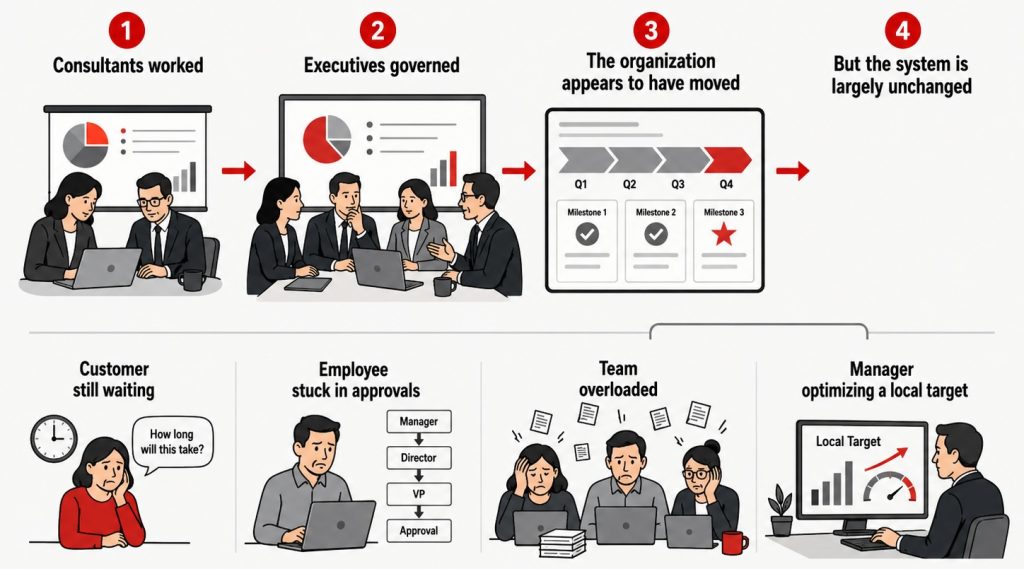
This is not merely a problem of excessive documentation. It reveals where authority and attention are directed. When senior leaders consume transformation through presentations, consultants naturally optimize the work for presentation.
- What cannot be made visible on a slide risks being treated as though it does not exist.
- What cannot be reduced to a milestone, score or color-coded status becomes difficult to govern.
The transformation system is therefore designed around executive consumption rather than organizational learning.
The Transformational Irony
An organization begins by asking for simplification but receives another layer of machinery.
- The old meetings remain, and new meetings are added.
- The old reports remain, and new dashboards appear.
- The old hierarchy remains, while new governance structures are placed alongside it.
- The old targets remain, while transformation measures compete for attention.
- Nothing is removed.
- More is simply added.
This is the bureaucratic sediment described earlier, created in the name of change. Each initiative leaves behind another layer of terminology, reporting, governance and expectation. Over time, the organization becomes harder to navigate, slower to change and increasingly detached from the work through which value is created.
This complexity is not necessarily created deliberately. Many consultants genuinely believe they are helping the client manage a difficult transformation.
But the commercial model does not naturally reward radical simplification.
A consultant who removes ten meetings, eliminates three approval layers and equips internal people to continue improving without external support may create enormous value. They may also reduce their own future revenue.
It is therefore worth asking:
How many additional meetings, governance forums, reporting cycles and coordination roles have been created since the large consulting firm backed the bus up to the building?
By contrast, a consultant who designs a multi-year transformation architecture comprising dozens of workstreams may create less operational value while generating a much larger engagement.
Obvious Incentives
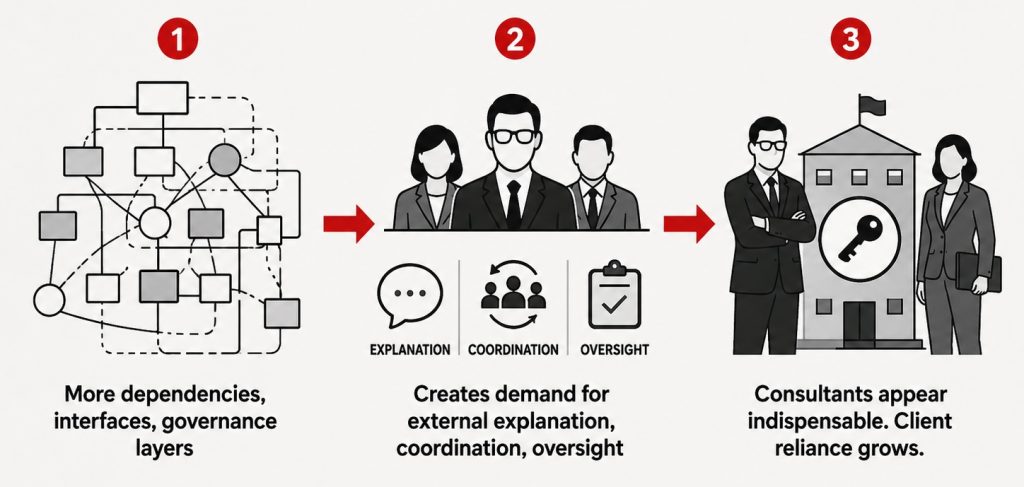
The organization’s complexity becomes the consultant’s market. Every new dependency, interface and governance layer creates further demand for external explanation, coordination and oversight. The more complicated the transformation becomes, the more indispensable the consultant can appear.
The company gradually becomes reliant upon outsiders to explain, manage and govern a transformation it is supposedly learning to own.
- Internal capability does not expand sufficiently.
- Leaders become accustomed to receiving synthesized answers.
- Employees become sources of data rather than participants in diagnosis.
- The consulting team becomes the institutional memory of the program.
When the consultants leave, much of the apparent capability leaves with them. The transformation has produced dependency rather than self-sufficiency. What emerges is a mutually reinforcing relationship between leadership and the consulting firm.
Mutual Dependence
Leaders need someone to maintain the appearance of purposeful action and protect the transformation narrative. Consultants need the work to remain sufficiently complex, incomplete and difficult to govern that the billable engagement continues.
Neither party may consciously intend to create this dependency, but both can become invested in preserving it.
- The leaders gain reassurance, legitimacy and distance from the underlying problem.
- The consultants gain scope, access and revenue.
- The organization gains more machinery.
This is how complexity ceases to be the problem transformation is intended to solve and becomes the product being sold.
The test of genuine transformation should therefore be reduction.
- Which meetings disappeared?
- Which approvals were removed?
- Which reports stopped?
- Which targets were abandoned?
- Which decisions moved closer to relevant knowledge?
- Which dependencies were eliminated?
- Which capabilities can internal people now exercise without external support?
A transformation that cannot answer those questions may have produced considerable activity, but it has not necessarily made the organization simpler, faster or more capable.
It may simply have made the transformation too complex to manage without the people who designed it.
10. What Are You Actually Buying?
Experts who genuinely believe in Lean, flow and continuous improvement must sometimes refuse to sell the product the customer has requested.
The organization may ask for another transformation program, a larger transformation office, more training, a new framework or another maturity assessment. The request may arrive with executive sponsorship and an approved budget.
The commercially convenient response is to accept the brief. The honest response may be that none of those things will solve the problem.
Before the contract is signed or the first consultant arrives, both parties should ask a more direct question:
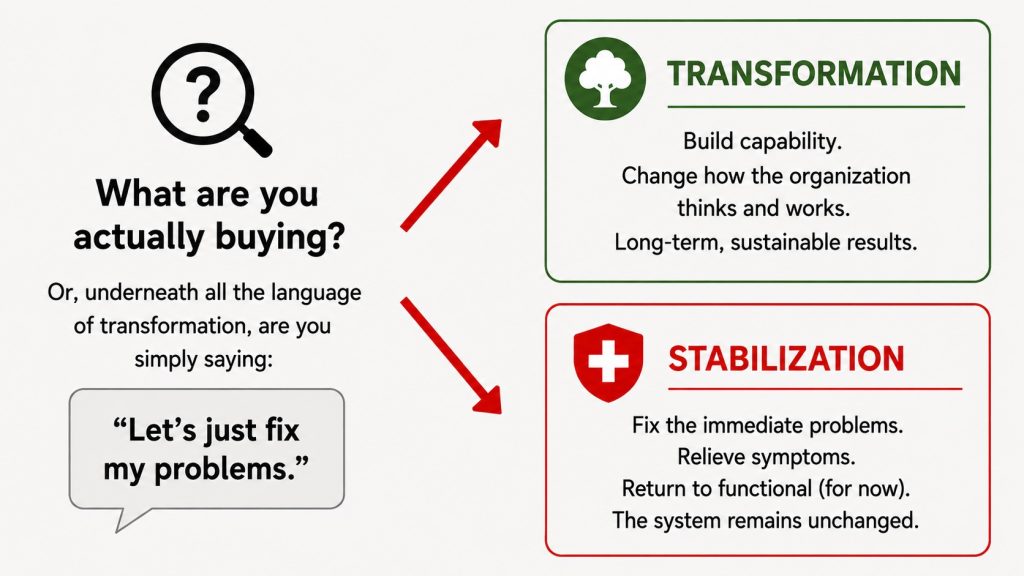
Transformation or Stabilization
Costs may be rising, delivery may be deteriorating, customers may be complaining and the board may be demanding action. Leaders want the immediate pain removed, performance restored and confidence rebuilt. But fixing immediate problems is not necessarily transformation. It may be stabilization, specialist support or symptom relief. Those are legitimate products, but they are different products.
The organization may not need another transformation program. It may need to understand why work does not flow, how decisions are made, how targets and incentives shape behavior and where leadership practices create delay, overload, fear and concealment.
That is a much harder conversation because the people commissioning the work may also need to become subjects of it.
Authority to Act
Consultants can provide expertise, challenge assumptions, facilitate diagnosis, teach methods and help develop internal capability. What they cannot do is change how leaders use authority on their behalf. The buyer must therefore distinguish between purchasing an output and developing a capability.
- An assessment can be delivered.
- An operating model can be approved.
- A roadmap can be completed.
- An Obeya can be constructed.
- Employees can be trained.
But the value of those things depends upon what the organization continues to do after delivery.
Saying One Thing and Doing Another
A decision-rights framework has little value if executives ignore it. An Obeya cannot create transparency if people are afraid to speak. Training cannot create capability if employees lack the time and authority to apply what they learned.
The contract may be fulfilled while the purpose remains unmet, and this is why experts must sometimes refuse the sale or redefine it.
The product should not be a transformation performed for the client. It should be the development of the client’s ability to understand and improve its own system.
That may mean a smaller engagement, fewer workstreams, fewer presentations and a direct challenge to leadership rather than another assessment of everyone below them. It should also include a credible path for the consultant to leave.
The best consultant should become progressively less necessary, and both buyer and seller must therefore tell the truth. The buyer must decide whether it genuinely wants systemic change or merely relief from immediate discomfort. The seller must decide whether to offer the difficult product the organization needs or the more comfortable product its leaders are willing to purchase.
Sometimes the most valuable thing an expert can say is:
You do not need what you are asking us to sell. You need to confront what is preventing your organization from improving—and decide whether you are willing to change it.
But that takes a fearless consultant, and one who does not need the paycheck!
11. Conclusion and Next Steps
So, are we selling you the wrong product, or are you asking for the wrong thing? The answer is YES.
Organizations frequently ask for transformation when what they really want is relief from visible symptoms: lower costs, faster delivery, improved quality, greater engagement and renewed confidence from the board. They call for help as though they were calling the emergency services – stabilize the patient, relieve the immediate distress and restore normality as quickly as possible.
But normality is often what caused the emergency.
Transformation is Dead
I believe the transformation industry is over. I think we are in the world of break fix, and perhaps we always were.
Leaders want a different organization, but not a different system.
Transformation happens naturally over time. Systems evolve as do the people in them. What we need is intervention when things are out of whack.
We do not need armies of consultants waving reams of PowerPoint slides. What we need are small teams of deep experts to “just solve problems” and then hand back control to the organization.
It’s a distinction that matters: If you want the results associated with Toyota without accepting the leadership discipline that produced them, you will fail.
The Power Paradox
The people most affected by organizational dysfunction usually lack the authority to change it, while those with the greatest authority are often increasingly protected from the consequences.
Thurlow’s Law explains what can happen next. People seek authority because they want to change the system, but once they acquire it, the system begins to reward, protect and validate them. Their capacity to create change increases while their desire to disturb the status quo may begin to weaken.
This is why leaders cannot stand outside transformation as sponsors of everyone else’s change. They must be part of it too.
The Consulting Industry
Too many firms have learned to sell exactly what leaders are willing to buy: visible activity, impressive language, elaborate operating models, endless meetings and PowerPoint decks that create the appearance of treatment without confronting the disease.
Leaders purchase symptom relief. Consultants sell the appearance of treatment. Both parties can claim progress while the underlying system remains largely unchanged.
The honest product is far less comfortable. Lasting improvement cannot be bought as a temporary program. It must become part of how the organization is led and operated, and it may not be for you.
So What Happens Next?
Leaders must examine how their own priorities, measures, incentives, reactions and use of power shape the organization they later criticize.
The first step is to stop calling everything transformation. Establish what you are actually trying to do. Is this an intervention intended to stabilize a specific problem, or are you genuinely attempting systemic change?
If it is an intervention, design it as an intervention. Fix the problem, restore performance, transfer the knowledge and get out. Do not surround a break-fix problem with a transformation office, an operating model and three years of governance.
If it really is transformation, then the rules are different.
Leaders cannot stand outside the system as sponsors of everybody else’s change. They are passengers too, and they must expect to be changed by the journey.
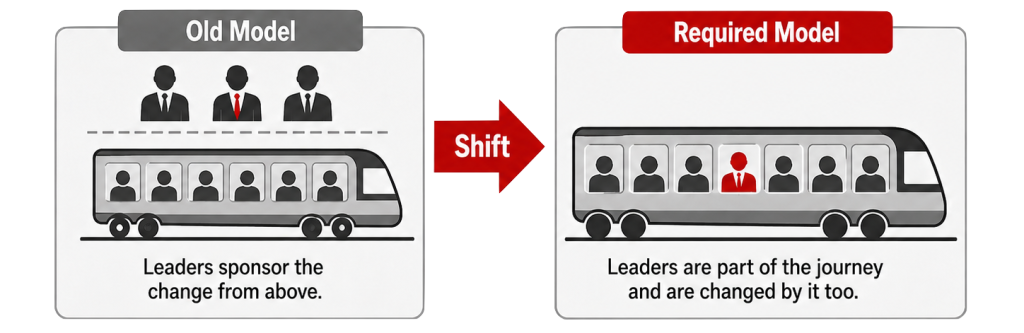
Decouple the leaders from the change. They are not the sponsors. They are passengers and will also be transformed
Change How Authority Works
- Move authority toward information. Decisions should move closer to the gemba and the people with relevant knowledge rather than requiring information to travel upward toward authority.
- Use distributed leadership. Senior leaders retain responsibility for overall strategy, intent and appropriate constraints, while teams and individuals are given greater authority to act.
- Remove fear. People must be able to expose problems, challenge assumptions and report what is actually happening without first calculating the personal consequences.
Change the Conditions That Shape Behavior
- Change behavior if you expect culture to change. Slogans, values statements and communication campaigns will achieve little while the same behaviors continue to be rewarded and tolerated.
- Break down functional barriers. Companies may scale vertically, but work and customer value move horizontally across those boundaries. The organizational chart should not become an obstacle to value.
- Create enabling constraints. Give people enough structure to protect the organization from unacceptable outcomes, but enough freedom to exercise judgment and act without continually seeking permission.
- Change what is measured and rewarded. Measures and incentives should reinforce the outcomes the organization actually needs rather than encourage local optimization, gaming and short-term performance.
Leadership Must Participate
Leadership cannot direct this from a distance. Leaders must engage with the work, listen and learn, remove barriers and improve the system alongside the people operating within it.
None of this requires an army of consultants. It requires clarity about the problem, deep expertise where it is needed, and an organization willing to assume responsibility for what happens after the experts leave.
The consultant can help repair the plumbing. The organization still has to own the house.
So before the next transformation begins, both buyer and seller should therefore answer a more challenging question:
Are we genuinely prepared to change the system, or are we merely looking for another way to make its symptoms temporarily easier to endure?
You can Download an A3 Poster of the Full Thurlow’s Law to display in your transformation office.
Further Reading
The arguments developed in this article draw upon a long tradition of thinking about management as a system, the Toyota Production System, organizational learning, flow, complexity and participatory leadership. The following works provide useful starting points for readers who want to explore those foundations more deeply.
Deming, W. Edwards. Out of the Crisis. Cambridge, MA: MIT Press, 1986.
Deming’s foundational statement on management’s responsibility for the performance of the system. His 14 Points include the call to create constancy of purpose and challenge management practices built around short-term results, numerical targets and fear.
Deming, W. Edwards. The New Economics for Industry, Government, Education. 2nd ed. Cambridge, MA: MIT Press, 2000.
Deming’s explanation of the System of Profound Knowledge: appreciation for a system, knowledge about variation, theory of knowledge and psychology. It provides an essential foundation for understanding why organizational performance cannot be improved by treating isolated symptoms.
Ohno, Taiichi. Toyota Production System: Beyond Large-Scale Production. Cambridge, MA: Productivity Press, 1988.
Ohno’s account of the thinking and experimentation from which the Toyota Production System emerged. It presents TPS not as a packaged toolkit but as a practical response to constraints, waste, limited resources and the need to improve flow.
Fujimoto, Takahiro, and Koichi Shimokawa. The Birth of Lean: Conversations with the Founders of TPS. Cambridge, MA: Lean Enterprise Institute, 2012.
A collection of interviews and reflections from people who helped create the Toyota Production System. It demonstrates how the system developed through experimentation, trial and error, and persistent problem-solving rather than through the implementation of a predetermined transformation architecture.
Rother, Mike, and John Shook. Learning to See: Value-Stream Mapping to Add Value and Eliminate Muda. Cambridge, MA: Lean Enterprise Institute, 1999.
A practical introduction to seeing the flow of value across functions rather than optimizing isolated activities. Although best known for value-stream mapping, its deeper contribution is helping organizations examine the complete system through which value is created.
Shook, John. Managing to Learn: Using the A3 Management Process to Solve Problems, Gain Agreement, Mentor, and Lead. Cambridge, MA: Lean Enterprise Institute, 2008.
An exploration of the A3 management process as a means of developing people, thinking through problems and creating dialogue between leaders and those performing the work. It demonstrates why the value of an A3 lies in the learning process rather than in the document itself.
Rother, Mike. Toyota Kata: Managing People for Improvement, Adaptiveness, and Superior Results. New York: McGraw-Hill, 2010.
Rother examines the routines through which scientific thinking, experimentation and coaching can become part of everyday management. It is especially relevant to the argument that continuous improvement depends upon practiced behavior rather than occasional improvement events.
Senge, Peter M. The Fifth Discipline: The Art and Practice of the Learning Organization. New York: Doubleday, 1990.
A foundational work on learning organizations and systems thinking. Senge explains why recurring organizational problems cannot be understood through isolated events alone and why organizations must examine the structures producing their behavior.
Mintzberg, Henry. Managing. San Francisco: Berrett-Koehler Publishers, 2009.
Mintzberg presents management as a practice rooted in experience, context and engaged participation rather than as an abstract profession conducted remotely through reports and analysis. His work supports the distinction made in this article between leadership and sponsorship.
Marquet, L. David. Turn the Ship Around! A True Story of Turning Followers into Leaders. New York: Portfolio/Penguin, 2012.
Marquet describes moving authority toward information rather than continually moving information upward toward authority. It provides a practical example of distributed leadership without abandoning hierarchy, responsibility or accountability.
Meadows, Donella H. Thinking in Systems: A Primer. Edited by Diana Wright. White River Junction, VT: Chelsea Green Publishing, 2008.
An accessible introduction to feedback loops, delays, system structures, leverage points and unintended consequences. It helps explain why interventions aimed only at visible symptoms frequently preserve or intensify the conditions producing them.
Argyris, Chris. Overcoming Organizational Defenses: Facilitating Organizational Learning. Boston: Allyn and Bacon, 1990.
Argyris examines how organizations protect themselves from threatening information and how leaders unintentionally create defensive routines that suppress learning. His work is particularly relevant to transformation theater, filtered reporting and the punishment of bad news.
Edmondson, Amy C. The Fearless Organization: Creating Psychological Safety in the Workplace for Learning, Innovation, and Growth. Hoboken, NJ: Wiley, 2019.
An examination of the conditions required for people to report errors, challenge assumptions, speak openly and contribute their knowledge. It reinforces the argument that invitations to speak up are meaningless when the system punishes those who do.
Pfeffer, Jeffrey. Power: Why Some People Have It—and Others Don’t. New York: HarperBusiness, 2010.
An examination of how power is acquired, exercised and preserved within organizations. It can be read alongside the power paradox and Thurlow’s Law: gaining authority may increase a person’s capacity to change the system while simultaneously altering their incentives to do so.
Turner, John R., and Nigel Thurlow. The Flow System Playbook. 3 Helix Publishing, 2023.
A practical guide to the methods, techniques and tools associated with the Triple Helix of Flow: complexity thinking, distributed leadership and team science. It expands upon the argument that sustainable performance requires more than Lean tools and must integrate how value flows, how decisions are distributed and how teams operate in complex environments.
Bertsch, Boudewijn, Riva Greenberg, and Dave Snowden, eds. Cynefin: Weaving Sense-Making into the Fabric of Our World. Singapore: Cognitive Edge, 2020.
A collection tracing the development and application of the Cynefin framework across leadership, strategy, organizational change, healthcare, safety and other complex environments. It supports the argument that leaders must distinguish between ordered and complex situations rather than assuming that every organizational problem can be diagnosed and solved through conventional analysis and predetermined plans.
Emiliani, Bob. The Triumph of Classical Management Over Lean Management: How Tradition Prevails and What to Do About It. South Kingstown, RI: Cubic, LLC.
Emiliani examines why traditional systems of status, authority and privilege repeatedly defeat progressive management practices. The book closely supports your argument that leaders may claim to want Lean while remaining attached to the structures, incentives and privileges that prevent it from taking root.
Emiliani, Bob, with David J. Stec, Lawrence Grasso, and James Stodder. Better Thinking, Better Results: Case Study and Analysis of an Enterprise-Wide Lean Transformation. 2nd ed. Wethersfield, CT: The Center for Lean Business Management, 2007.
A detailed study of the Wiremold Company’s enterprise-wide Lean transformation. The book is especially relevant to the argument that Lean is a complete management system requiring both continuous improvement and respect for people, rather than a collection of tools delegated to specialists. It also illustrates the importance of senior leadership, constancy of purpose and the difficulty of sustaining Lean after leadership changes.