Organizational blindness is the gradual loss of an organization’s ability to recognize the significance of conditions that have become familiar. Assumptions, delays, workarounds, recurring failures and distorted measures become normalized until people stop treating them as evidence that the system itself needs to change.
Estimated reading time: 25–35 minutes
Five Key Takeaways for Leaders
- Every system creates its own blindness. The longer we work within an organization, the more its assumptions, language, metrics and routines become invisible to us.
- Improvement begins with perception, not intervention. Before we solve problems, we must first learn to see them. That is why Deming insisted that transformation requires a view from outside.
- Organizations filter out weak signals long before they become crises. Customer frustrations, workarounds, delays and anomalies are often dismissed as noise until they become impossible to ignore.
- Expertise is both a strength and a liability. Experience enables rapid pattern recognition, but it can also create pattern entrainment: the tendency to keep interpreting new conditions through patterns that were learned in the past, even when those patterns are no longer valid.
- Great leaders deliberately seek independent perspectives. The purpose is not to validate existing beliefs but to expose assumptions that have become invisible from inside the system.
Organizational blindness is why most organizations believe they have a problem-solving issue.
They don’t. They have a seeing problem.
Spend enough years inside any organization and its assumptions stop looking like assumptions. The language, routines, meetings, targets, metrics and workarounds all begin to feel normal. What was once an exception becomes accepted practice. Intelligent people continue working hard, convinced they are improving the organization, while remaining largely unaware of the very system shaping their decisions.
This is not a criticism of leaders or employees. It is simply how human beings work.
More than thirty years ago, W. Edwards Deming articulated one of the most profound observations ever made about management.
“The prevailing style of management must undergo transformation. A system cannot understand itself. The transformation requires a view from outside.”
Deming, W. Edwards. The New Economics for Industry, Government, Education. 2nd ed. Cambridge, MA: MIT Press, 2000 (originally published 1993), Chapter 4, A System of Profound Knowledge, p. 92.
Deming’s observation is fundamental to systems thinking: people inside a system are influenced by its incentives, assumptions, measures and structures. Their view is therefore never entirely independent of the system they are attempting to understand.
It is a statement that deserves far more attention than it receives today.
Deming was not arguing that every organization needs consultants. He was making a far deeper point. Every system creates its own perspective, its own assumptions and its own blind spots. Those operating within that system cannot fully perceive it because they are part of it.
Organizational blind spots are the specific assumptions, behaviors or conditions that a company has stopped questioning. Organizational blindness is the wider process through which those blind spots become normalized.
That is not a management problem. It is a human problem.
Three Forms of Organizational Blindness
I have spent much of my career helping organizations improve operational performance. Whether inside Toyota or working with executive teams around the world, I have repeatedly encountered the same challenge.
Organizations rarely fail because they lack intelligent people. They fail because they cannot see what has become normal.
There are at least three forms of blindness at work.
System Blindness
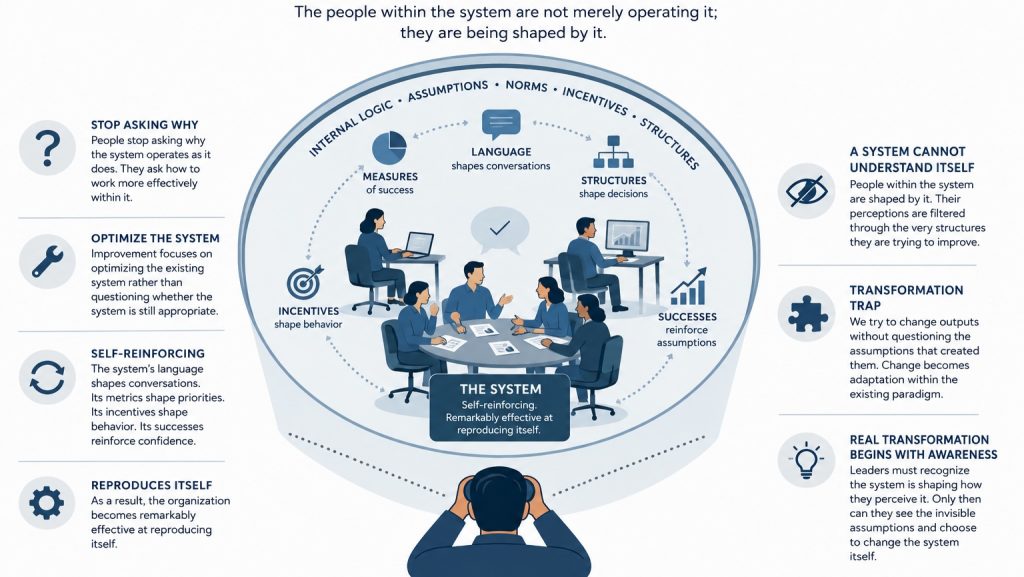
The people within the system are not merely operating it; they are being shaped by it.
This was Deming’s insight.
Every organization develops its own internal logic. It establishes measures of success, accepted ways of working, familiar language, reporting structures, incentives and deeply held assumptions about how work should be done. Over time these cease to feel like choices. They become accepted reality.
People stop asking why the system operates as it does. Instead, they ask how to work more effectively within it. That subtle shift changes everything.
Improvement becomes focused on optimizing the existing system rather than questioning whether the system itself remains appropriate. Teams work harder to meet targets, streamline processes and remove local inefficiencies, often without asking whether the measures, structures or assumptions driving those activities still make sense.
- The system quietly becomes self-reinforcing.
- Its language shapes conversations.
- Its metrics shape priorities.
- Its incentives shape behavior.
- Its successes reinforce confidence that the underlying assumptions must be correct.
As a result, the organization becomes remarkably effective at reproducing itself.
This is what Deming meant when he observed that “a system cannot understand itself”. The people within the system are not merely operating it; they are being shaped by it. Their experiences, decisions and perceptions are filtered through the very structures they are trying to improve.
This explains why so many transformation programs disappoint. They attempt to improve the outputs of the system without questioning the assumptions that produced those outputs in the first place. They redesign processes while preserving the incentives that created the behavior. They introduce new technologies while leaving decision-making unchanged. They train people to work differently without examining whether leadership’s mental model of the organization has evolved.
The result is often what appears to be change, but is actually adaptation within the existing paradigm.
Real transformation begins at a much deeper level. It begins when leaders recognize that the system they are trying to improve is also shaping the way they perceive it. Only then can they begin to see the assumptions that have become invisible.
Habitual Blindness
Organizations develop collective habits of attention.
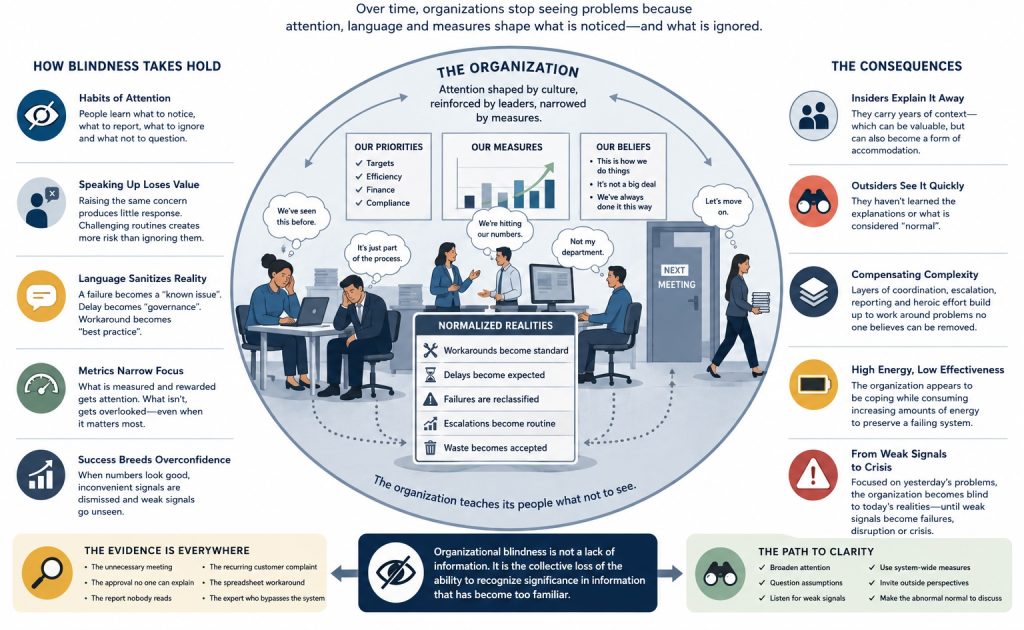
Over time, people learn what to notice, what to report, what to ignore and what not to question. Attention becomes shaped by the culture, reinforced by leadership priorities and narrowed by the measures used to define success.
- Waste that once frustrated people becomes accepted.
- Meetings that add no value become routine.
- Approval processes grow longer.
- Decision-making slows.
- Customers complain about the same issues.
- Employees invent workarounds to survive.
At first, these conditions are recognized as problems. People raise concerns, propose changes and attempt to correct them. But when the underlying causes remain untouched, the organization gradually adapts.
- Workarounds become standard practice.
- Delays become expected lead times.
- Escalations become part of the process.
- Repeated failures are reclassified as operational realities.
- Eventually, the abnormal becomes normal.
This is how organizational blindness develops. It is not that people cannot see the problem at all. Many can see it very clearly. The blindness emerges because the organization collectively stops treating the condition as unusual, unacceptable or worthy of attention.
People learn that raising the same concern produces little response. They learn that challenging established routines can create more difficulty than tolerating them. They learn which issues senior leaders consider important and which are likely to be dismissed as anecdotal, local or unavoidable.
The organization begins to teach its people what not to see.
This is why silence should never be confused with agreement, and the absence of reported problems should never be mistaken for the absence of problems. Often, it simply means people have learned that reporting them changes nothing.
The blindness is reinforced by language.
- A recurring failure becomes a “known issue”.
- Excessive delay becomes “governance”.
- Overloaded employees are praised for being “resilient”.
- Constant escalation is described as “collaboration”.
- A workaround becomes a “best practice”.
Language does not merely describe reality. It can sanitize it.
Once a problem has been given an acceptable label, the urgency to confront it begins to disappear.
Metrics can deepen the blindness. Organizations naturally direct attention toward what is measured, reviewed and rewarded. Anything that falls outside those measures becomes easier to overlook, even when it is essential to performance.
- A team may achieve its productivity target while creating delays elsewhere.
- A department may reduce its costs while transferring work to another part of the organization.
- A project may be declared green while customers, suppliers or frontline employees experience a very different reality.
Each local measure may appear positive while the performance of the wider system deteriorates.
Success, therefore, can become one of the most powerful causes of blindness. When the numbers appear reassuring, inconvenient signals are more easily dismissed. Strong historical performance encourages the belief that the organization understands its environment and that its established methods will continue to work.
This is why outsiders often notice problems almost immediately. They have not yet learned the organization’s explanations. They do not know which delays are considered normal, which meetings are regarded as essential or which recurring failures are no longer discussed. They see the gap between what the organization says should happen and what actually happens.
Insiders often see the same gap, but they also carry years of context explaining why it exists. That context can be valuable. It can also become a form of accommodation. The danger is not simply that the organization becomes inefficient. It is that it becomes highly skilled at functioning around its inefficiencies. It builds layers of coordination, escalation, reporting and heroic effort to compensate for problems it no longer believes can be removed.
The organization appears to be coping. In reality, it is consuming increasing amounts of energy to preserve a system that is becoming less effective. This is why organizational blindness is so difficult to confront. The evidence is rarely hidden. It is embedded in everyday experience.
It can be found in the meeting everyone knows is unnecessary.
- The approval no one can explain.
- The report nobody reads.
- The customer complaint that has appeared repeatedly.
- The spreadsheet created to compensate for a system that does not work.
- The experienced employee who knows exactly whom to call to bypass the official process.
These are not isolated irritations. They are signals from the system. Yet once they become familiar, they lose their ability to provoke attention. What an outsider immediately questions is simply described internally as “it’s the way we do things”.
The greatest danger is that the organization becomes very good at solving yesterday’s problems while becoming increasingly blind to today’s realities. Its routines, measures and expertise remain aligned with conditions that may no longer exist. By the time the evidence becomes impossible to ignore, the weak signals have often become failures, disruption or crisis.
Organizational blindness is therefore not a lack of information. It is the collective loss of the ability to recognize significance in information that has become too familiar.
Inattentional Blindness
Only when we deliberately widen our field of view do the ‘gorillas’ inside our own organizations begin to appear.

Inattentional blindness occurs when people fail to notice visible information because their attention is concentrated elsewhere. In organizations, targets, dashboards and urgent priorities can create the same effect, narrowing attention so completely that important signals remain unseen even when they are plainly visible.
One of the most famous demonstrations was conducted by psychologists Daniel Simons and Christopher Chabris in what has become known as the Invisible Gorilla experiment.
Participants were asked to watch a short video and count the number of basketball passes made by one team of players. The task required concentration, and most participants became completely absorbed in counting accurately. During the exercise, a person wearing a full gorilla suit calmly walked into the middle of the scene, stopped, faced the camera, beat their chest and then walked away.
Remarkably, a large proportion of participants never saw the gorilla at all. Not because it was hidden. Not because it appeared only briefly. Not because people were unintelligent. They simply were not looking for it. Their attention had become so narrowly focused on one task that something obvious disappeared from conscious awareness.
The experiment has become one of the most compelling demonstrations that seeing is not the same as looking.
We do not consciously process everything that reaches our eyes. We perceive what our attention has prepared us to perceive. Everything else is filtered away.
Organizations behave in exactly the same way.
Leadership teams become consumed by quarterly financial results, operational targets, utilization figures, productivity metrics and strategic initiatives. These are important measures, and they deserve attention. The problem arises when they become the only things receiving attention.
Meanwhile, weak signals quietly accumulate around the edges of the system.
- Customer frustrations.
- Informal workarounds.
- Growing technical debt.
- Increasing employee frustration.
- Repeated quality escapes.
- Longer decision cycles.
- Rising coordination costs.
- Small failures.
- Declining trust.
- Changing customer expectations.
- Emerging technologies.
- Shifting competitive behavior.
None of these signals are concealed.
They are often discussed every day by frontline employees, customers and suppliers. They exist in meeting conversations, support tickets, informal comments, recurring exceptions and “temporary” workarounds that have become permanent. The organization simply lacks the attention to recognize their significance.
This is why hindsight is so deceptive. When a major failure finally occurs, people often ask,“Why didn’t anyone see this coming?”. In reality, someone almost certainly did. The signals were there. The complaints existed. The anomalies were visible. The unexpected behaviors had already begun to emerge. The organization simply failed to connect them into a meaningful pattern before they became impossible to ignore!
This is where inattentional blindness becomes deeply relevant to leadership.
The challenge is not merely to collect more data. Most organizations are already overwhelmed with data. The challenge is deciding what deserves attention before the numbers become obvious. That is precisely why weak signal detection matters.
Weak signals are small anomalies, unusual customer behaviors, repeated exceptions, or emerging patterns that may indicate the system or its environment is beginning to change. Individually they often appear insignificant. Collectively they can provide the earliest indication that existing assumptions are no longer valid.
Weak signals rarely announce themselves as strategic threats. They arrive quietly.
- A customer asks an unusual question.
- A trusted employee begins expressing frustration.
- An experienced engineer starts using a workaround.
- A competitor behaves in an unexpected way.
- A supplier mentions a changing trend.
Individually, each event appears insignificant. Collectively, they may be revealing that the system is beginning to change.
The irony is that the more successful an organization becomes, the more vulnerable it can be to inattentional blindness. Success reinforces confidence in existing assumptions. It narrows attention toward the measures that created that success. It encourages leaders to optimize what is already working rather than question whether the environment itself has changed.
In this sense, the greatest threat is not failure. It is certainty.
Deming understood that a system cannot fully understand itself because it becomes trapped within its own assumptions.
Cognitive psychology explains why. Our attention is finite. Our perception is selective. We do not simply observe reality. We construct it from the signals we choose, or have learned, to notice.
Learning to see therefore begins with learning where our attention has become too narrow.
Only when we deliberately widen our field of view do the “gorillas” inside our own organizations begin to appear.
The Expert’s Paradox
The future does not belong to organizations with the most expertise. It belongs to organizations that know how to combine expertise with curiosity.
There is another paradox that makes organizational blindness even more dangerous. The very people we rely upon to improve the system are often the least able to recognize when the system itself has changed.
At first glance, that sounds absurd. Surely the most experienced people should also be the most perceptive.
After all, expertise matters. It enables us to recognize patterns, anticipate problems and make decisions with remarkable speed. It is one of the reasons experienced leaders, engineers, clinicians, pilots and craftspeople consistently outperform novices. Years of deliberate practice create mental models that allow them to distinguish signal from noise, recognize familiar situations almost instantly and respond with confidence.
Without expertise, organizations would struggle to function. Yet expertise carries an often-overlooked cost.
As we gain experience, our brains become increasingly efficient. Instead of consciously analyzing every situation from first principles, we begin comparing what we observe with thousands of previous experiences. We compress vast amounts of information into recognizable patterns, allowing us to make rapid judgments with remarkably little conscious effort.
This is one of the brain’s greatest strengths. It is also one of its greatest vulnerabilities. The more familiar a situation appears, the more likely we are to stop looking for evidence that it has fundamentally changed.
Psychologist Daniel Kahneman describes this as our tendency to substitute difficult questions with easier ones. Rather than asking, “What is happening here that I have never seen before?” we unconsciously ask, “What does this most resemble?”
Gary Klein, whose research examined how experts make decisions under pressure, reached a complementary conclusion. Experts excel because they recognize patterns that novices cannot. Their experience allows them to identify meaningful cues almost intuitively. But even Klein cautioned that expertise is reliable only when the patterns upon which it depends remain valid.
This is where pattern entrainment becomes important. David Snowden uses the term to describe our tendency to interpret new observations through established patterns derived from past experience. Through repetition, experts become increasingly attuned to particular cues, relationships, and familiar configurations. Their perception becomes trained to recognize what has mattered before.
In stable conditions, this is enormously valuable. It enables experts to interpret situations and act with a speed that novices cannot match. Yet it also makes established patterns difficult to unlearn.
Pattern Entrainment is the idea that once our brains learn a pattern, it is very difficult to unlearn it.
The danger appears when the environment changes. Pattern entrainment can cause us to impose familiar interpretations upon unfamiliar conditions. We recognize the pattern we expect, discount anomalies that do not fit it, and mistake rapid recognition for accurate understanding. The expertise has not disappeared. The pattern to which it is calibrated has become outdated.
This can then contribute to what Snowden calls retrospective coherence: our tendency to construct a logical explanation after an event that makes what happened appear inevitable and our interpretation appear correct.
Pattern entrainment makes familiar interpretations feel immediately plausible. Retrospective coherence reinforces them afterward by creating a compelling account of why they must have been right, obscuring the fact that other interpretations and outcomes were possible.
When the environment changes, the very mechanism that created expertise can begin to work against us. We start seeing what we expect to see rather than what is actually unfolding.
Toyota understood this long before cognitive science explained why it happens.
One of the disciplines I learned inside Toyota was to observe before explaining. Leaders were expected to go to the gemba (the actual place work is done), slow down, suspend assumptions and understand the actual conditions before proposing solutions. This was not simply a method for solving problems. It was a discipline designed to interrupt the automatic pattern recognition that accompanies expertise.
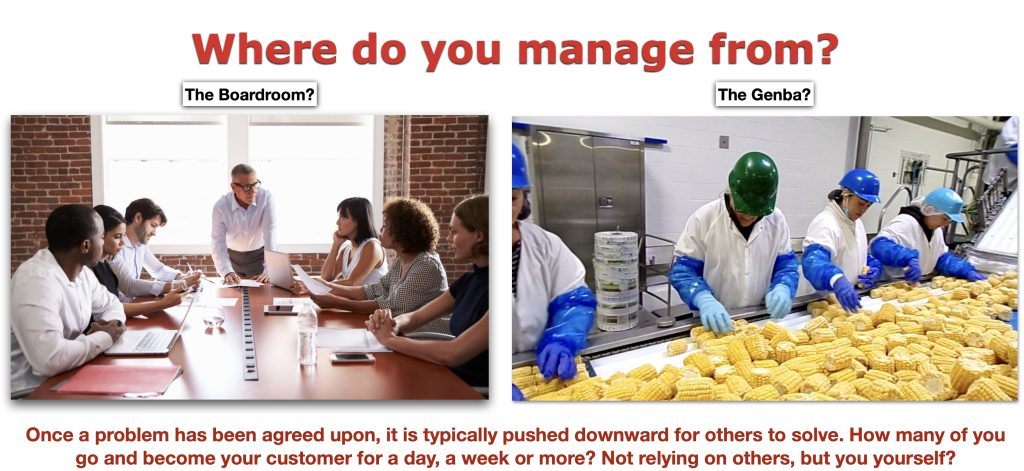
Observation came before interpretation. Reality came before explanation. And this is far more difficult than it sounds. And yes, that is me in the green hat!
Experienced practitioners often see familiar patterns almost instantly. The challenge is not identifying those patterns; it is remaining sufficiently curious to ask whether they still apply.
The novice approaches the same situation very differently. They lack experience. They ask basic questions. They notice inconsistencies. They often challenge assumptions simply because they do not yet know they are “supposed” to accept them. The novice lacks expertise but possesses something equally valuable. Fresh eyes.
History provides countless examples of organizations that failed not because the evidence was unavailable, but because it failed to fit established patterns. Digital photography did not arrive without warning. Streaming did not emerge overnight. Artificial intelligence did not suddenly appear in 2022. In each case, weak signals had existed for years. The technologies matured gradually, customer behaviors evolved incrementally and new competitors entered the market one step at a time.
The evidence was visible. The significance was not.
Organizations interpreted these developments through the lens of existing business models and historical success. They asked how the new technology fitted the current system instead of asking whether the system itself was about to become obsolete. The paradox is therefore not that expertise is dangerous. The paradox is that the very capability that allows experts to recognize familiar patterns with extraordinary speed can also reduce their ability to notice unfamiliar ones. Success reinforces this effect.
Organizations become increasingly confident that the assumptions which brought success yesterday will continue to explain tomorrow. Performance metrics validate existing practices. Promotions reward current expertise. Processes become standardized around established ways of thinking. Over time, expertise becomes institutionalized. Eventually, the organization no longer merely employs experts. It begins to think like one. Deming understood this when he observed that a system cannot understand itself. Toyota responded by creating disciplines that continually exposed assumptions to observation.
Modern cognitive psychology explains why those disciplines work. The more familiar we become with a system, the more likely we are to mistake recognition for understanding. The most effective leaders understand that expertise should never become certainty. They deliberately seek contradiction. They invite alternative perspectives. They spend time with customers, frontline employees and people outside their industry. They create environments where assumptions can be challenged before reality forces the issue.
This is also why I increasingly see artificial intelligence not as a replacement for expertise, but as a partner to it.
AI possesses very little lived experience, but neither does it inherit decades of organizational assumptions. It often asks questions experienced practitioners no longer think to ask. Sometimes those questions are naïve. Occasionally they expose assumptions that everyone else has stopped seeing.
The future does not belong to organizations with the most expertise. It belongs to organizations that know how to combine expertise with curiosity. Because expertise tells us what has mattered. Curiosity helps us discover what matters now.
Overcoming Organizational Blindness: Learning to See… and Learning to Unsee
One of the greatest lessons I learned inside Toyota was that the purpose of the Toyota Production System was never simply to solve problems.
It was to develop the ability to see them.
Most organizations are quick to act. They diagnose, intervene, reorganize, automate, escalate, and launch improvement initiatives. What they are far less practiced at doing is slowing down long enough to understand what is actually happening. Toyota taught me that better problem solving begins with better observation. This is the art of Genchi Genbutsu.
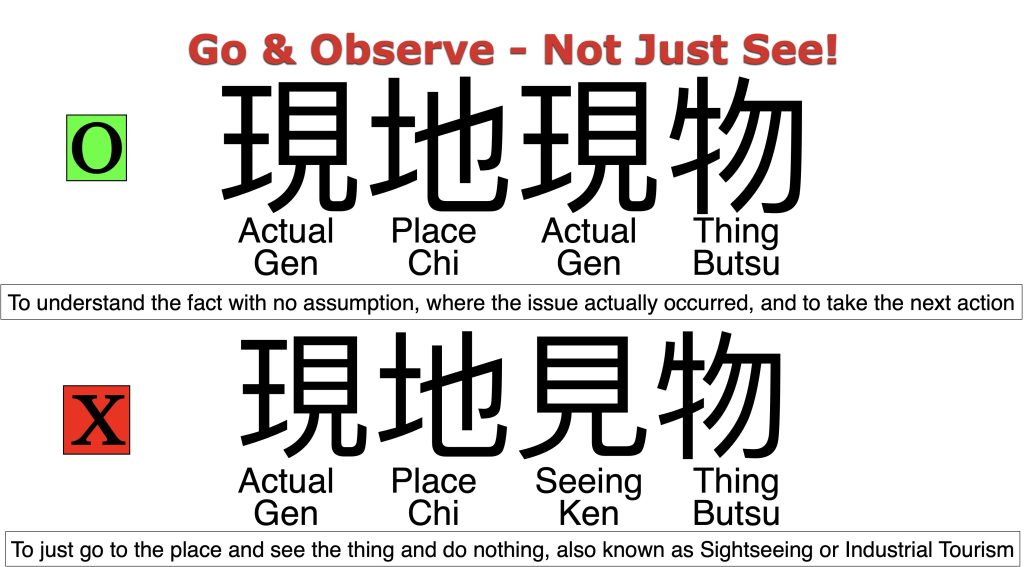
Many people encounter TPS as a collection of methods and tools: Kanban, Andon, Standard Work, A3 Thinking, visual management, and the disciplines associated with going to the gemba. These practices are important, but they are often misunderstood when treated as ends in themselves. They are not the destination. They are mechanisms for making reality harder to ignore.
Kanban reveals the movement of work and the consequences of imbalance.
Andon makes abnormal conditions visible rather than allowing them to disappear into the process.
Standard Work creates a basis for distinguishing what should happen from what is actually happening.
A3 Thinking forces people to clarify the problem, examine evidence, and make their reasoning visible.
The gemba places leaders where the work occurs, not because physical presence alone creates understanding, but because direct observation challenges the comfort of reports, summaries, and assumptions.
The common purpose is not simply control or efficiency. It is visibility. It is seeing to understand, not just to observe.
Toyota’s disciplines continually push people back toward the actual condition. They ask us to observe before explaining, understand before acting, and separate what we know from what we merely assume.
- At the gemba, reports are tested against reality.
- Opinions are tested against evidence.
- Explanations are tested against observation.
- Certainty gives way to curiosity.
This is far more demanding than it appears. Experienced leaders often arrive with a diagnosis already forming. They recognize patterns, recall previous situations, and begin constructing solutions before they have fully understood the present one. Their judgment is shaped by mental shortcuts, cognitive biases, and heuristics that allow them to act quickly but can also cause them to force a new situation into an old pattern. Kahneman showed how readily the mind substitutes familiar answers for difficult questions; Klein demonstrated the power of expert pattern recognition; and Snowden reminds us that patterns that are reliable in one context may become dangerously misleading in another.
The discipline is to resist that impulse. To look again. To ask what is actually happening rather than what usually happens. To notice the gap between the official process and the lived reality of the work.
Toyota taught people to delay explanation until they had first learned to see. Yet there is another lesson hidden within that practice. Before we can learn to see, we often have to learn to unsee.
- We have to unsee the labels that have replaced direct observation.
- We have to unsee the process maps that tell us how work is supposed to flow.
- We have to unsee the metrics that reassure us the system is performing.
- We have to unsee the organizational stories that explain why delays, workarounds, and recurring failures are inevitable.
- We have to unsee what our experience has taught us to overlook.
This does not mean abandoning expertise. It means becoming more conscious of the filters expertise creates.
Every experienced person carries a library of mental models. Those models help us make sense of complexity, but they also shape what we notice. Once we classify something as a familiar problem, a known issue, a cultural challenge, or an unavoidable constraint, we may stop examining it with fresh eyes.
A label can create the illusion of understanding. A metric can create the illusion of control. A familiar explanation can create the illusion that no further inquiry is necessary.
Learning to unsee means suspending those interpretations long enough to encounter the system again.
- It means asking what we would notice if we did not already believe we knew the answer.
- It means examining the workaround without immediately accepting the explanation for why it exists.
- It means listening to the customer complaint without categorizing it as an isolated event.
- It means watching the work without imposing the process diagram upon it.
- It means recognizing that much of what we call experience is not only accumulated knowledge. It is also accumulated assumption.
Information Is Not the Same as Understanding
Learning to see is not simply about acquiring more information.
Organizations are rarely short of information. Most are surrounded by it: dashboards, reports, customer data, performance measures, meeting notes, forecasts, emails, surveys, and increasingly, vast quantities of machine-generated analysis. The deeper challenge is that information does not possess value merely because it exists.
In our paper, The Substrate-Independence Theory, John Turner, Dave Snowden, and I argued that information value is created when relevant information is made available in a form that enables action. Information must reach the right people, in the right context, at the point when it can still influence what happens next. (MDPI)
A report produced after the opportunity to act has passed may be accurate, but it has little practical value. A weak signal buried among hundreds of measures may be available, yet functionally invisible. A customer complaint recorded in a database but disconnected from operational decision-making remains data rather than actionable information.
The problem, therefore, is not simply the absence of information. It is the failure of information to flow.
Information becomes trapped in organizational silos, delayed by reporting cycles, stripped of context, aggregated beyond recognition, or filtered through layers of interpretation. By the time it reaches senior leaders, the detail that gave it meaning may have disappeared. The organization may know a great deal while understanding very little.
Our paper also proposed that energy follows information. The more difficult it is to locate, interpret, verify, and transmit relevant information, the more organizational energy must be expended. That energy appears in repeated meetings, escalations, searches, handoffs, duplicate analysis, clarification requests, and the constant reconstruction of knowledge that already exists somewhere within the system. (MDPI)
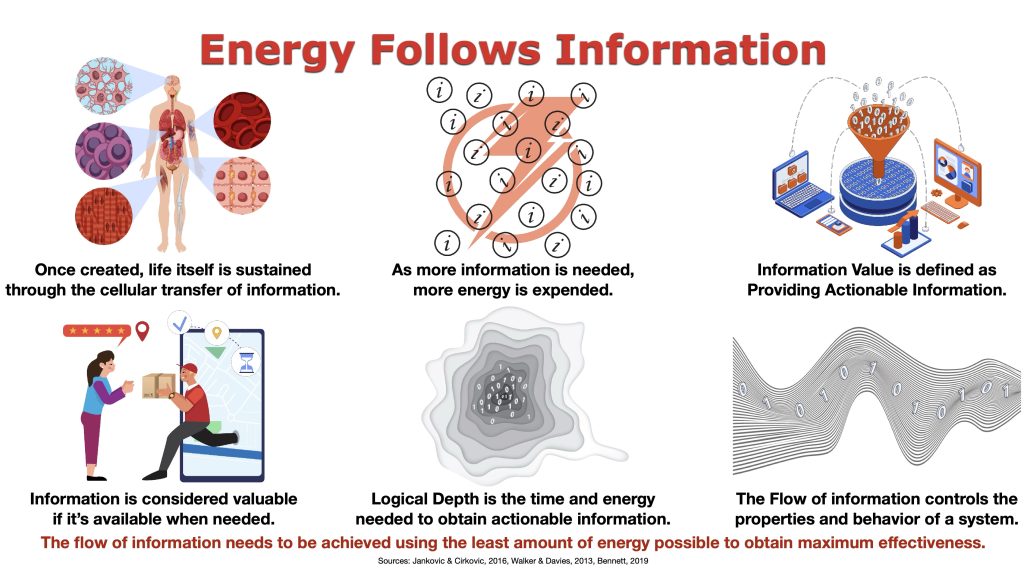
This is not an abstract concern. It is visible in everyday organizational life.
- When employees must search through several systems to understand a customer problem, energy is being consumed.
- When multiple teams independently recreate the same analysis, energy is being consumed.
- When leaders request another presentation because the previous one failed to make the situation clear, energy is being consumed.
- When frontline knowledge must travel through several hierarchical layers before anyone can act, energy is being consumed.
The inefficiency lies not only in the work itself, but in the effort required to obtain information that is sufficiently coherent to support action.
This is where the concept of logical depth becomes useful. Some information is valuable because considerable time, knowledge, and effort were required to produce it. Its recipient is spared from having to repeat that work independently. Yet that value is only realized when the information is accessible and usable at the moment it is needed. (MDPI)
Timeliness is therefore inseparable from value. Information that arrives too late may explain what happened, but it cannot shape what happens.
This is one reason weak signals are so frequently missed. They rarely arrive as finished conclusions. They appear as fragments: an unusual customer request, a recurring workaround, a subtle change in behavior, an anomaly in a process, or a concern raised without supporting data. These fragments require attention, interaction, and sense-making before their significance becomes clear.
Traditional reporting systems often do the opposite. They compress uncertainty into categories, averages, traffic-light indicators, and retrospective explanations. In doing so, they may reduce the very ambiguity that leaders needed to examine. The information is made cleaner, but sometimes less informative.
Learning to see therefore requires more than visibility. It requires creating conditions in which information can move through the organization with enough context intact to remain meaningful.
- That means reducing the energy required to obtain it.
- It means shortening the distance between observation and action.
- It means allowing anomalies to remain visible before they are normalized.
- It means connecting people who hold different fragments of knowledge.
- It means recognizing that information is not valuable because it has been collected, but because it changes what someone is able to perceive and do.
The real question is not:
How much information do we have?
rather
Does the right information reach the right people, with sufficient context, while there is still time to act?
- Only then does information become valuable.
- Only then can it help the organization see.
- Only then do the tools of TPS begin to reveal their real purpose.
They help people distinguish the expected from the actual, the normal from the normalized, and the visible condition from the story the organization tells itself about that condition.
The goal is not merely to see more. It is to see with fewer assumptions. Only then can we begin to recognize what was present all along.
Sensemaking: How Organizations Construct Reality
Organizations rarely fail because they lack information. They fail because they assign the wrong meaning to the information they already possess.
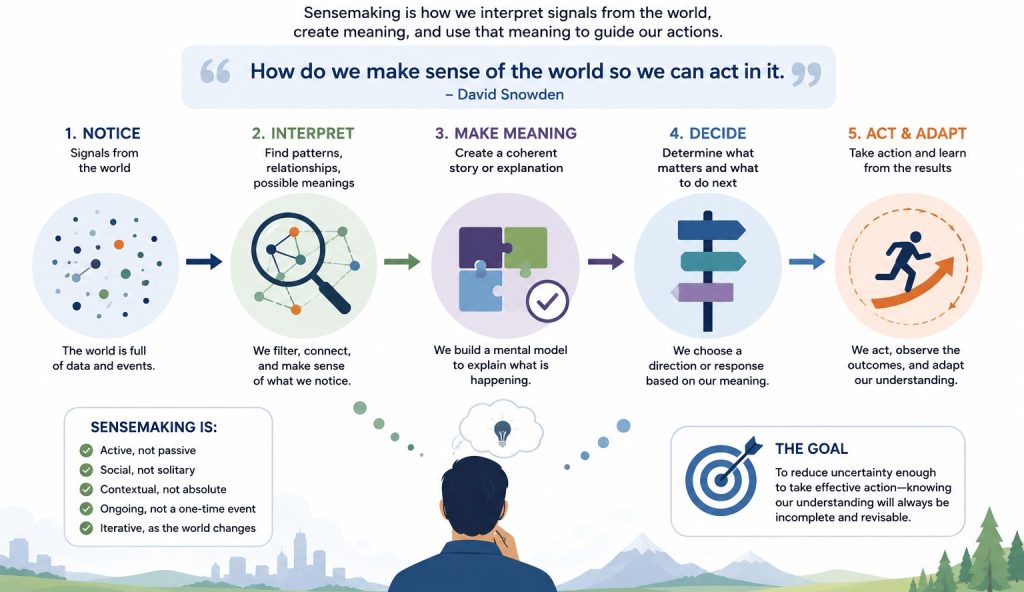
Sensemaking is the process through which people interpret events and construct enough shared understanding to act. The quality of action therefore depends upon the quality of what the organization notices and how it interprets those signals.
This is where the work of Karl Weick and Dave Snowden becomes especially relevant.
Organizations do not simply receive and process information as though meaning were self-evident. They interpret events through existing assumptions, prior experience, shared language, power structures, and expectations about how the world is supposed to work. They do not merely observe reality. They construct an account of it.
They decide what deserves attention, which signals are credible, which explanations are acceptable, and which anomalies can be dismissed as noise. They develop stories about why the organization succeeds, why certain problems persist, what customers value, and what the future is likely to hold.
Over time, these stories become more than interpretations. They become the operating reality of the organization.
They shape what leaders ask, what employees report, what data is collected, and which possibilities are considered plausible. Information that reinforces the dominant narrative is more readily accepted. Information that challenges it is more likely to be questioned, reclassified, or ignored.
This is why two leadership teams can examine exactly the same evidence and reach entirely different conclusions. They may be looking at the same data, but they are not seeing the same situation. Each team is interpreting the evidence through a different set of mental models, experiences, assumptions, and expectations. What one team recognizes as an emerging threat, another may dismiss as temporary variation. What one sees as a failure of execution, another may understand as evidence that the system itself is no longer fit for purpose.
The difference is not necessarily intelligence. It is sensemaking.
Weick’s work helps explain how people create plausible meaning from incomplete and ambiguous events, often retrospectively. Snowden’s work adds an equally important warning: the form of sensemaking appropriate in a stable, ordered environment may be dangerously misleading in a complex one.
In an ordered context, patterns may be sufficiently repeatable for experience, analysis, and established practice to guide action. In a complex context, causality is less visible in advance. Novel patterns emerge through interaction, and leaders must probe, observe, and adapt rather than assume that prior knowledge will reveal the correct answer.
The danger arises when organizations treat every situation as though it belongs to the world they already understand. They impose familiar explanations on unfamiliar conditions. They search for known causes. They apply established solutions. They mistake confidence for comprehension.
Improvement therefore begins long before action. It begins before the workshop, the transformation program, the reorganization, or the new technology is introduced.
It begins with better sensemaking.
That means creating space for multiple perspectives, preserving ambiguity long enough to examine it, and resisting the urge to force emerging evidence into familiar categories. It means asking not only, “What is happening?” but also, “What assumptions are shaping what we believe is happening?”
The quality of action depends upon the quality of the meaning that precedes it.
When sensemaking is poor, even disciplined execution can move the organization rapidly in the wrong direction.
When sensemaking improves, the organization becomes more capable of noticing change, interpreting weak signals, and responding before the evidence becomes impossible to ignore.
Weak Signals: Knowing Before the Organization Knows
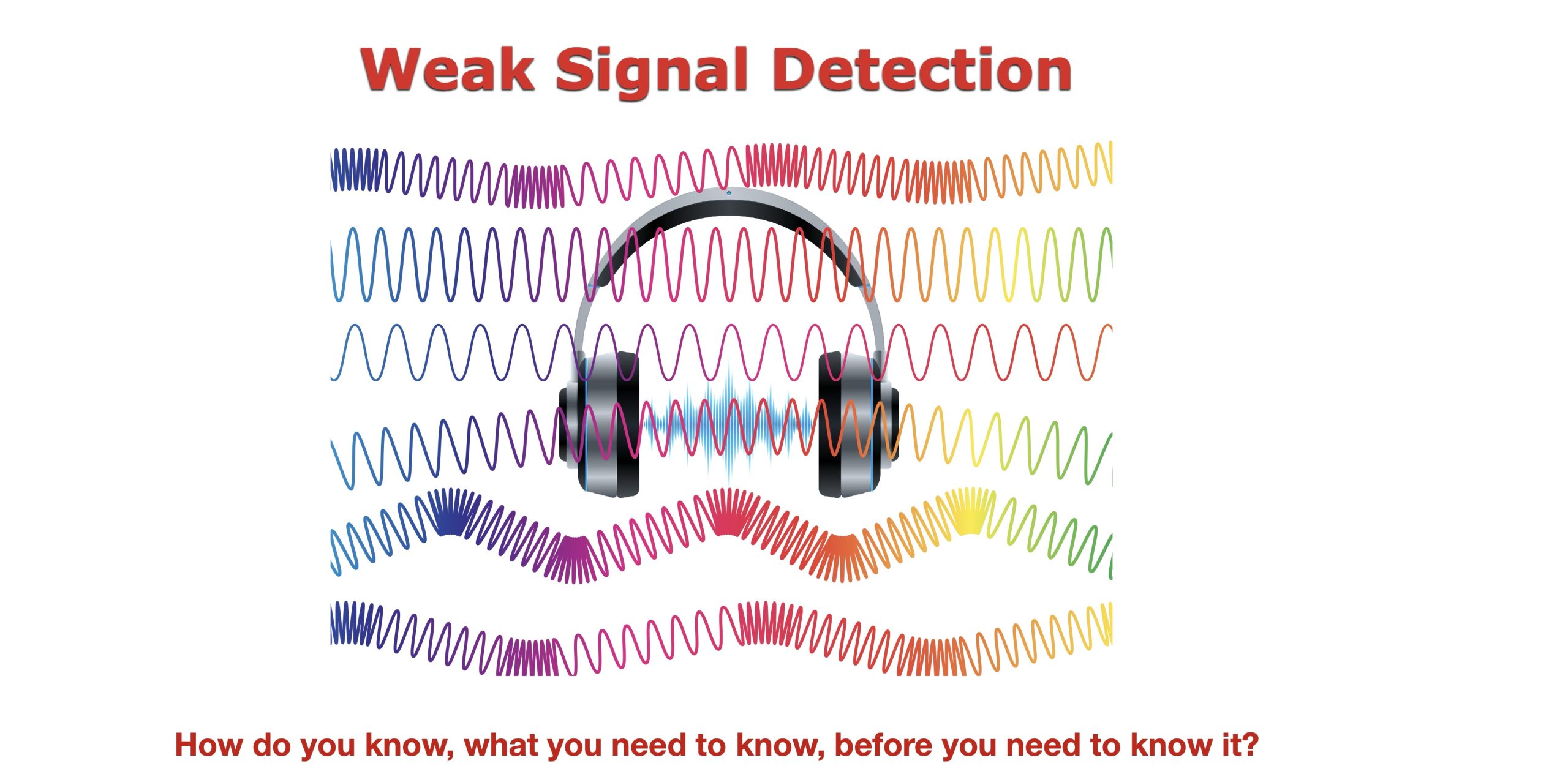
One of the recurring themes in my work is helping leaders detect weak signals before they become major disruptions. That question sits at the heart of adaptive leadership.
Weak signals rarely arrive with certainty. They do not present themselves as fully formed conclusions, supported by complete data and accompanied by an obvious course of action. By the time the evidence is that clear, the opportunity to respond early has usually passed.
Weak signals appear as fragments.
- An isolated customer complaint.
- A small inconsistency in performance.
- An unexpected shift in behavior.
- A delay that seems too minor to investigate.
- A workaround that has quietly become routine.
- A question no one can answer with confidence.
- A concern raised by someone who cannot yet prove why it matters.
Individually, these signals are easy to dismiss. They may appear anecdotal, ambiguous, or unrelated. They lack the weight normally required to enter a formal report or attract executive attention. Yet their weakness is precisely what makes them important. A weak signal is not weak because it lacks significance. It is weak because its significance has not yet become obvious.
This creates a profound challenge for organizations. Most management systems are designed to respond to strong signals: missed targets, customer losses, quality failures, rising costs, regulatory action, or visible disruption. They are far less capable of noticing the faint indications that precede them. Organizations therefore become highly efficient at measuring what has already become undeniable while remaining comparatively poor at sensing what is still emerging.
Experience can make this worse. An established organization develops filters for distinguishing signal from noise. Those filters are necessary; without them, leaders would be overwhelmed by every anomaly, opinion, and fluctuation. But the same filters that protect attention can also remove the earliest evidence that the environment is changing.
- The complaint is classified as an exception.
- The delay is explained as temporary.
- The workaround is praised as resourcefulness.
- The unusual customer request is treated as an outlier.
- The unanswered question is deferred until better data becomes available.
Each judgment may appear reasonable in isolation. Collectively, they can prevent the organization from recognizing a pattern until it has become a crisis. This is why weak signal detection is not simply a data problem. It is an attention problem. It is a sensemaking problem. It is a challenge of remaining open to information that does not yet fit the dominant explanation.
The most useful question is often not, “Can we prove this matters?” rather, “What might this be an early indication of?”
That shift changes the role of leadership. Instead of waiting for certainty, leaders create safe-to-learn ways of investigating ambiguity. They look for recurrence, seek additional perspectives, test small hypotheses, and preserve anomalies long enough to understand whether they are connected.
They do not overreact to every signal. Neither do they dismiss signals simply because they are weak.
This is one reason independent reviews can create enormous value. An outsider often notices what insiders have learned to ignore. They hear the hesitation in an answer, question a workaround everyone else considers normal, or see significance in a pattern that does not fit the organization’s established categories.
Not because outsiders are necessarily smarter. Not because they possess superior knowledge of the system. They simply have not yet absorbed the explanations that make its abnormalities appear ordinary. They have not learned which questions are considered unhelpful, which contradictions are accepted, or which recurring failures are no longer regarded as surprising. They are seeing with fewer filters.
The value of an independent perspective is therefore not that it delivers answers from outside the system. Its deeper value is that it helps the organization notice the questions it has stopped asking.
Weak signal detection is ultimately the discipline of creating awareness before certainty. It is how leaders begin to know what they need to know before the need becomes obvious. And it is how organizations create the possibility of acting before disruption removes the choice.
AI and the Outside View
Artificial intelligence introduces an intriguing possibility. Used well, AI can serve as an external thinking partner: not because it possesses superior wisdom, but because it does not automatically inherit the assumptions, routines, and explanations embedded within a particular organization.
It can ask unfamiliar questions, test familiar reasoning, and expose inconsistencies that experienced practitioners may no longer notice. But AI also lacks lived experience, organizational context, and practical judgment. It can challenge assumptions without fully understanding the consequences of doing so.
Neither internal expertise nor artificial intelligence is sufficient on its own. The real opportunity lies in combining experienced human judgment with independent challenge.
The goal is not to replace expertise. It is to stop expertise from becoming blindness.
Seeing Is a Leadership Discipline in Organizational Blindness
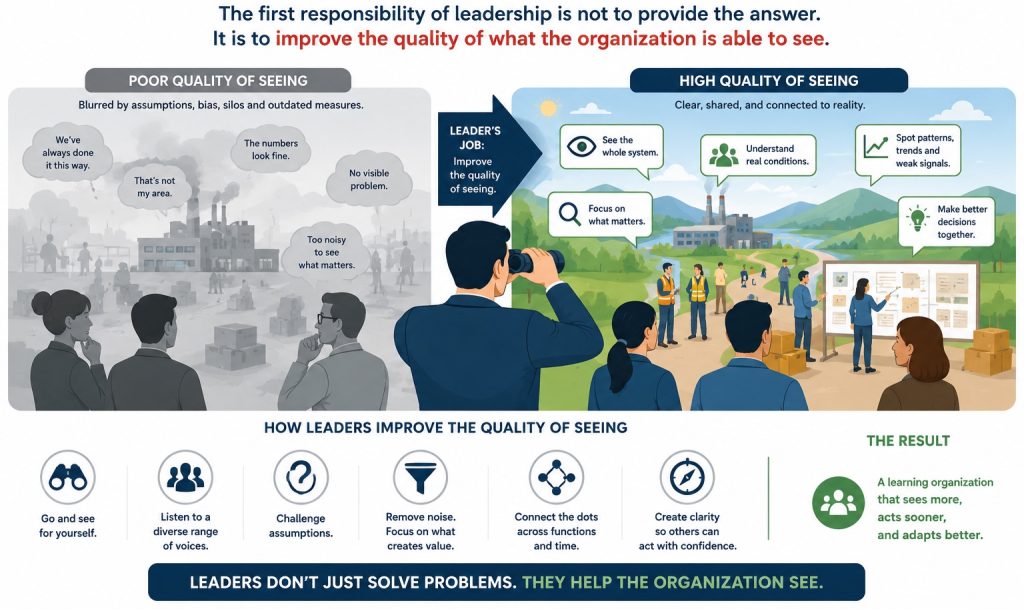
The first responsibility of leadership is not to provide the answer. It is to improve the quality of what the organization is able to see.
Leadership is often described as the ability to make decisions, set direction, and mobilize others, but that is incomplete. Leadership begins with perception.
Before a leader can decide what to do, they must first understand what is happening. The quality of every decision depends upon the quality of the reality upon which it is based. When that reality is partial, filtered, delayed, or distorted, even an intelligent and well-intentioned leader can make the wrong decision with complete confidence.
This is why seeing is not a passive act. It is a leadership discipline.
Leaders must continually question what is being brought to their attention, what is being filtered out, whose perspective is missing, and which assumptions are shaping the interpretation of events. They must distinguish between what the organization knows, what it believes, and what it has simply become accustomed to.
That requires humility.
Humility is not indecision or a lack of confidence. It is the recognition that no leader, however experienced, can see the whole system from a single vantage point.
- Humility creates curiosity.
- Curiosity leads to better questions.
- Better questions direct attention.
- Attention improves observation.
- Observation strengthens understanding.
And understanding creates the conditions for better decisions.
The greatest leaders I have worked with were not those who always had the answers. They were the ones who resisted the temptation to assume that they already understood the problem. They went to see for themselves, invited contradiction, listened to people closest to the work, and continually tested whether their view of the system was complete.
They understood that leadership is not only about deciding what the organization should do. It is about ensuring the organization can see clearly enough to decide well.
Final Thoughts: Learning to See
Deming challenged us to step outside the system because he understood that every system shapes the thinking of those within it.
Toyota transformed that insight into a discipline. Before solving problems, people were taught to observe. Before explaining, they were expected to understand. Before changing the system, they first had to learn to see it.
Over the last half-century, psychology, complexity science, and organizational research have helped explain why that discipline is so necessary.
Kahneman showed that our minds rely on heuristics and cognitive shortcuts that allow us to act quickly but also bias what we notice. Klein demonstrated the extraordinary power—and the limitations—of expert pattern recognition. Weick reminded us that organizations do not simply process information; they construct meaning. Snowden showed that the nature of the environment determines how we should make sense of what we observe. My own work on information value and weak signal detection has explored how organizations can recognize emerging patterns before they become obvious, asking a deceptively simple question:
How do you know what you need to know before you need to know it?
Together, these ideas point toward the same conclusion.
- Organizations rarely fail because they lack intelligence.
- They rarely fail because people are unwilling to work hard.
- They rarely fail because they have too little information.
They fail because the system gradually teaches people what to pay attention to, what to ignore, and what to accept as normal. Eventually, yesterday’s explanations become today’s blind spots.
That is why the most dangerous assumptions are not the ones we debate. They are the ones we no longer recognize as assumptions. The ones embedded in our language, our metrics, our routines, our reporting structures, and our collective stories about how work gets done.
Leadership, therefore, is not simply about making better decisions. It is about creating the conditions in which better perception becomes possible. It is about building organizations that remain curious enough to question their own success, humble enough to invite challenge, and disciplined enough to distinguish reality from the stories they tell themselves about reality.
That is why independent perspectives matter. Not because outsiders are always right. Not because experience has lost its value. But because every system needs voices that have not yet learned what the system has stopped seeing.
Deming was right. A system cannot fully understand itself because it is continually shaped by the assumptions it cannot observe.
Transformation does not begin with a strategy, a reorganization, an AI initiative, or another change program. It begins when leaders become willing to question what everyone else has learned to accept.
When they replace certainty with curiosity. When they observe before they explain.
When they learn not only to see…
…but first, to unsee.
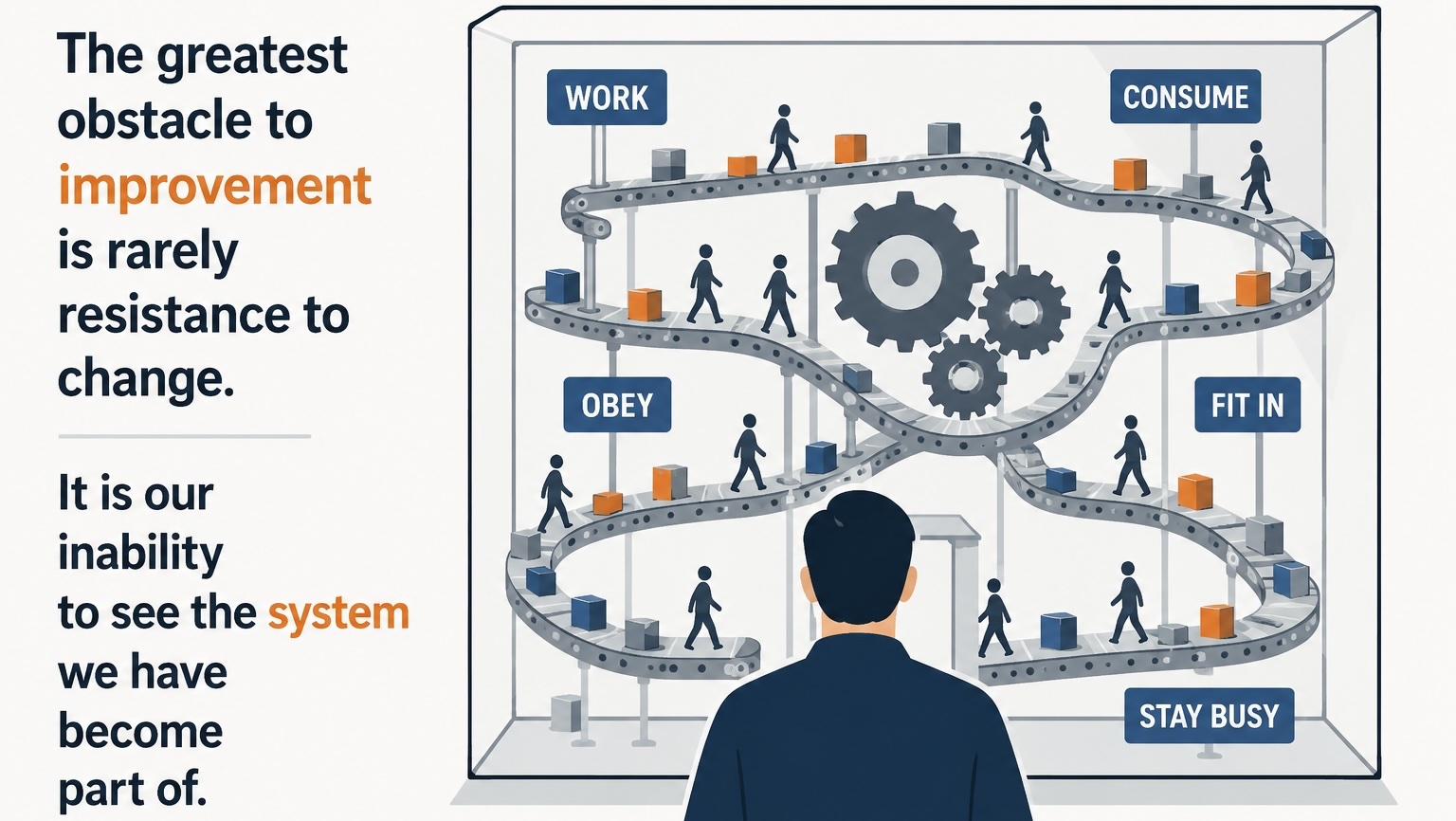
Because the greatest obstacle to improvement is rarely resistance to change.
It is our inability to see the system we have become part of.
Sources and Influences
The ideas in this article draw upon several decades of work in systems thinking, organizational learning, cognitive psychology, naturalistic decision-making, and complexity science. The following works provide an excellent starting point for exploring these concepts in greater depth.
Systems Thinking and Management
Deming, W. Edwards. The New Economics for Industry, Government, Education. MIT Press, 2nd Edition, 2000.
Perhaps Deming’s most important management work, introducing his System of Profound Knowledge and the observation that “A system cannot understand itself. The transformation requires a view from outside.”
Deming, W. Edwards. Out of the Crisis. MIT Press, 1986.
A foundational work on quality, leadership and systemic improvement that transformed management thinking around the world.
Toyota and Learning to See
Ohno, Taiichi. Toyota Production System: Beyond Large-Scale Production. Productivity Press, 1988.
The original explanation of the thinking behind the Toyota Production System by one of its principal architects.
Shingo, Shigeo. A Study of the Toyota Production System. Productivity Press, 1989.
A detailed examination of the principles and mechanisms underlying Toyota’s production philosophy.
Rother, Mike, and Shook, John. Learning to See: Value Stream Mapping to Add Value and Eliminate MUDA. Lean Enterprise Institute, 1999.
Although best known for value stream mapping, the title itself captures one of the central themes of this article: improvement begins with learning to perceive reality more accurately.
Sensemaking and Complexity
Weick, Karl E. Sensemaking in Organizations. Sage Publications, 1995.
The seminal work explaining how people and organizations construct meaning from ambiguous events rather than simply receiving and processing an objective reality.
Snowden, Dave, and Boone, Mary E. “A Leader’s Framework for Decision Making.” Harvard Business Review, November 2007.
Introduces the Cynefin Framework and explains why different situations require different approaches to leadership, decision-making and sensemaking.
Snowden, David J. “Complex Acts of Knowing: Paradox and Descriptive Self-Awareness.” Journal of Knowledge Management, vol. 6, no. 2, 2002, pp. 100–111.
A foundational paper in Snowden’s development of complexity-informed knowledge management and sensemaking. It challenges overly simplified assumptions about knowledge, rationality, and organizational decision-making.
Kurtz, Cynthia F., and David J. Snowden. “The New Dynamics of Strategy: Sense-Making in a Complex and Complicated World.” IBM Systems Journal, vol. 42, no. 3, 2003, pp. 462–483.
A major exposition of the Cynefin framework as a sensemaking device. The paper challenges assumptions of order, rational choice, and intent, and distinguishes between complicated situations that can be analyzed and complex situations in which patterns emerge retrospectively.
Snowden, David J. “Naturalizing Sensemaking.” In Informed by Knowledge: Expert Performance in Complex Situations, edited by Kathleen L. Mosier and Ute M. Fischer, Psychology Press, 2010, pp. 223–234.
Develops Snowden’s naturalistic approach to sensemaking and its relationship to human cognition, expertise, decision-making, and action under conditions of uncertainty. Together, Snowden’s work helps explain several ideas used in this article: why cause and effect in complex situations may only become clear retrospectively, why familiar patterns can dominate interpretation, and why leaders must adapt their methods to the nature of the situation rather than impose a single universal approach.
Cognitive Psychology and Perception
Simons, Daniel J., and Chabris, Christopher F. “Gorillas in Our Midst: Sustained Inattentional Blindness for Dynamic Events.” Perception, Vol. 28, No. 9, 1999.
The famous Invisible Gorilla experiment demonstrating how people can fail to notice obvious events when their attention is directed elsewhere.
Simons, Daniel J., and Chabris, Christopher F. The Invisible Gorilla: How Our Intuitions Deceive Us. Crown Publishing, 2010.
A highly accessible explanation of inattentional blindness and other cognitive illusions affecting everyday decision-making.
Kahneman, Daniel. Thinking, Fast and Slow. Farrar, Straus and Giroux, 2011.
A landmark work explaining cognitive biases, heuristics and the distinction between intuitive and deliberate thinking.
Klein, Gary. Sources of Power: How People Make Decisions. MIT Press, 1998.
An important counterpoint to Kahneman, showing how experts develop rapid pattern recognition through experience while also highlighting the strengths and limitations of expertise.
Expertise and Naturalistic Decision-Making
Klein, Gary. Sources of Power: How People Make Decisions. MIT Press, 1998.
A foundational work on naturalistic decision-making and recognition-primed decisions. Klein explains how experienced practitioners recognize meaningful patterns and act rapidly without comparing every possible option.
Klein, Gary. The Power of Intuition: How to Use Your Gut Feelings to Make Better Decisions at Work. Currency, 2003.
Explores how expertise produces intuitive judgment while emphasizing that intuition is dependable only when experience has been developed in an environment containing sufficiently valid and recurring patterns.
Klein’s work provides an important counterpoint to research focused primarily on bias. Expertise is not simply a source of error; it is a powerful adaptive capability. The risk arises when previously reliable patterns are applied to conditions that have changed.
Organizational Culture
Schein, Edgar H. Organizational Culture and Leadership. 5th Edition, Wiley, 2017.
One of the definitive works on how organizational assumptions become embedded and why culture often operates below conscious awareness.
Argyris, Chris, and Donald A. Schön. Organizational Learning II: Theory, Method, and Practice. Addison-Wesley, 1996.
Explains how organizations defend established assumptions, avoid uncomfortable learning, and reproduce patterns of behavior even when those patterns undermine performance.
Schön, Donald A. The Reflective Practitioner: How Professionals Think in Action. Basic Books, 1983.
Examines how professionals use experience and reflection to navigate uncertain situations, while also showing why established frames can restrict what they are able to notice and question.
Further Reading
Turner, John, and Thurlow, Nigel, and Rivera Brian. The Flow System®: The Evolution of Agile and Lean Thinking in an Age of Complexity. University of North Texas Press, 2020.
Introduces The Flow System®, integrating Lean, complexity thinking, distributed leadership, and team science into a coherent framework for improving organizational performance in uncertain environments.
Turner, John, and Thurlow Nigel. The Flow System® Playbook. 3 Helix Publishing, 2025.
Expands the practical application of The Flow System through leadership practices, organizational design, and methods for improving flow, decision-making, and adaptive capability in modern organizations.
Closing Reflection
These works span more than four decades and come from different disciplines, yet they converge on a remarkably consistent conclusion.
This article represents my own synthesis of these influences, informed by more than three decades of studying and applying systems thinking, the Toyota Production System, organizational learning, complexity science, and leadership in practice. While the concepts presented here draw upon the work of many outstanding researchers and practitioners, any interpretations, integrations, or conclusions are my own.
Organizations do not fail because people lack intelligence. They fail because human beings, individually and collectively, struggle to perceive the systems they inhabit.
The disciplines of systems thinking, Toyota, cognitive psychology and complexity science all point toward the same leadership challenge:
Before we can improve the system, we must first learn to see it.