Five Key Takeaways for Leaders
- Continuous improvement is not always enough.
Kaizen is powerful when the existing system remains fit for purpose. When the environment changes fundamentally, leaders must be willing to question the system itself. - Know when Kaikaku is required.
Incremental improvement asks how to make the current model better. Kaikaku asks whether a different model, structure or operating approach is now needed. - Look for opportunities to repurpose existing capabilities.
Exaptation shows that knowledge, technology, data or processes developed for one purpose may create greater value when applied somewhere entirely different. - Pay attention to weak signals before they become obvious.
Emerging customer behavior, unusual workarounds, new combinations of technology and repeated anomalies may reveal the beginnings of a larger shift. - Do not use AI merely to optimize yesterday’s organization.
The greatest risk is not failing to adopt AI quickly enough. It is using AI to make an outdated operating model more efficient instead of redesigning the organization for what comes next.
Kaizen, Kaikaku and Exaptation: Leading Through AI’s Punctuated Equilibrium
Everyone seems to assume that artificial intelligence will continue improving along a smooth and predictable trajectory.
Each model will be slightly more capable than the last. Costs will gradually fall. Adoption will steadily increase. Organizations will introduce AI into more processes, learn how to use it and progressively become more productive.
That may happen for a while, but history suggests that profound change rarely follows such a neat path.
Evolution certainly does not.
The theory of punctuated equilibrium, developed by paleontologists Niles Eldredge and Stephen Jay Gould, challenged the assumption that evolution always occurs through continuous, gradual change. It proposed that long periods of relative stability, or stasis, are interrupted by comparatively brief periods of rapid evolutionary change.
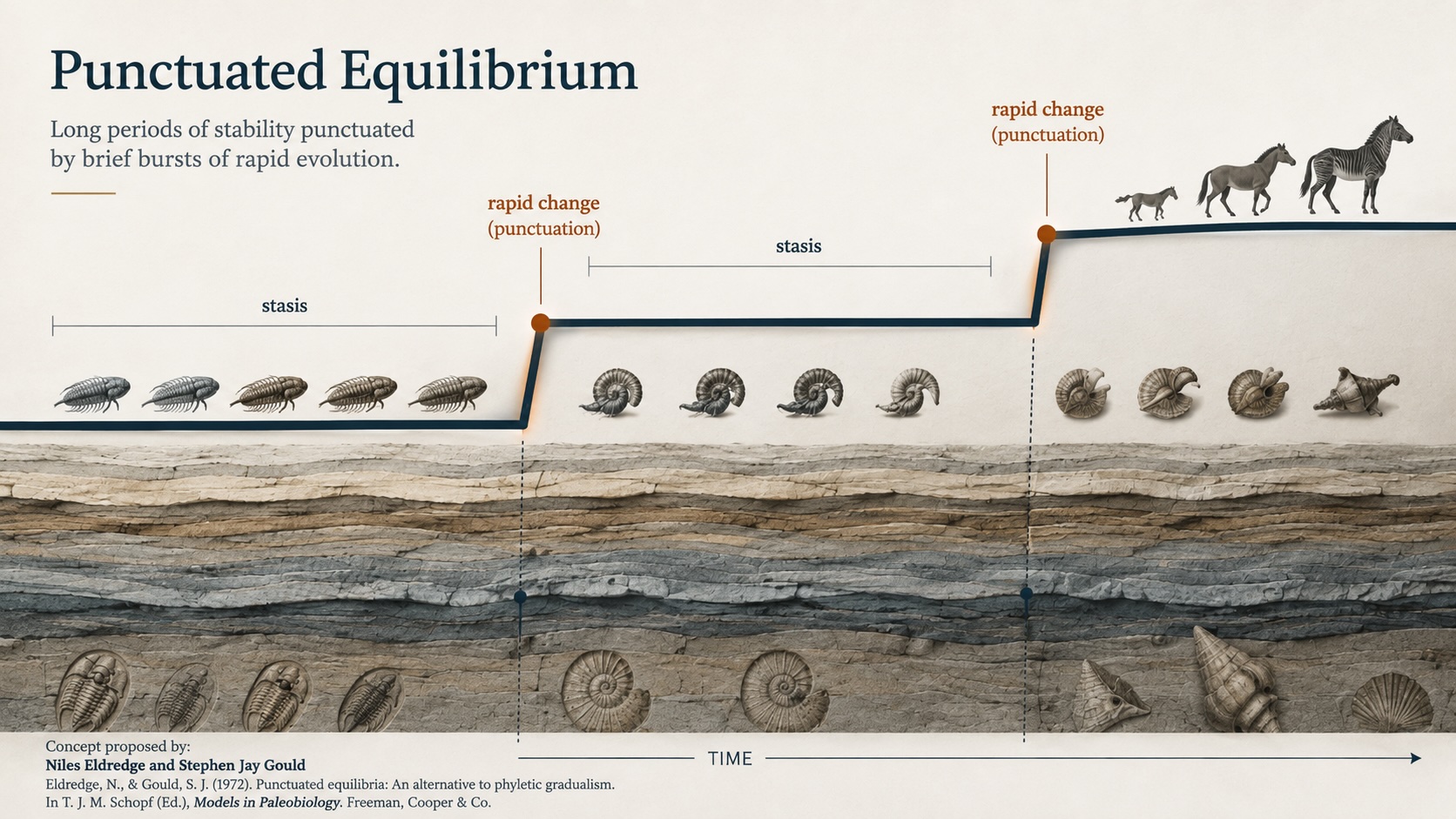
The important word is not simply change. It is punctuation.
A system can appear stable for a long time. Its participants adapt incrementally, its structures become established and its assumptions become increasingly difficult to question. Then environmental pressures accumulate, previously separate developments converge, and the system crosses a threshold.
What appeared stable suddenly becomes unstable. What appeared peripheral becomes central. What appeared unlikely becomes unavoidable.
Organizations often evolve in much the same way.
The Difference Between Kaizen and Kaikaku
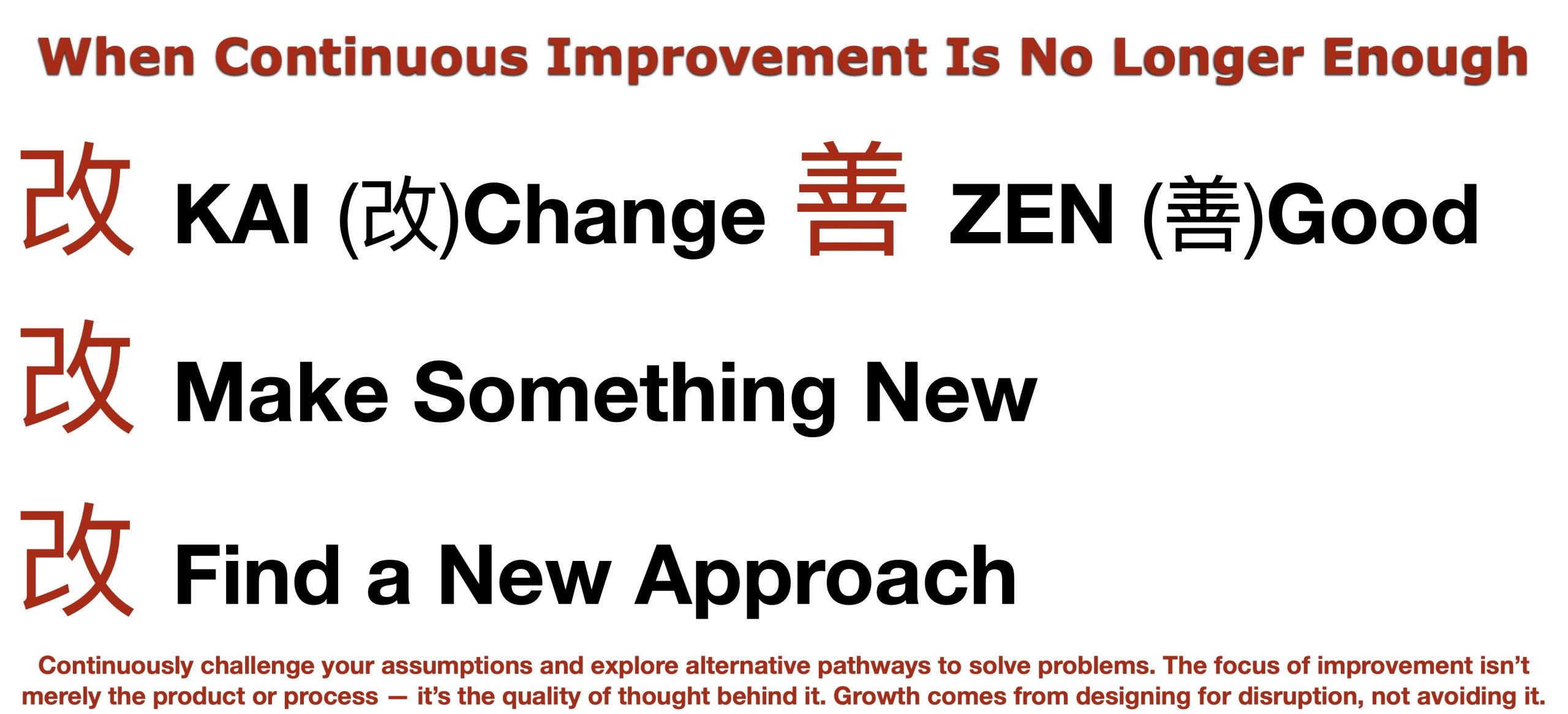
Within Lean thinking, Kaizen is usually translated as continuous improvement.
Kaizen improves the current system through repeated learning, experimentation and the removal of obstacles to flow. It develops people’s capability to see problems, investigate causes and improve how work is performed.
It is extraordinarily powerful.
However, Kaizen generally begins with an important assumption: the existing system remains sufficiently appropriate to the environment in which it operates.
The system may contain waste, poor flow, excessive variation, unnecessary complexity or badly designed processes, but its underlying purpose and architecture remain broadly valid. We are improving a system that still deserves to exist in approximately its current form.
Kaikaku is different.
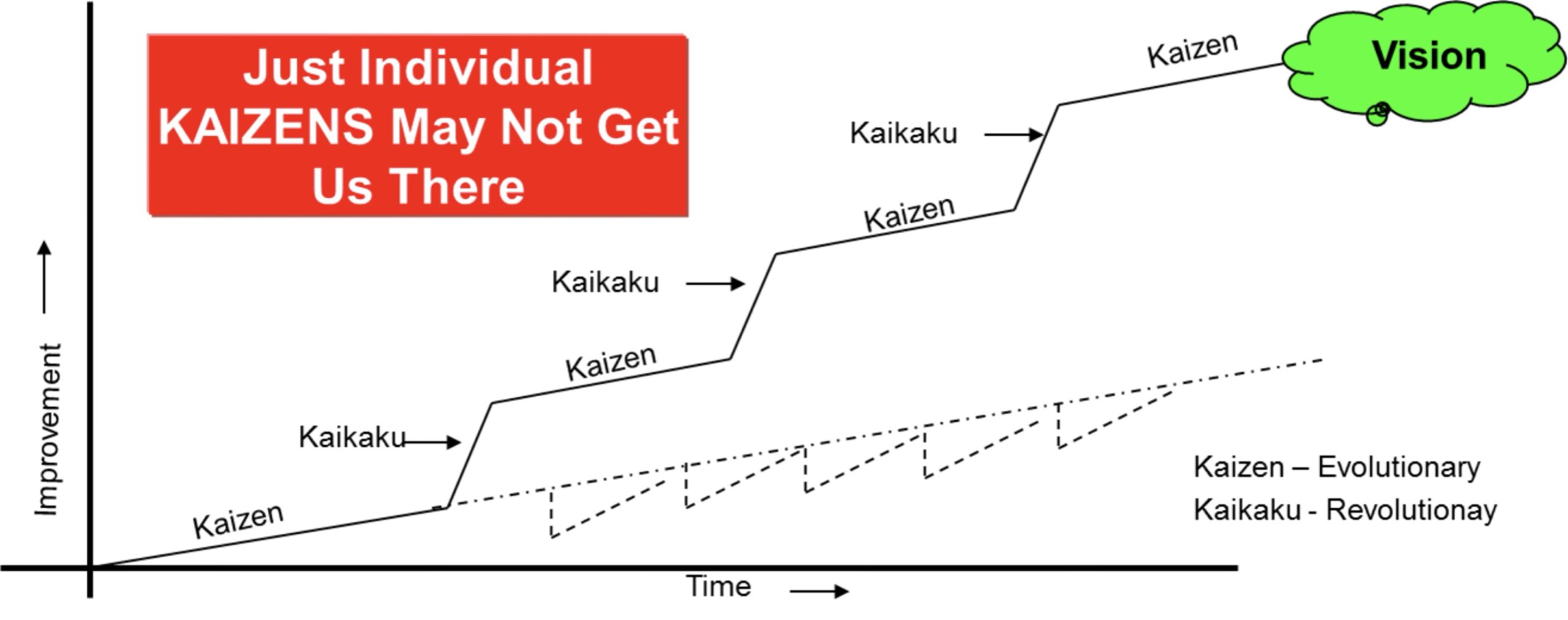
Kaikaku represents radical or transformational change. It becomes necessary when improving the existing system is no longer enough because the assumptions on which that system was built have ceased to be valid.
Kaizen asks:
How can we make this system work better?
Kaikaku asks:
Is this still the right system?
That distinction matters enormously as organizations respond to AI.
Many businesses are currently approaching artificial intelligence as a Kaizen opportunity. They are using it to write documents more quickly, summarize meetings, automate administrative tasks, improve customer support, assist software developers and reduce the time required to search for information.
These are legitimate improvements. Some will produce considerable value. But they largely preserve the existing organization.
The same departments remain. The same products remain. The same operating model remains. The same decision structures remain. AI is inserted into the existing system to make parts of it faster or less expensive. That is AI-enabled Kaizen.
The more difficult question is whether AI will eventually invalidate some of the assumptions upon which the existing organization was designed. When that happens, Kaizen will no longer be enough.
AI May Not Develop Gradually
The first major wave of generative AI was dominated by increasingly large foundation models trained on enormous quantities of publicly available information. This created systems with remarkable breadth. They could discuss almost any subject, generate text and images, write software, analyze documents and imitate many forms of human communication.
It was tempting to assume that the next stage would simply involve building larger versions of the same thing. However, the next wave may not be defined only by greater scale.
It is increasingly likely to include highly specialized models and systems built around proprietary, domain-specific knowledge. In engineering, manufacturing, medicine, science, finance and law, depth may ultimately matter more than breadth.
A general model may understand the published literature about a particular industry. It will not automatically possess decades of accumulated organizational experience, undocumented problem-solving knowledge, engineering decisions, customer insight, failure data or the practical knowledge held by experienced employees. That distinction creates an important strategic shift.
For many organizations, the most valuable AI asset may not be access to a publicly available model. Their competitors can purchase access to the same model. The real advantage may come from combining models with knowledge, data, processes and experience that competitors cannot obtain.
This changes how leaders should think about operational data and organizational knowledge. Information previously treated as a historical record may become training material. Technical documentation may become the foundation of an expert assistant. Decades of problem-solving experience may become a reusable organizational capability.
The organization’s history may become part of its future competitive advantage.
AI Is Leaving the Screen
A second discontinuity is also emerging. Artificial intelligence is beginning to leave the purely digital environment and enter the physical world.
Google DeepMind, for example, describes its Gemini Robotics systems as models designed to help robots perceive their surroundings, reason about physical space, plan tasks and take action. This is an important shift from AI that produces an answer to AI that can influence or manipulate the physical environment.
This is sometimes described as physical AI, embodied AI or embodied intelligence. The implications extend far beyond humanoid robots.
Manufacturing equipment, warehouses, vehicles, medical devices, agricultural machinery, construction equipment and distributed logistics systems can all become more capable of perceiving conditions, interpreting what they observe and adjusting their behavior. A conventional automation system follows predetermined instructions.
An increasingly intelligent physical system may interpret its environment, select between possible actions, recognize when an expected outcome has not occurred and modify what it does next. That is not merely a more efficient machine. It changes the boundary between software, equipment, workers and management.
Organizations that treat this only as an opportunity to automate a few existing tasks may miss the larger change.
The operating model itself may need to be reconsidered.
Exaptation: Discovering a New Purpose for an Existing Capability
There is another evolutionary concept that leaders should understand: exaptation.
Stephen Jay Gould and Elisabeth Vrba introduced the term to describe a feature that developed for one purpose, or without its current purpose, and was later co-opted for a different use.
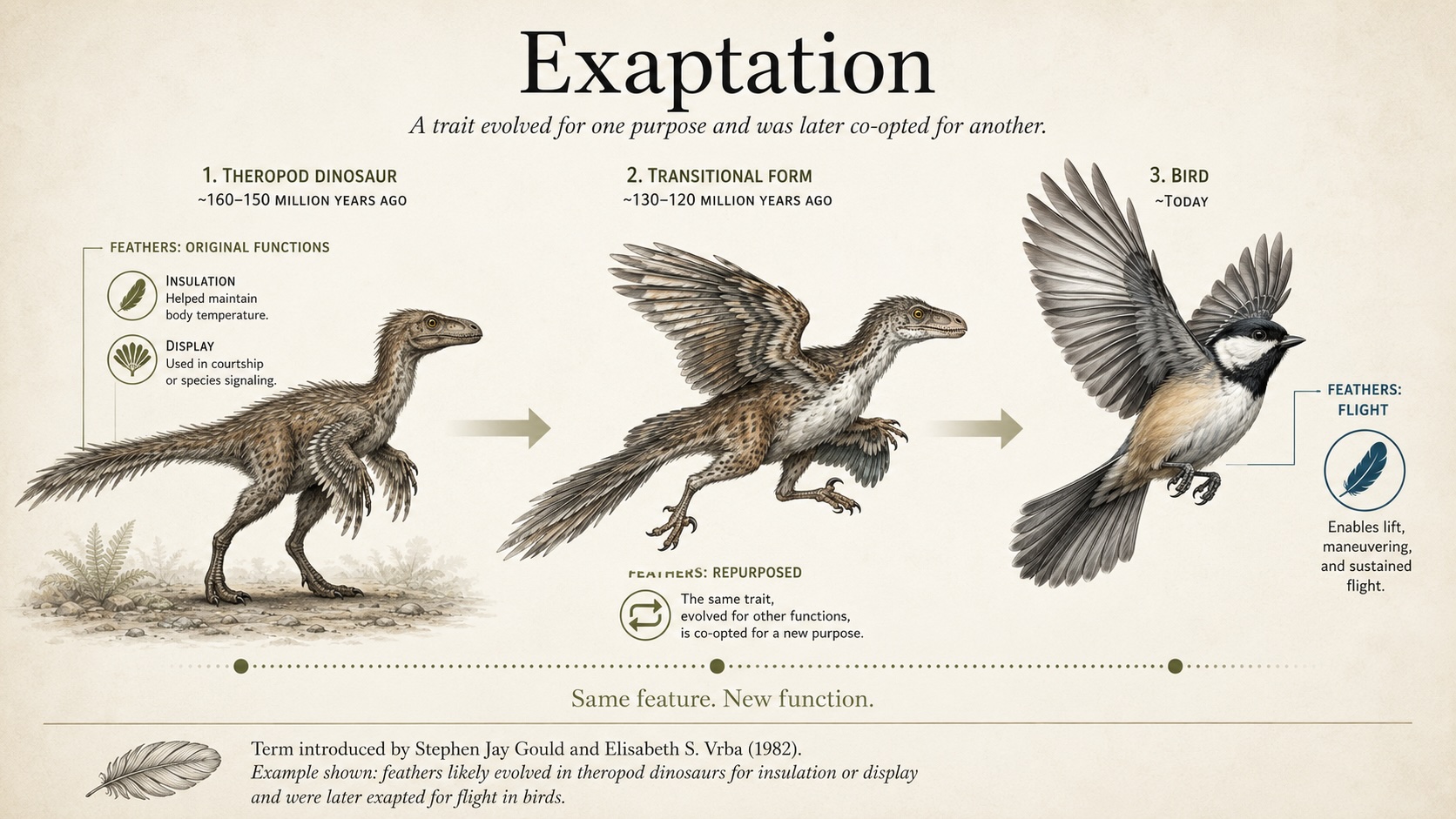
The concept has since proved useful beyond biology, particularly in understanding technological and organizational innovation.
A capability does not have to remain tied to the reason it was originally created. Technologies developed for one purpose are frequently repurposed for another. Organizational knowledge gathered to solve one problem can become the foundation of an entirely different capability.
The microwave oven provides a familiar technological analogy. The magnetron was developed and used in radar systems. The ability of microwave energy to heat food later became the basis of a completely different product category.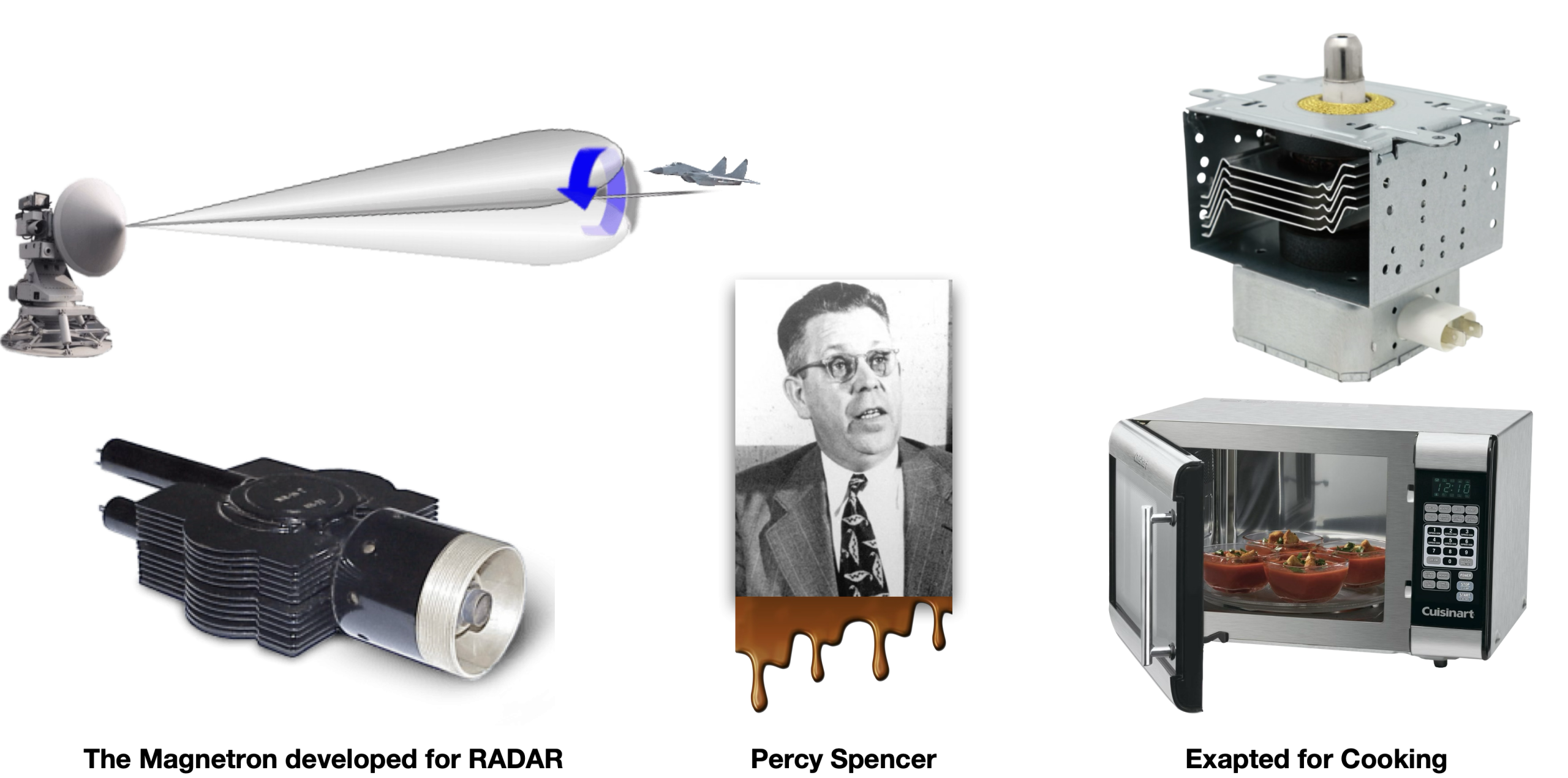
In 1945, the heating effect of a high-power microwave beam was accidentally discovered by Percy Spencer, an American self-taught engineer from Howland, Maine. Employed by Raytheon at the time, he noticed that microwaves from an active radar set he was working on started to melt a chocolate bar he had in his pocket. The first food deliberately cooked with Spencer’s microwave was popcorn, and the second was an egg, which exploded in the face of one of the experimenters.[10][11] To verify his finding, Spencer created a high density electromagnetic field by feeding microwave power from a magnetron into a metal box from which it had no way to escape. When food was placed in the box with the microwave energy, the temperature of the food rose rapidly. On 8 October 1945, Raytheon filed a United States patent application for Spencer’s microwave cooking process, and an oven that heated food using microwave energy from a magnetron was soon placed in a Boston restaurant for testing.
The original capability was not gradually improved into a better radar system. It was applied to an entirely new purpose. Organizations may possess similar opportunities without recognizing them.
For example:
- Operational data collected for quality control may become training data for a specialized AI system.
- A knowledge-management platform may become the foundation of an internal expert assistant.
- Maintenance records may support predictive services that can be sold to customers.
- A scheduling capability developed for internal operations may become a separate commercial product.
- Engineering simulations may become digital twins that support real-time operational decisions.
- Knowledge held by experienced employees may become an interactive training and decision-support system.
- A process created to serve one customer segment may solve a more valuable problem in another market.
These possibilities do not necessarily emerge from traditional strategic planning. They often appear when someone notices that an existing capability has become useful in a context for which it was never designed.
That is exaptation.
The Future First Appears as Weak Signals
Periods of genuine disruption create a difficult leadership problem.
By the time a change is obvious, the most valuable opportunities may already have been captured by others. Yet acting too early on every new technology, claim or prediction creates distraction, waste and strategic confusion.
Leaders therefore need more than forecasts. They need the ability to detect and interpret weak signals.
Weak signals may include:
- An unexpected use of an existing product.
- A customer behaving differently from established expectations.
- A new combination of technologies.
- A capability emerging in another industry.
- A repeated anomaly in operational data.
- Employees informally using AI to bypass an established process.
- A competitor solving the customer’s problem without using the traditional industry model.
- A new entrant appearing insignificant because it does not yet resemble a conventional competitor.
A weak signal is not proof of the future.
It is a fragment of information that may become significant when connected to other fragments.
The critical leadership capability is therefore sense-making: interpreting incomplete and sometimes contradictory evidence, challenging existing assumptions and deciding what the emerging pattern might mean.
This cannot be reduced to a dashboard.
Dashboards are usually designed to monitor the system leaders already understand. They report performance against categories, measures and assumptions established in the past.
Weak signals often appear outside those categories.
They may initially look like exceptions, noise, local workarounds or irrelevant experiments. In many organizations, the management system is designed to remove precisely this kind of variation rather than investigate what it might reveal.
Knowing Which Kind of Change Is Required
The strategic challenge is not choosing between continuous improvement and radical change as though one is always superior.
Both are necessary.
The challenge is knowing which situation you are confronting.
Kaizen is appropriate when the system remains fundamentally suited to its environment. The organization should improve flow, reduce waste, address variation, develop people and strengthen its ability to learn.
Kaikaku becomes necessary when the environment or the underlying technology changes so significantly that the current system is no longer adequate. Improving its individual components may simply optimize an increasingly obsolete model.
Exaptation becomes possible when an existing capability can be repurposed to create value in a new context. The opportunity may already exist inside the organization, but leaders must be capable of seeing it differently.
These forms of change can also reinforce one another.
Kaizen builds knowledge and exposes problems. That knowledge may reveal the need for Kaikaku. Capabilities developed through years of Kaizen may then be exapted into entirely new products, services or operating models.
Continuous improvement is therefore not the opposite of radical innovation. Done properly, it develops the knowledge from which more radical possibilities can emerge.
The danger arises when Kaizen becomes an ideological commitment to incrementalism, when leaders continue improving the current system because questioning the system itself is considered too disruptive.
The Leadership Risk in an AI Punctuation Point
AI may represent one of those moments when several developments converge:
- General models continue becoming more capable.
- Specialized models gain access to proprietary knowledge.
- Agents begin coordinating sequences of work.
- AI becomes embedded in physical systems.
- Organizational data becomes a strategic asset.
- Interfaces between people, software and machines are redesigned.
- Activities previously requiring a conventional organization can be performed through entirely different structures.
No single development guarantees a revolution. Together, however, they may create a punctuation point: a comparatively brief period in which established assumptions become unstable and new organizational forms emerge unusually quickly.
The greatest risk during such a period is not simply failing to adopt the latest AI tool. It is using AI to perfect yesterday’s operating model.
An organization may become more efficient while becoming less relevant. It may automate existing work without asking why that work exists. It may reduce the cost of processes that customers no longer value. It may use advanced technology to preserve structures created for a previous environment.
This is why the conversation about AI must move beyond productivity.
Leaders need to ask:
- Which assumptions underlying our organization are becoming less reliable?
- What proprietary knowledge do we possess that could become an AI-enabled capability?
- What are customers beginning to do differently?
- Which existing processes might disappear rather than merely become faster?
- What capabilities could be repurposed for uses we never originally intended?
- Where are weak signals appearing that our formal reporting systems do not capture?
- Which problems require Kaizen, and which now require Kaikaku?
The answers will not come from technology teams alone. They require the combined knowledge of people who understand customers, operations, engineering, organizational design, technology and the realities of how work is actually performed.
Do Not Improve the Wrong System
Continuous improvement remains essential. Organizations should never stop learning, experimenting or developing the capability of their people. But improvement is not automatically progress.
A system can become increasingly efficient while the environment moves away from it. A process can meet every internal target while becoming irrelevant to the customer. An organization can become exceptionally good at performing work that no longer needs to be performed.
Punctuated equilibrium reminds us that long periods of apparent stability do not guarantee continued stability.
Kaizen teaches us how to improve.
Kaikaku reminds us that sometimes the system itself must change.
Exaptation helps us recognize that the capabilities required for the future may already exist, although they may have been created for an entirely different purpose.
The leadership task is to understand which is required—and when.
In turbulent times, the greatest risk is not failing to improve.
It is continuing to improve a system whose environment has already changed.
For more information in how I can help your leadership journey schedule time here – Contact