The Toyota Production System (TPS): What the House Actually Represents
Click the image to enlarge and right click to save it.
There is no shortage of Toyota Production System diagrams online. Many are visually polished. Some are attractively designed. A growing number appear to have been created through artificial intelligence, assembled from scraped terminology, familiar Lean language and whatever structure the prompt happened to produce.
The problem is not that these diagrams look modern. The problem is that many are inaccurate.
They rearrange concepts, confuse principles with tools, omit essential relationships and often present the Toyota Production System as little more than a collection of techniques. The result may look authoritative while revealing very little understanding of how Toyota itself describes and applies the system.
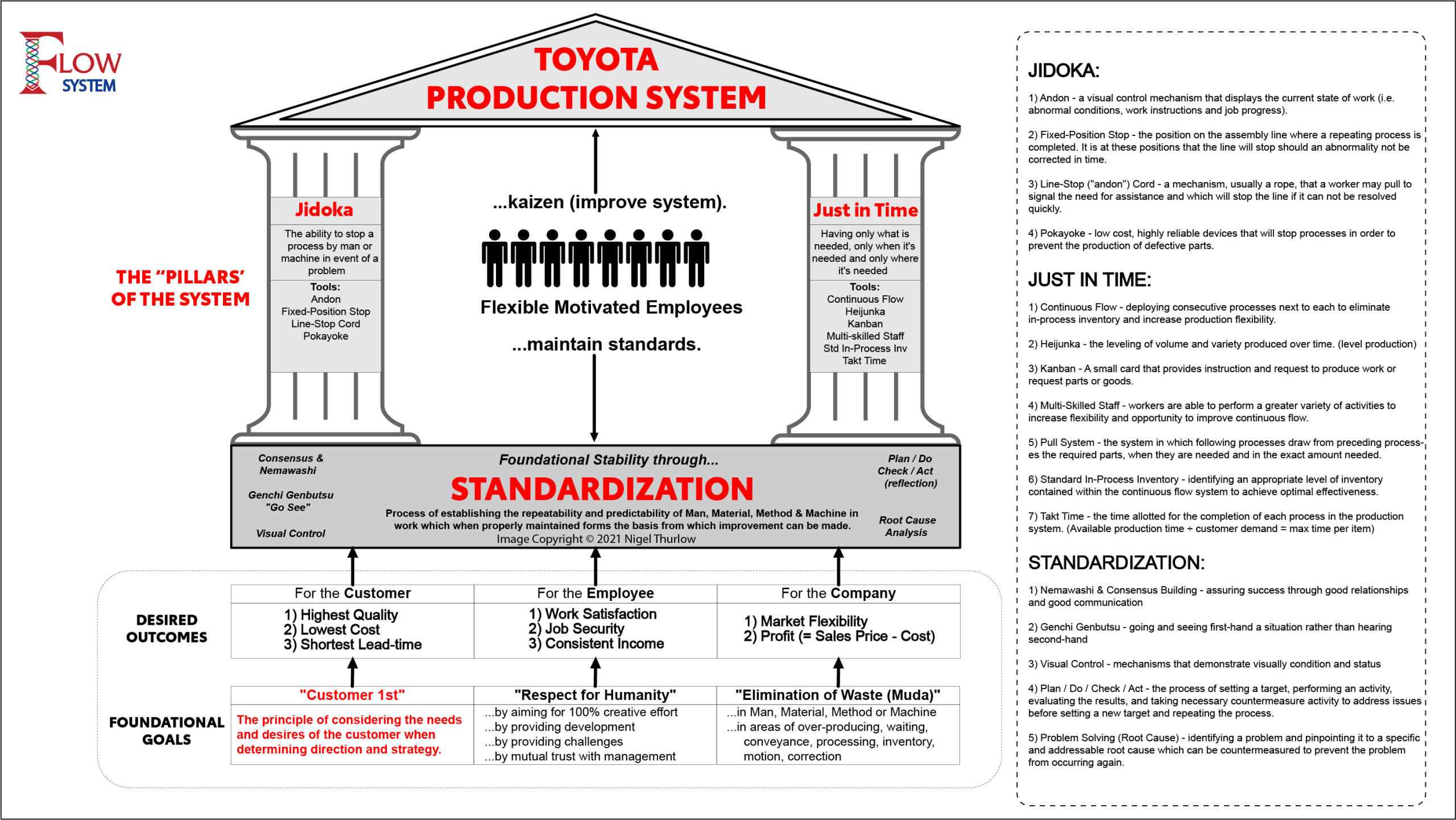
The visual shown here is rather different. It is an orginal Toyota document.
This Toyota Production System model was created within Toyota Motor Europe (TME). I know because I was there, and I have the original source file. It was initially produced in Microsoft Visio and has since been carefully recreated by me in Adobe Illustrator.
That does not mean it is the only Toyota Production System diagram used anywhere in Toyota. Across regions, functions, plants and periods of time, the precise illustrations and terminology may vary. TPS has never been taught through one universally mandated poster.
However, this visual contains the essential concepts and relationships taught and practised by Toyota, the company that created the system.
The Two Pillars of the Toyota Production System
At its heart, the Toyota Production System (TPS) has two key pillars: Jidoka and Just-in-Time. Sakichi Toyoda, founder of the Toyota Group, was a Japanese inventor whose work on automatic looms established the origins of Jidoka. His looms were designed not merely to operate automatically, but to detect abnormalities—such as a broken thread—and stop immediately rather than continue producing defective cloth. This ability to distinguish normal from abnormal, stop the process and free people from simply watching machines became known at Toyota as “automation with a human touch” and later formed one of the two pillars of the Toyota Production System. Source: Toyota
The Toyota Production System was developed by Eiji Toyoda, the cousin of Kiichiro Toyoda who founded The Toyota motor Corporation, and Taiichi Ohno, a vice president and career employee. Underpinning the pillars of Jidoka and Just-in-Time, are three key principles: Customer 1st, respect for humanity, and the elimination of waste.
Sakichi Toyoda instilled in Toyota the concept that we must in invest machines with a humanlike intelligence. Only if machines have intelligent functions—jidoka—can we really get them to do useful work for us; otherwise, we end up serving the machines. (The Flow System Playbook, 2023, p. 32)
Jidoka
Jidoka is the ability to stop a process when an abnormality occurs.
Jidoka literally translates to automation, but Toyota changed the kanji ever so slightly to add the human and a bad English translation emerged, autonomation, or automation with a human touch.
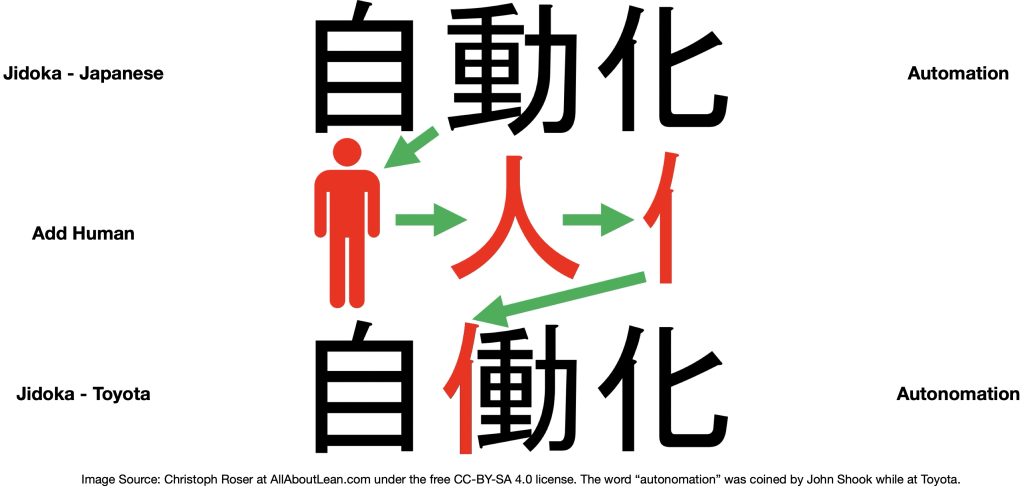
The purpose of Jidoka is to prevent defects, errors and abnormal conditions from continuing unnoticed through the process. Rather than allowing production to proceed while problems are hidden or passed downstream, Jidoka makes the abnormality visible and creates the opportunity for intervention.
Ohno decided to develop a system of multi-machine handling, where each employee would be responsible for operating more than one machine. He also devised a mechanism whereby machine tools in the machine shop would automatically stop in the event of trouble and also at the end of the machining process… Ohno got part of the idea for this system from the device Sakichi Toyoda, the founder of the original company, had invented many years earlier where a loom would stop automatically when a thread broke. By 1949, the multi-machine handling system had developed considerably, and productivity improved as a result. (Toyota, Our First 50 Years, 1988, p. 142)
The visual identifies several mechanisms associated with Jidoka:
- Andon
- Fixed-position stop
- Line-stop cord
- Poka-yoke
These are not isolated tools. They support a broader management principle: abnormalities should be detected, made visible and addressed as close as possible to the point at which they occur.
It is also significant that Jidoka appears on the left of this English-language version of the house.
In some copied diagrams, Jidoka appears on the right because the designer has reproduced the layout of a Japanese document without accounting for the different direction in which the information is read. Jidoka historically predates Just in Time and occupies the first pillar position in this version for a reason.
That may appear to be a small detail, but accuracy matters when explaining the history and structure of TPS.
ANDON
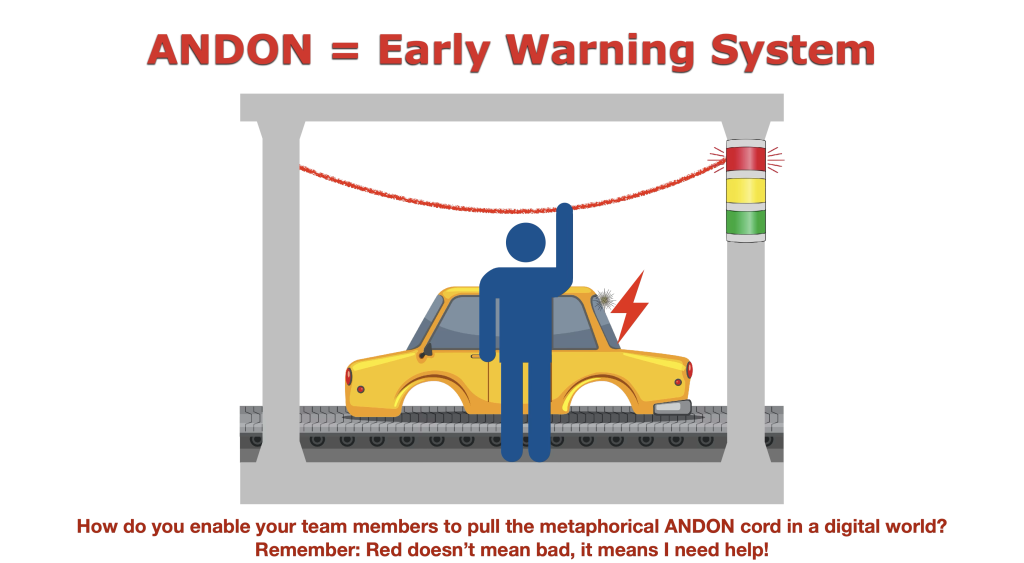
The one tool that gets much attention online is andon. It is also the most misused word. It is NOT a cord, it is a display. Andon literally translates to “lantern”. It is a display or a light.
In 1950, an andon (literally lantern) board was used for the first time. The board displayed various code numbers and letters to inform floor employees of how line operations were proceeding and when and where problems occurred. Also, cords were suspended above the production line that could be pulled to stop the line if complications arose. The combination of these and other innovations was called Jidoka. Jidoka gradually resulted in the building in quality into each process. (Toyota, Our First 50 Years, 1988, p. 144)
The line stop cord, as it is correctly called, is also colloquially known as the “andon cord” and is a “visual signal”. You now see why the list shows both andon and line-stop cord separately. They are different things, a cord to stop the line and a visual signal. Conflating them shows a lack of understanding.
Fixed-position stop
A fixed-position stop is a defined point on an assembly line at which the line will stop if an abnormality has not been resolved.
When an operator identifies a problem (Toyota use the term “discrepancy from standard”), they activate the andon signal (line stop cord) and request assistance, visually and audibly (andon). The line does not necessarily stop immediately. Instead, the team leader has a limited amount of time to reach the operator, understand the issue and either correct it or decide that the process cannot safely continue.
If the problem remains unresolved when the product reaches the designated stop position, the line stops automatically.
This is important because it balances two needs:
- maintaining production flow where a problem can be resolved quickly;
- preventing a known abnormality from being passed to the next process.
The fixed-position stop is therefore not simply a mechanical stopping point. It is part of a management system that makes abnormalities visible, creates an immediate response and protects quality at the source.
For it to work properly, the organization must provide rapid support. An andon signal that is ignored, delayed or treated as an inconvenience quickly teaches employees not to use it.
Poka-Yoke
Poka-yoke refers to simple, reliable methods used to prevent errors or detect them before they become defects. Usually translated as “mistake-proofing”.
The objective is not to make people incapable of thinking or to assume that employees are careless. It is to design the process so that predictable human mistakes are either impossible to make or immediately obvious.
A poka-yoke may:
- prevent a component from being installed in the wrong orientation;
- stop a machine if a part is missing;
- confirm that the correct number of fasteners has been fitted;
- prevent the wrong tool or setting from being used;
- detect an incomplete operation before the product moves forward.
The best poka-yoke devices are usually simple, inexpensive and located close to the point where the error could occur.
They should prevent the mistake where possible. Where prevention is not practical, they should detect it immediately and trigger a response.
Poka-yoke supports Jidoka by building abnormality detection into the process itself. Rather than relying solely on final inspection, it helps ensure that defects are not created or passed downstream in the first place.
Just in Time
Just in Time means producing only what is needed, when it is needed and in the amount needed.
Kiichiro Toyoda was the son of Sakichi Toyoda, the founder of the original Toyota company, and it was Kiichiro that took Toyota into automobile production. Kiichiro was challenged with adapting Henry Ford’s conveyor system (modern technology in the 1930s) to meet the harsh realities of the Japanese market (limited supplies and resources). To meet this challenge, Kiichiro developed the concept of just-in-time.
It is intended to create flow, reduce unnecessary inventory, expose delays and connect production more closely to actual demand.
With the introduction of multi-machine and multi-process handling of jidoka, Toyota faced the problem of what is known as in-process inventory, a buildup of parts waiting to be processed by the next step in the process, or the next machine. This required another innovation to enable a true Just-in-Time system to be successful. (The Flow System Playbook, 2023, p. 33)
The visual associates Just in Time with:
- Continuous flow
- Heijunka
- Kanban
- Multi-skilled employees
- Standard in-process inventory
- Takt time
Again, these should not be understood as an independent Lean toolkit.
Kanban, for example, is an important mechanism within the system, but it operates within a much broader set of conditions. It depends upon stable processes, clear standards, reliable problem solving and disciplined control of flow.
TPS cannot be reduced to the presence of Kanban cards, just as Just in Time cannot be reduced to cutting inventory.
Kanban is a way to achieve just-in-time; its purpose is just-in-time. Kanban, in essence, becomes the autonomic nerve of the production line. Based on this, production workers start work by themselves, and make their own decisions concerning overtime. The Kanban system also makes clear what must be done by managers and supervisors. This unquestionably promotes improvement in both work and equipment. (Ohno, Toyota production system: Beyond large-scale production 1988, p. 29)
For a deep dive into Lean Measures and Metrics including Takt Time see this article I wrote to clear the fog or online nonsense. All About Lean Metrics
A note on Kanban
Many Agile implementations of Kanban methods have been derived from this just-in-time system that utilizes Kanban. However, many fail to adhere to the basic rules that were defi ned by Toyota. As a result, they become little more than a visualization of status more akin to andon than Kanban.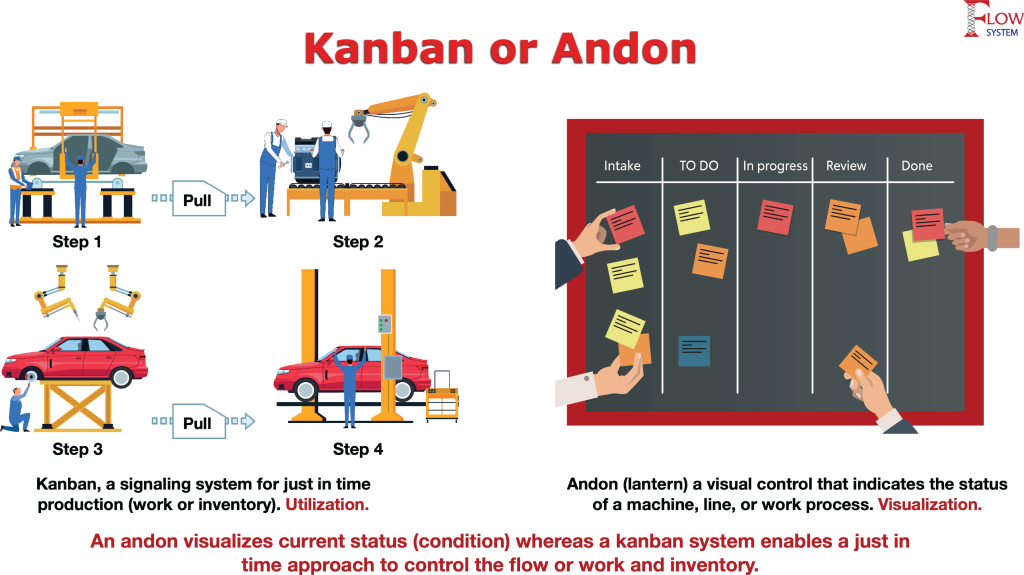
Kanban best represents “any small sign displayed in front of a worker” (Kanban: Just-in-time at Toyota (D. J. Lu, Trans.; Revised ed. 1989 p27) whereas andon is simply a lamp. Kanban is one tool that helps make just-in-time work while providing workers with the freedom to schedule their work with the autonomy to make decisions.
Kanban is a way to achieve just-in-time; its purpose is just-in-time. Kanban, in essence, becomes the autonomic nerve of the production line. Based on this, production workers start work by themselves, and make their own decisions concerning overtime. The Kanban system also makes clear what must be done by managers and supervisors. This unquestionably promotes improvement in both work and equipment. (Ohno, Toyota production system: Beyond large-scale production 1988, p. 29)
Kanban, along with how it fits into the just-in-time process and some of the different types of kanban, is described best by Ohno (1988) in the following:
A Kanban (‘tag’) is a tool for managing and assuring just-in-time production, the first pillar of the Toyota Production System. Basically, a Kanban is a simple and direct form of communication always located at the point where it is needed. In most cases, a Kanban is a small piece of paper inserted in a rectangular vinyl envelope. On this piece of paper is written how many of what part to pick or which parts to assemble.
In the just-in-time method, a later process goes to an earlier process to withdraw needed goods, when and in the quantity needed. The earlier process then produces the quantity withdrawn. In this case, when the later process goes to the earlier process to pick up, they are connected by the withdrawal or transport information, called withdrawal Kanban and transport Kanban, respectively. This is an important role of Kanban.
Another role is the in-process, or production ordering Kanban, which tells the operator to produce the quantity withdrawn from the earlier process. These two Kanban work as one, circulating between the processes within the Toyota Motor Company, between the company and its affiliates, and also between the processes in each affiliate. In addition, there is the signal Kanban used in the stamping process, for instance, where production of a specific quantity, perhaps more than required by just-in-time, cannot be avoided. (pp. 123-124)
Before you implement Kanban in software start by asking yourself “can we actually use a pull system”? If you are assigning work upstream you are in a push system.
The Foundation Is Standardization
The two pillars rest upon a foundation of standardization. This is one of the most frequently misunderstood elements of the Toyota Production System.
The visual defines standardization as establishing the repeatability and predictability of people, materials, methods and machines.
Standards do not exist to prevent thought, restrict people or freeze the process permanently. They establish the known basis from which work can be performed, abnormalities can be recognized and improvements can be evaluated.
Without a standard, there is no reliable reference point.
- You cannot meaningfully distinguish normal from abnormal.
- You cannot understand whether variation is caused by the process, the method, the material or the equipment.
- You cannot determine whether a proposed change has genuinely improved performance.
- And you cannot sustain an improvement once it has been made.
A standard is therefore not the opposite of kaizen. It is what makes kaizen possible.
Improvement requires a baseline. Once the process has been improved, the standard must be updated so the new method becomes the basis for further learning.
This creates the essential relationship shown in the center of the house. Maintain standards. Improve the system. The two activities are inseparable.
Flexible, Motivated Employees at the Center
At the center of the Toyota Production System are flexible, motivated employees.
They are not shown as passive operators who merely follow instructions. They are active participants in maintaining and improving the system.
Employees:
- Perform work according to agreed standards
- Recognize abnormalities
- Make problems visible
- Support the process when difficulties arise
- Participate in problem solving
- Improve the system through kaizen
- Develop the flexibility to perform a wider range of work
This is why TPS cannot be understood as a purely technical production system. It is a socio-technical management system.
The technical elements of flow, Kanban, takt time, standardized work, visual control and poka-yoke, depend upon the behavior, capability and judgment of the people operating the system.
People cannot succeed simply through motivation or good intentions. They require well-designed processes, clear standards, effective support and the authority to respond when something is wrong.
The social and technical elements must work together.
The Management Practices Supporting the Foundation
The standardization foundation also includes several important management practices.
Consensus and Nemawashi
Nemawashi is the process of building understanding, relationships and support before a significant decision is formally made.
It is sometimes mistaken for slow decision-making or an attempt to achieve universal agreement. In practice, it helps ensure that relevant perspectives have been considered and that the people responsible for implementation understand the issue and the direction being proposed.
Genchi Genbutsu
Genchi genbutsu means going to see the actual situation firsthand. It translates as “actual place, actual thing”.
Problems should not be managed entirely through reports, presentations and secondhand explanations. Leaders and problem solvers need to observe the work, understand the conditions and speak with the people closest to the process.
Visual Control (Mieruka (見える化)
Visual controls make the condition of the process immediately apparent.
A good visual control allows people to distinguish normal from abnormal without requiring a lengthy explanation or a detailed search through data.
Mieruka (見える化) means “making visible” or “visualization.” Within the Toyota Production System, it refers to making the current condition of work immediately understandable so that normal and abnormal conditions can be distinguished at a glance. This may include andon lights, production-status boards, floor markings, standard-work displays and clearly defined locations for materials. Mieruka is more than simply displaying information: the visual signal must help people recognize a problem, understand its significance and take appropriate action. It therefore supports Jidoka by ensuring that abnormalities cannot remain hidden.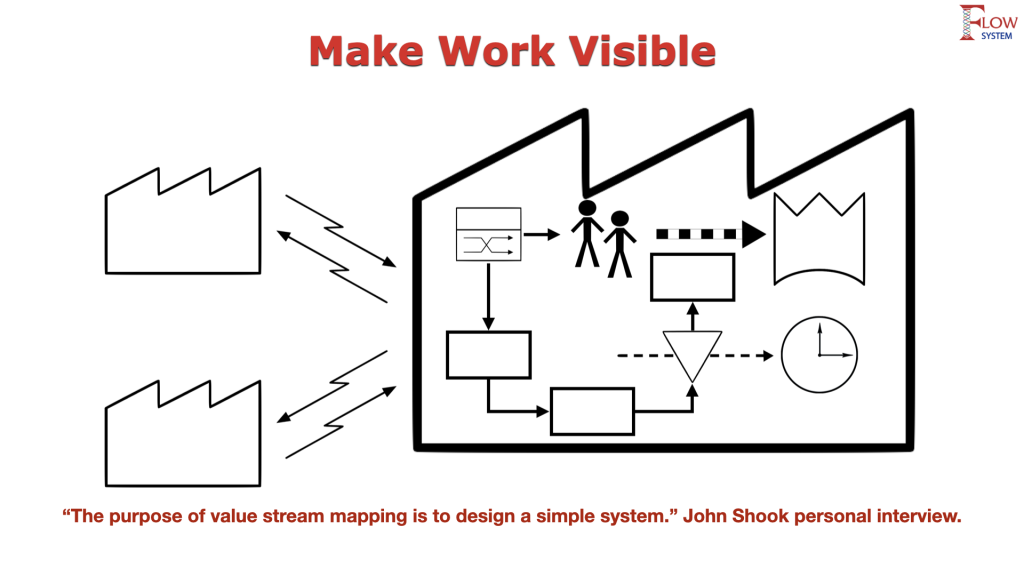
Plan, Do, Check, Act
PDCA provides a disciplined cycle for learning and improvement.
A change is planned, tested, evaluated and either standardized, adjusted or abandoned based upon what is learned.
Contrary to popular culture Edwards Deming did not created PDCA. That is the topic of a much longer discussion. PDCA emerged from the early days of SQC. Deming later defined PDSA (Plan, Do, Study, Adjust) in the book “Out of The Crisis” in 1982.
Reflection
Reflection is essential because improvement depends upon honest examination of what happened, what was expected and what should be done differently.
Root-Cause Analysis
Root-cause analysis seeks to move beyond symptoms and understand the conditions that allowed a problem to occur.
The objective is not simply to restore production as quickly as possible. It is to prevent recurrence by addressing the underlying causes within the system.
The Three Foundational Goals
Beneath the TPS house sit three foundational goals.
Customer First
Customer First means considering the needs and expectations of the customer when determining direction and strategy. This has underpinned everything Toyota has done since 1946.
Shotaro Kamiya was Toyota’s pioneering sales leader and the first president of Toyota Motor Sales Co., Ltd. In May 1946, he publicly declared that “the primary focus of an automobile manufacturer must always be the customer”. His philosophy helped establish “Customer First” as a foundational Toyota principle, emphasizing that the customer’s interests must come before those of the dealer and the manufacturer.
This does not mean giving customers everything they request without question. It means understanding what creates genuine value for them and aligning the system around quality, delivery, reliability and appropriate cost.
Respect for Humanity
The diagram uses the term Respect for Humanity.
The more familiar phrase Respect for People became prominent through the Toyota Way in 2001, but the underlying idea existed long before the publication of that document.
Respect is not simply politeness, inclusion or employee engagement.
Within TPS, respect is demonstrated through the design and management of the work.
It means:
- Providing people with clear standards
- Giving them the opportunity to succeed
- Developing their capability
- Responding when they identify an abnormality
- Avoiding systems that waste their time or effort
- Creating meaningful work
- Building trust between employees and management
- Providing challenge and the opportunity to contribute creatively
A system that continually creates frustration, hides problems or treats people as interchangeable labor cannot credibly claim to practice Respect for People.
Elimination of Waste
The third foundational goal is the elimination of waste, or muda. Muda simply means senseless or meaningless activity that we describe as “anything non-value-adding”.
The visual identifies waste across people, materials, methods and machines, including:
- Overproduction
- Waiting
- Transportation/Conveyance
- Over-Processing
- Excess Inventory
- Motion
- Correction/Defects
I don’t know who came up with it but people often talk about ‘the seven types of waste.’ This might have started when the book came out [Ohno is referring to the book ‘Toyota Production System, Beyond Large-Scale Production’], but waste is not limited to seven types. There’s an old expression: ‘He without bad habits has seven,’ meaning even if you think there’s no waste you will find at least seven types. So, I came up with overproduction, waiting, etc., but that doesn’t mean there are only seven types. So don’t bother thinking about ‘what type of waste is this?’ Just get on with it and do kaizen. (Ohno, 2013, Workplace Management (Special 100th Birthday Edition ed.) p. 175, emphasis in original)
The seven wastes have since grown to an accepted eight (unused employee creativity or similar variations). Although in Toyota, the 8th is not mentioned, perhaps as the principles of respect for humanity and respect for people (see The Toyota Way) address this need. Note: Among many TPS senseis in Japan, there’s a general disagreement with the idea of reducing the importance of “respect for people” by including it as an addition to the 7 wastes of production. Respect for people is considered more important and more foundational than that. Th e 7 wastes were named just as a contrivance to help teams identify and eliminate waste (at its source) through their eff orts to do Kaizen. It’s therefore seen by these same senseis as a disrespect to the notion of respect to make it simply an 8th waste. (The Flow System Playbook, 2023, p. 40-41)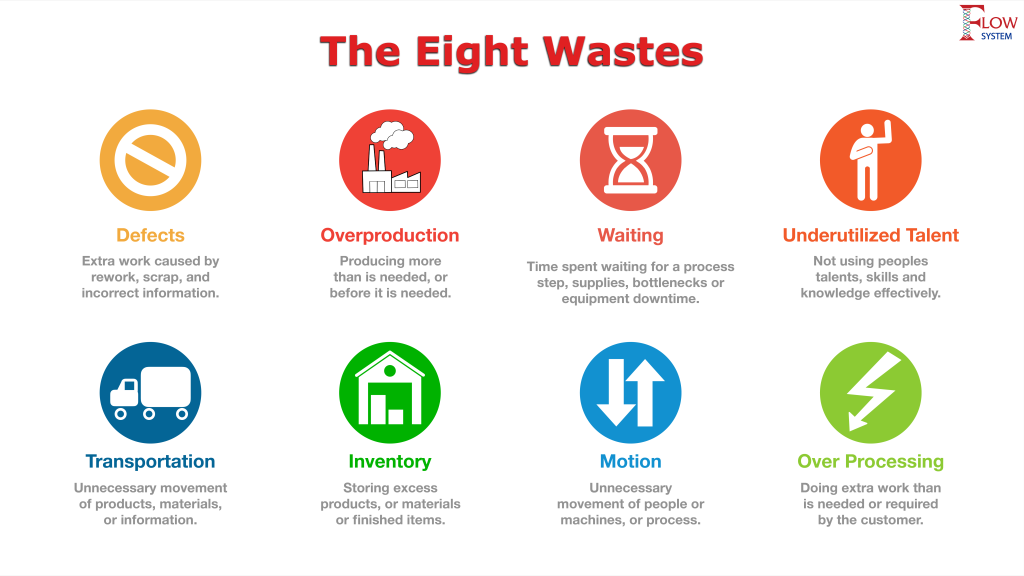 Waste elimination is not simply a cost-reduction exercise. Waste consumes capacity, extends lead times, conceals problems, creates frustration and prevents resources from being used to create value. The purpose is not to force people to work harder. It is to design the system so that unnecessary work is removed and value can flow more effectively.
Waste is best defined as the “factors that don’t add value and only serve to increase production costs” (Yamada, 2011, p. 58).
Balanced Outcomes for Customers, Employees and the Company
One of the most important features of TPS is the balance of its intended outcomes. TPS is not presented as a system designed solely to increase profit or output. The desired outcomes are divided among three groups.
For the Customer
- Highest quality
- Lowest cost
- Shortest lead time
These outcomes describe the system from the customer’s perspective. Customers want reliable products and services, delivered when needed, at a competitive cost.
For the Employee
- Work satisfaction
- Job security
- Consistent income
These outcomes matter because the system depends upon capable, experienced and engaged employees.
A production system that achieves short-term financial results by creating insecurity, instability and constant disruption is unlikely to build the knowledge and trust required for long-term improvement.
For the Company
- Market flexibility
- Sustainable profit
The company must be capable of responding to changes in demand, product mix and market conditions. It must also remain profitable.
Profit, however, is shown as an outcome of the system rather than its only purpose.
The model even expresses profit in operational terms:
Profit = Sales price − Cost
The company does not control the market price indefinitely. It must therefore improve the system, reduce waste and create greater value rather than relying solely upon higher prices.
TPS Is an Interconnected System
The Toyota Production System is often presented as a collection of tools: Kanban. Andon. Poka-yoke. Standardized work. Heijunka. Value-stream mapping. Five whys etc.
But the individual mechanisms are not TPS. Their value comes from the way they interact.
- Jidoka exposes abnormalities.
- Standards define normal conditions.
- Visual controls make those conditions visible.
- Employees respond to the abnormality.
- Problem solving investigates the cause.
- Kaizen improves the process.
- The improved method becomes the new standard.
- Just in Time connects processes and exposes problems in flow.
- Management provides the stability, support and capability necessary for the cycle to continue.
Remove these relationships and the tools become little more than disconnected techniques.
That is why copying selected practices rarely reproduces Toyota’s results.
Organizations introduce Kanban without process stability, flow without quality at the source, standard work without employee involvement, andon without meaningful management response, or kaizen without the discipline to maintain improvements. They adopt the visible mechanisms while missing the management system that makes them work.
More Than Kanban, but Kanban Remains Central
TPS is not just Kanban. However, Kanban remains one of the central mechanisms through which the system regulates production and connects processes. It communicates what is needed, in what quantity and when replenishment should occur. It helps establish a pull system in which downstream consumption signals the need for upstream production.
But Kanban cannot compensate for unstable processes, poor quality, unreliable equipment or unclear standards. It works because it operates inside a wider system designed to expose and address those problems.
Kanban may be the beating heart of TPS, but a heart cannot function independently of the rest of the body.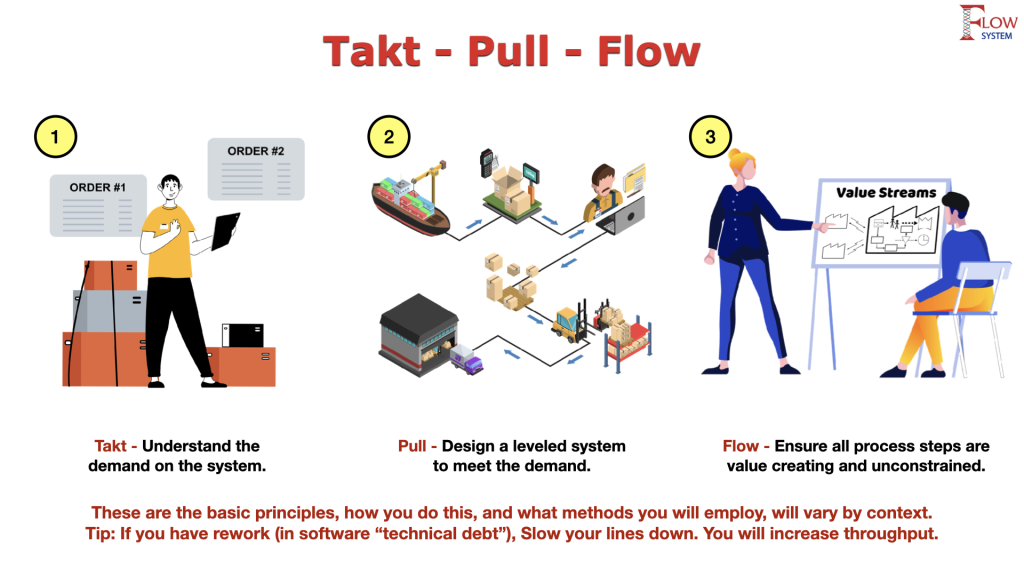
What The TPS Visual Helps Us Understand
This Toyota Production System visual is valuable because it shows relationships rather than merely listing terminology.
It shows that:
- Jidoka and Just in Time require a stable foundation.
- Standardization and kaizen depend upon one another.
- People are central to the operation and improvement of the system.
- Management practices such as genchi genbutsu, nemawashi, PDCA and root-cause analysis support the foundation.
- Customer value, employee wellbeing and company performance must be considered together.
- Waste elimination is part of a broader management philosophy, not simply a cost-cutting program.
- Sustainable performance emerges from the interaction of all these elements.
The Toyota Production System is therefore not a colorful house diagram, a Lean toolbox or a set of fashionable management terms.
It is an interconnected socio-technical management system designed to develop people, expose problems, maintain standards, improve flow and create value.
Before explaining Toyota’s system, it is worth taking the time to understand what Toyota actually teaches—and why each element exists.
Get in touch if you’d like to explore these concepts further Contact