The skills that sit between completing a template and preventing recurrence.
I recently delivered my updated A3 problem solving class. The feedback from participants was excellent, but the experience also reinforced something I have seen repeatedly: knowing the steps of A3 problem solving does not mean you can apply them effectively.
People can have Lean or Six Sigma qualifications, have attended A3 problem solving training, and still struggle to define a problem clearly. They can produce an impressive report while skipping the investigation needed to understand where an abnormality arises, what directly causes it, and what must change to prevent it from happening again.
My training and experience inside Toyota gave me a depth of understanding that I bring directly into my teaching. That depth becomes particularly apparent when we work through problem definition, problem breakdown, point-of-cause investigation, and the evidence required to establish causal relationships.
These are precisely the areas that much of the training I encounter treats too lightly.
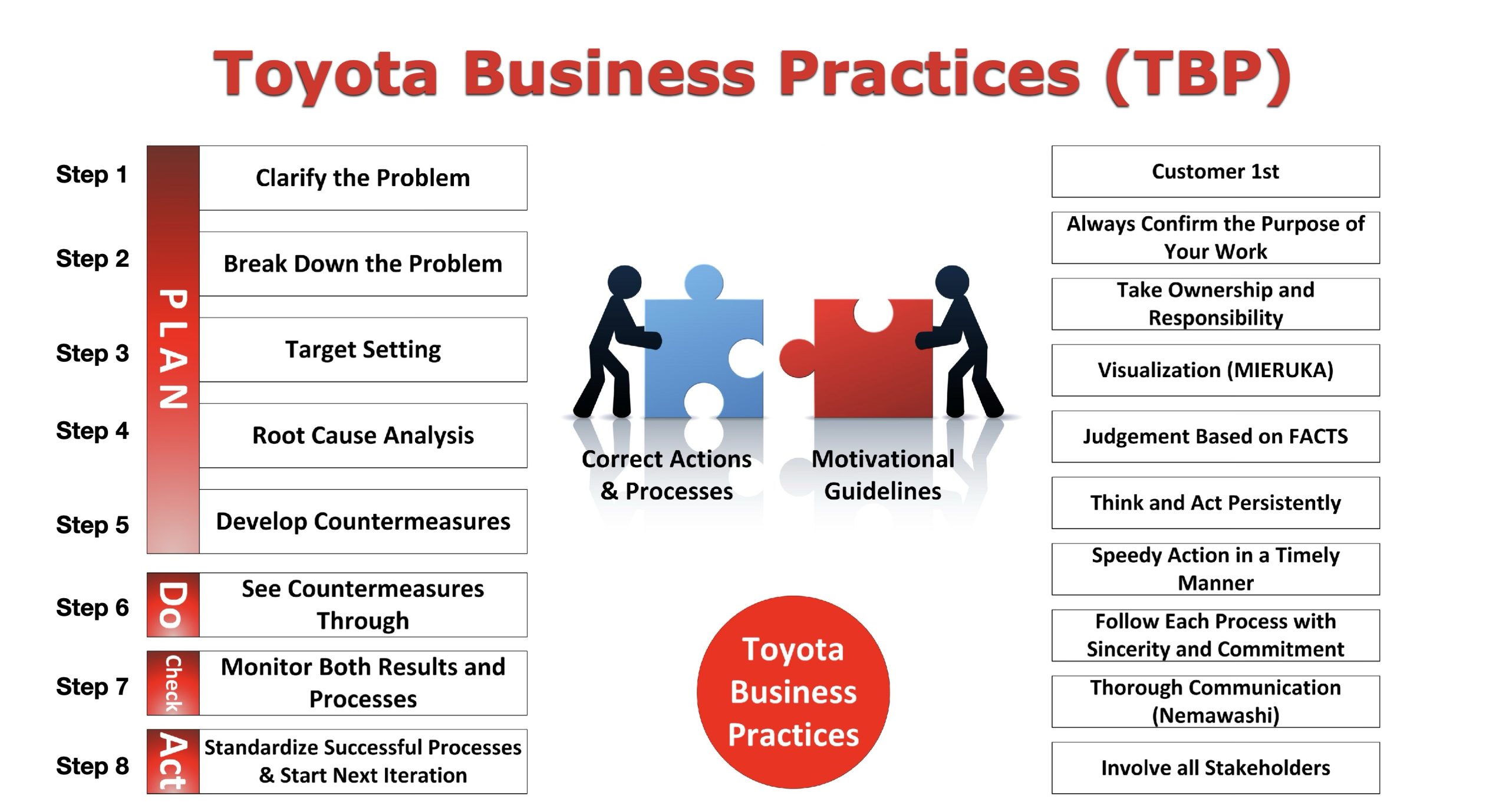
This discipline sits within the broader Toyota Production System, where standards make abnormalities visible and problem solving develops people’s capability.
Key Leadership Takeaways
- Ask for a quantified gap before an action plan. What should happen, what actually happens, and why does the difference matter?
- Require investigation where the abnormality occurs. Naming a machine, department, or team narrows the search. People must examine the actual process step and conditions producing the failure.
- Ask “How do we know?” Fishbone diagrams and Five Whys organize thinking. Observation, measurement, and testing establish whether the proposed causes explain the problem.
- Distinguish restoring performance from preventing recurrence. Cleaning the screen gets the machine working again. It does not address why the screen keeps becoming blocked.
- Look beyond the individual failure. Correcting inaccurate documentation matters. Understanding why the update was missed helps prevent similar failures across other equipment and processes.
- Create room for rigorous problem solving. Allow people to say “we don’t know yet,” challenge assumptions, and investigate. Reward recurrence prevention alongside immediate recovery.
- Develop capability through coaching. A completed A3 does not demonstrate sound thinking. Ask people to explain their evidence, reasoning, unanswered questions, and how they will verify sustained improvement.
The leader’s responsibility is to develop the thinking and create the conditions that allow real problem solving to happen.
What Toyota taught me about problem solving
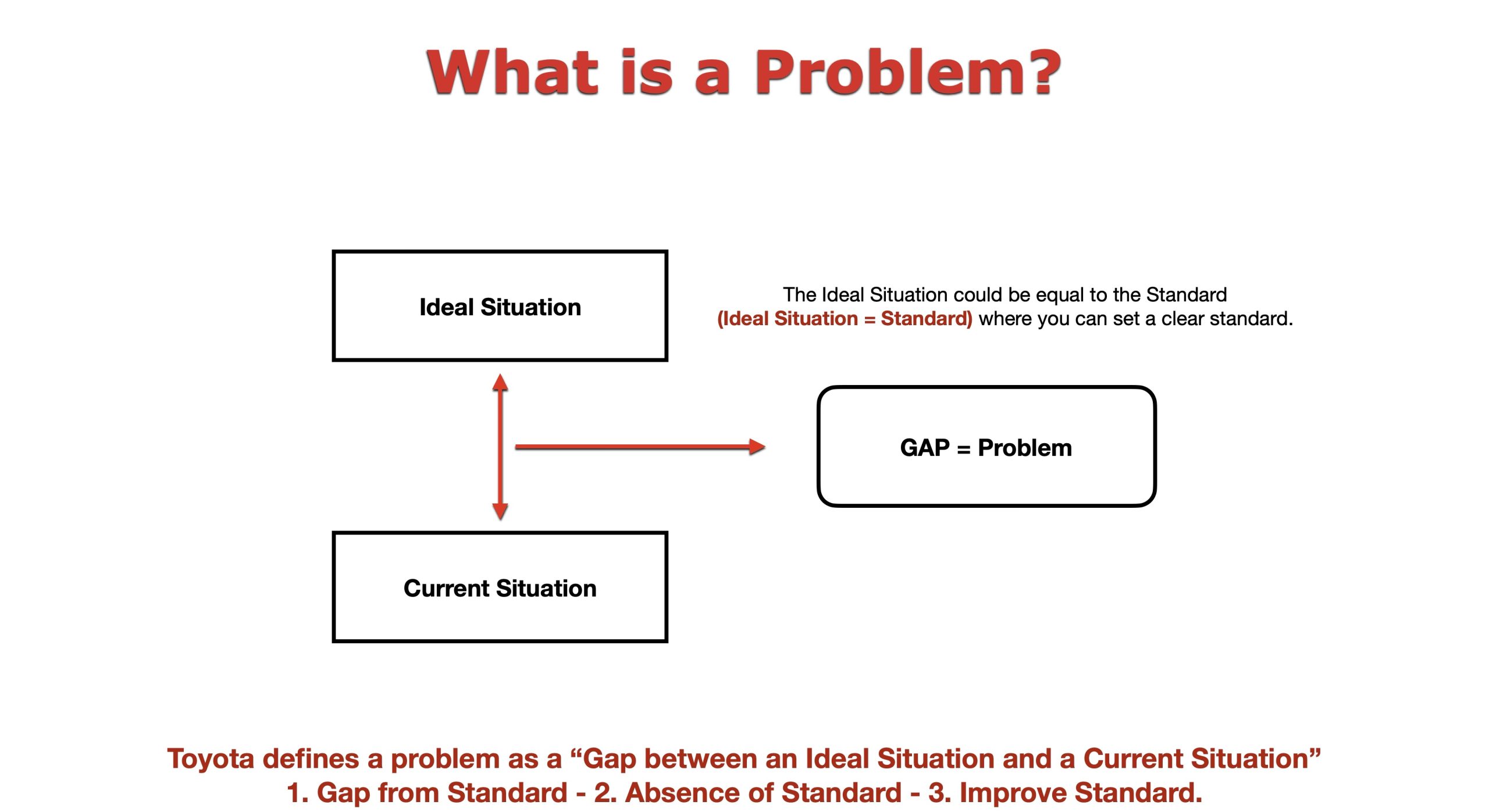
At Toyota, I learned how demanding good problem solving really is. You must understand the standard, grasp the actual situation, make the gap visible, break it down, and investigate the process closely enough to see where the abnormality arises.
You must also be able to explain how you know. What did you observe? What did you measure? What evidence supports the proposed cause? What remains an assumption?
That discipline shaped how I think, how I coach, and how I teach.
It also helps explain Toyota’s standing as a world leader in quality. The strength goes beyond knowing a collection of Lean tools. It comes from developing people who can investigate problems rigorously, supported by leaders who expect that rigor and make room for it.
Many companies want the results without developing the capability or creating the conditions that produce them.
They want a quick solution. They reward confident answers. They expect an action plan before anyone has properly understood the problem. Under pressure, people learn to jump to conclusions, choose a familiar intervention, and call the issue resolved when performance temporarily improves.
Then the problem returns.
A company can train everyone in A3 problem solving and still undermine problem solving every day through its management behavior. If people cannot say “we don’t know yet,” investigate an uncomfortable finding, or question an accepted explanation, their analysis will be limited by what the culture permits.
The quality of problem solving depends on both the capability of the people and the behavior of the leaders around them.
One exercise in my class makes these gaps particularly clear. It begins with a coffee machine.
The coffee machine makes bad coffee.

Problem: People in an office complain that the machine sometimes produces cups that are only half full.
What would you do?
- Call facilities to service the machine?
- Clean it?
- Retrain the users?
- Start asking why?
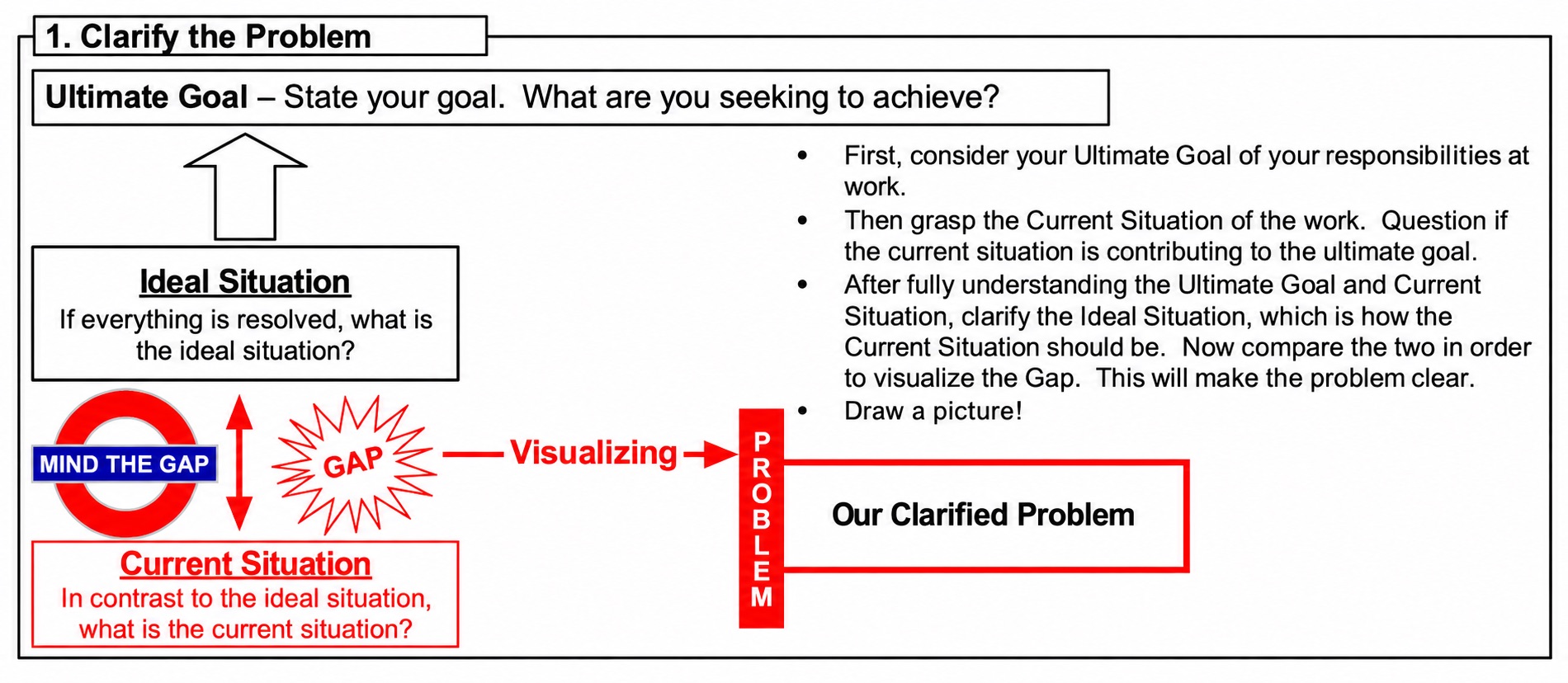
All are familiar responses. But we have not yet established what the machine should do, what it actually does, or the size of the gap.
Bad coffee could mean temperature, taste, strength, volume, or something else entirely. Even “half full” is an impression until we measure it.
Clarifying the problem
In the exercise, the drink-volume standard is 250 ml, with a tolerance of ±10 ml. In a sample of 200 drinks, 28 contain less than the minimum acceptable volume of 240 ml.
Now we have a problem we can investigate: In a sample of 200 drinks, 28 — 14% — were below the minimum acceptable volume of 240 ml.
That is very different from saying the machine needs servicing. One describes a measurable gap. The other proposes an action before we have established the cause.
Breaking down the problem takes discipline
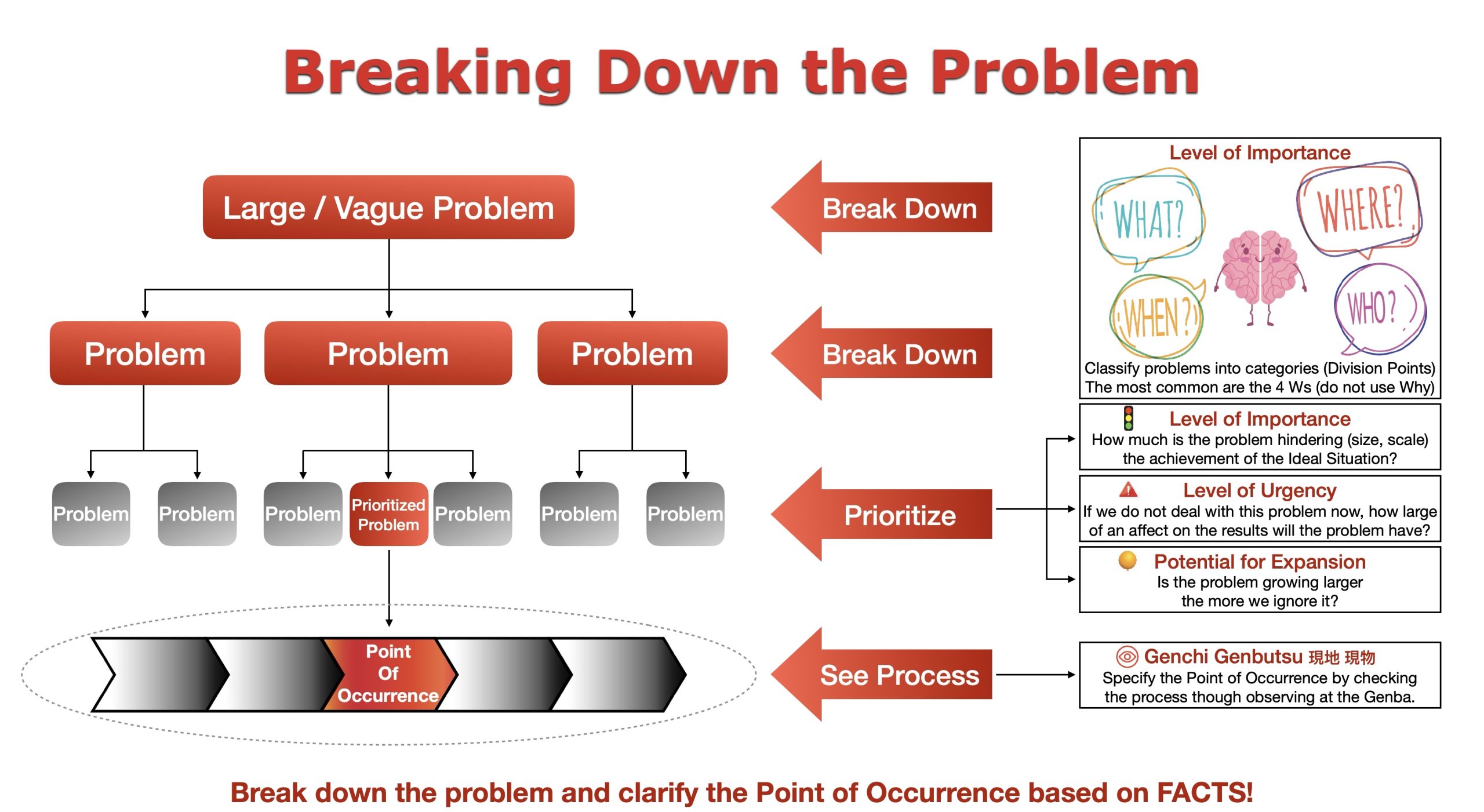
At this stage of the exercise, I introduce a rule: participants are not allowed to ask why. That forces them to establish the facts before explaining them. When they ask the right questions, the picture becomes clearer:
| What we investigate | What the exercise reveals |
|---|---|
| Drink Type | 26 of the 28 defective drinks are cappuccinos. |
| Machine | 25 of those 26 defective cappuccinos come from Machine 2. |
| Time | Defective cappuccinos occur predominantly between 9:00 and 10:30 a.m. |
| Operator | No meaningful relationship to the person using the machine is found. |
| Sequence | The abnormality appears after approximately 12 consecutive cappuccinos. |
But we still do not know why.
“Machine 2 needs servicing” remains a proposed countermeasure. “It happens during the morning rush” identifies a pattern. Neither establishes the cause.
We also have three defects outside the selected group. Prioritizing the largest concentration does not make the remaining defects disappear or prove they share the same cause.
This breakdown gives us a direction for investigation. We must now follow the actual work.
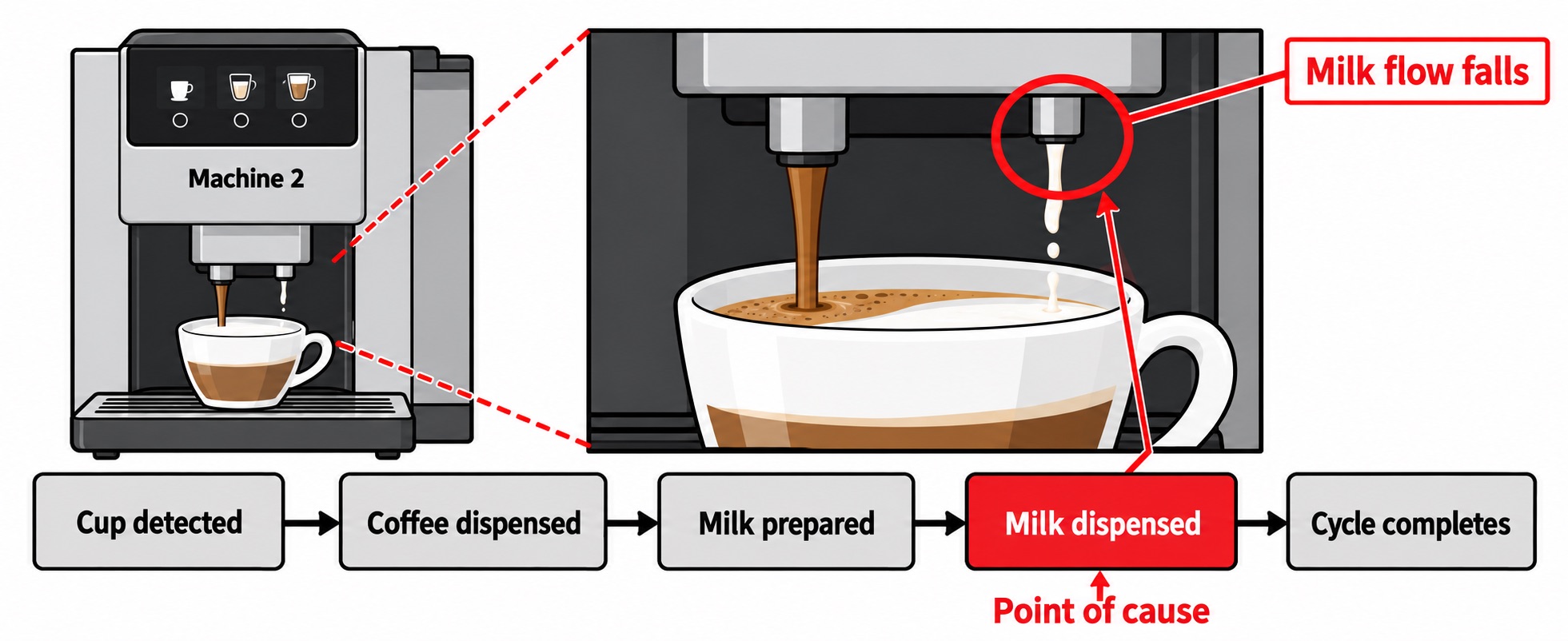
Machine 2 is a location. Where does the abnormality actually arise?
This is one of the most significant gaps I see in A3 problem solving practice and training.
People break down the data, identify a machine or department, and move straight into root cause analysis. Sometimes they immediately start a fishbone diagram or ask five whys.
They have narrowed the search. They have not yet reached the point of cause.
Point-of-cause investigation requires us to examine the process at the place and step where the abnormality arises, under the conditions that produce it. We need to understand what should happen there, what actually happens, and the specific difference between the two.
“Machine 2” is not enough.
In the exercise, we follow the process: Cup detected → coffee dispensed → milk prepared → milk dispensed → cycle completes. Then we observe and measure the drink components separately.
| Component | Normal cappuccino | Defective cappuccino |
|---|---|---|
| Coffee | 80 ml | 80 ml |
| Milk | 170 ml | 95 ml |
| Total | 250 ml | 175 ml |
The coffee volume is correct. The milk volume is low.
Observation reveals that milk flow is normal for approximately the first 12 consecutive cappuccinos. From approximately drink 13 onward, the flow visibly falls during milk dispensing. After a period of idle time, performance returns to normal.
Observe the process. Measure coffee and milk separately.
Our prioritized problem is now much more precise: On Machine 2, after approximately 12 consecutive cappuccinos, milk flow falls during the milk-dispensing step, resulting in about 95 ml of milk instead of 170 ml and causing the finished drink to fall below the 240 ml minimum.
We have moved from a complaint to a specific abnormality, at a specific process step, under identifiable conditions.
This depth of investigation is frequently missing from what people are taught about breaking down a problem. Yet it determines the quality of the causal analysis that follows.
Starting five whys from “bad coffee” leaves enormous room for speculation. Starting from an observed reduction in milk flow under specific operating conditions gives us something concrete to investigate.
A fishbone diagram does not establish root causes
Participants offer explanations: an overheating pump, warm milk, a blockage, low pressure, a software fault, or inadequate cleaning.
These are hypotheses.
A fishbone, or Ishikawa diagram, is a cause-and-effect diagram. It can help organize possible causes, expose different lines of inquiry, and structure a discussion about what might contribute to an observed effect.
For the diagram’s origins and Ishikawa’s explanation of its large, medium, and small branches, see JUSE, “The Research of Dr. Ishikawa,” Chapter 15, pp. 402–403 PDF
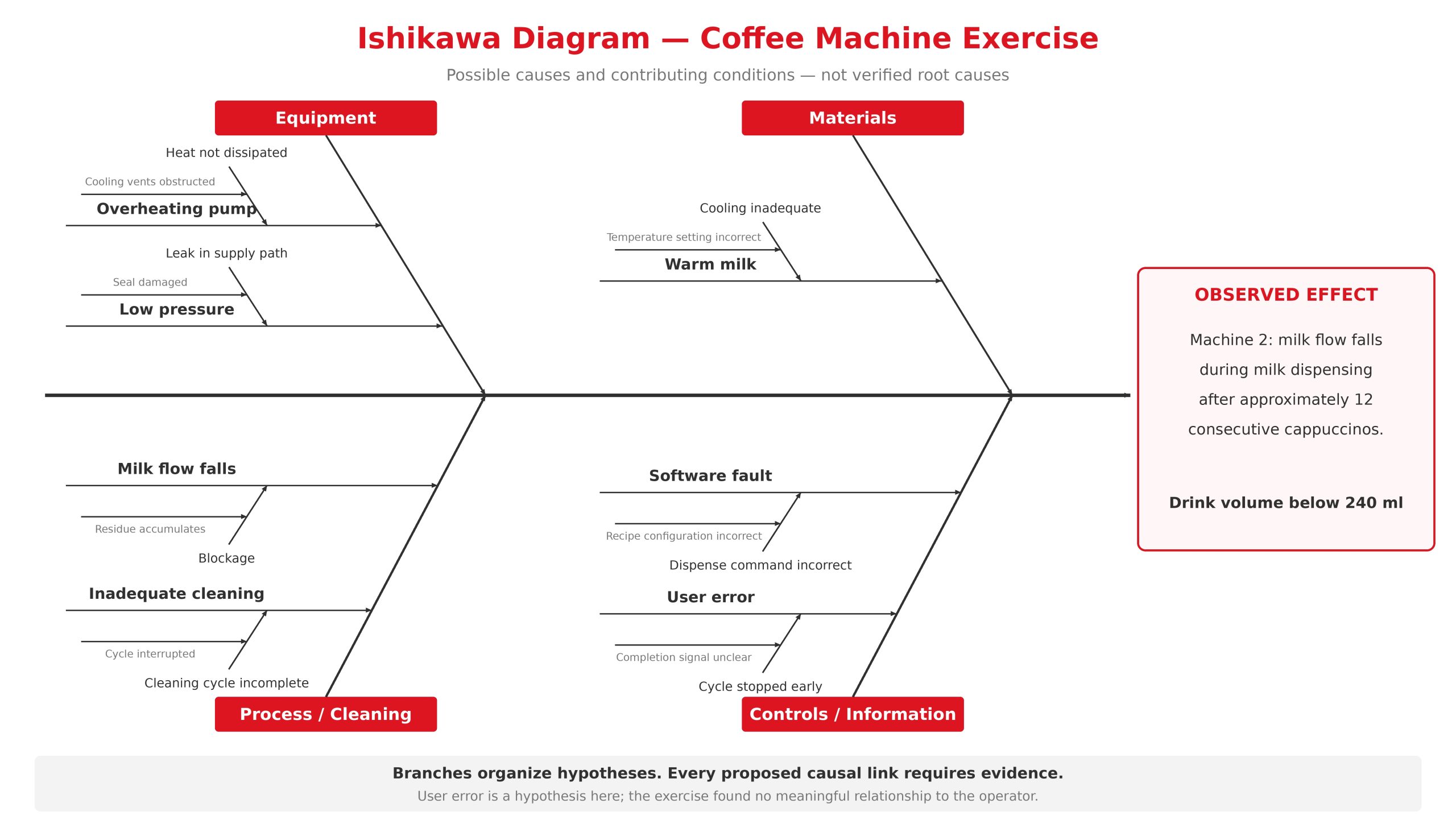
The fish’s head contains the clearly defined problem we are trying to solve. The bones organize possible contributing causes. Through investigation, we must establish which of those causes actually exist, where the associated abnormalities occur, and what evidence connects them to the problem in the head.
The abnormalities supported by that evidence must then be prioritized and investigated at their points of occurrence in the actual process. Each selected point of cause provides a specific starting point for deeper causal analysis.
A label on a bone is not a substitute for observing what happens, comparing it with the standard, and establishing the direct cause.
The purpose is to address the causal pathways producing the problem in the fish’s head. Where multiple pathways contribute, resolving one may reduce the problem without eliminating it. As the relevant points of cause are addressed through effective countermeasures, wherever feasible, we must verify that the overall problem has been resolved and that the conditions allowing it to recur have been addressed.
The diagram itself does not establish that any proposed cause is present, that it produces the effect, or that it explains recurrence.
I encounter training that teaches people to complete a fishbone diagram and treat the resulting list as root cause analysis. When the exercise ends with brainstorming and labeling branches, the teaching is flawed.
A fishbone can support a root cause investigation. Its contents still need to be investigated.
Calling a branch “root cause” does not turn an assumption into evidence. Neither does agreement among the people in the room.
In the coffee exercise, inspection while the fault is occurring reveals increasing restriction in the milk inlet path. Milk residue is accumulating on an inlet screen. Cleaning the screen immediately restores normal flow.
Now we have evidence of the direct cause of the reduced flow. We also have an action that restores performance.
But have we prevented recurrence? That question is where many investigations end too early.
Cleaning the screen restores the condition. Why is it becoming restricted?
The machine’s automatic cleaning cycle runs every evening. Records show it has been completed correctly. Machines 1 and 3 follow the same schedule without experiencing the problem.
“People are not cleaning it properly” does not fit the evidence.
Further investigation reveals the causal chain built into the exercise:
- Milk flow falls because the milk inlet becomes restricted.
- The inlet becomes restricted because residue accumulates on its screen.
- Residue accumulates because the screen is not adequately flushed during automatic cleaning.
- Flushing is inadequate because Machine 2 has a 0.8 mm cleaning jet instead of the specified 1.5 mm jet.
- The wrong jet was fitted because the maintenance parts list specified the 0.8 mm component.
- The parts list was wrong because it was not updated when Machine 2’s milk system was modified.
The technician followed the parts list. The cleaning cycle was completed. The information used to maintain the machine no longer matched its configuration.
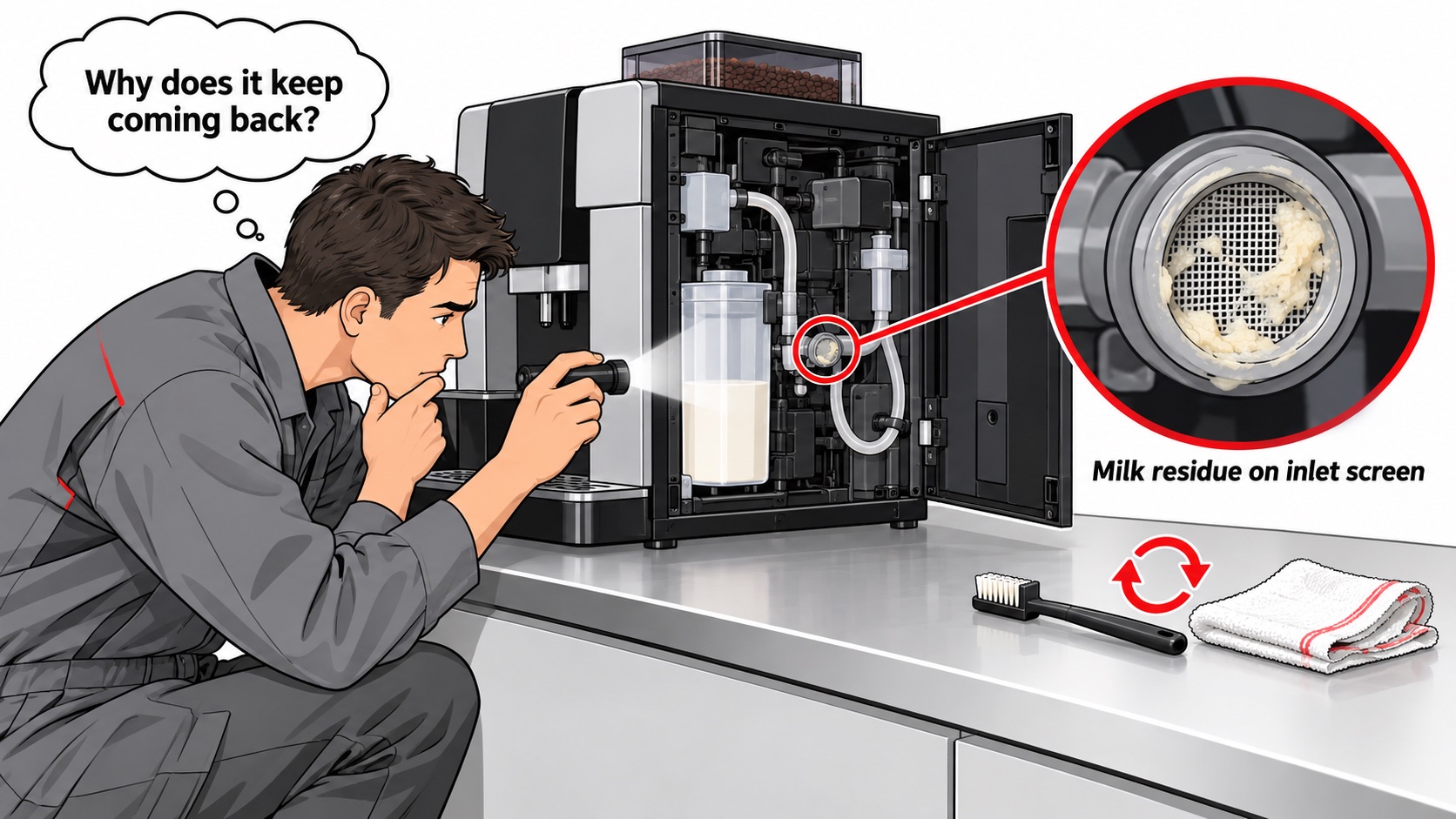
Consider how easily we could have stopped earlier.
- “Clean the screen more often,” could become an additional task for the users.
- “Retrain maintenance,” could become an action assigned to the technician.
- “Replace the jet,” could restore the machine’s performance while leaving the incorrect parts list ready to create the same problem again.
Each stopping point has consequences.
Changing the jet addresses the physical condition. Correcting the maintenance information addresses the route by which the wrong component could be installed again.
In this exercise, we established that the parts documentation was not updated when Machine 2’s milk system was modified. Correcting that documentation is a valid countermeasure. Checking and correcting the documentation for other affected machines can also prevent the same causal chain from developing elsewhere.
But Toyota’s problem-solving discipline may take us deeper: why wasn’t the documentation updated when the modification occurred? Fixing the document does not, by itself, explain or address the failure to update it. This point was made by one of my recent class participants.
We would investigate how modifications are approved, who is responsible for updating the associated information, and how completion is verified.
- Was that responsibility defined?
- Did the modification process require a documentation review?
- Was there a check that the machine configuration, parts list, and maintenance instructions agreed?
These are questions to investigate, not conclusions to assume.
That distinction matters. We need to correct the inaccurate documentation and address the conditions that allowed it to remain inaccurate. Otherwise, the next modification could create the same failure again — on another machine or in an entirely different process.
The broader learning extends beyond coffee machines: changes to equipment or processes must trigger the necessary updates to the information people rely on to operate and maintain them. Any countermeasure addressing that wider weakness must also be tested and verified.
You must ask why? Five Times!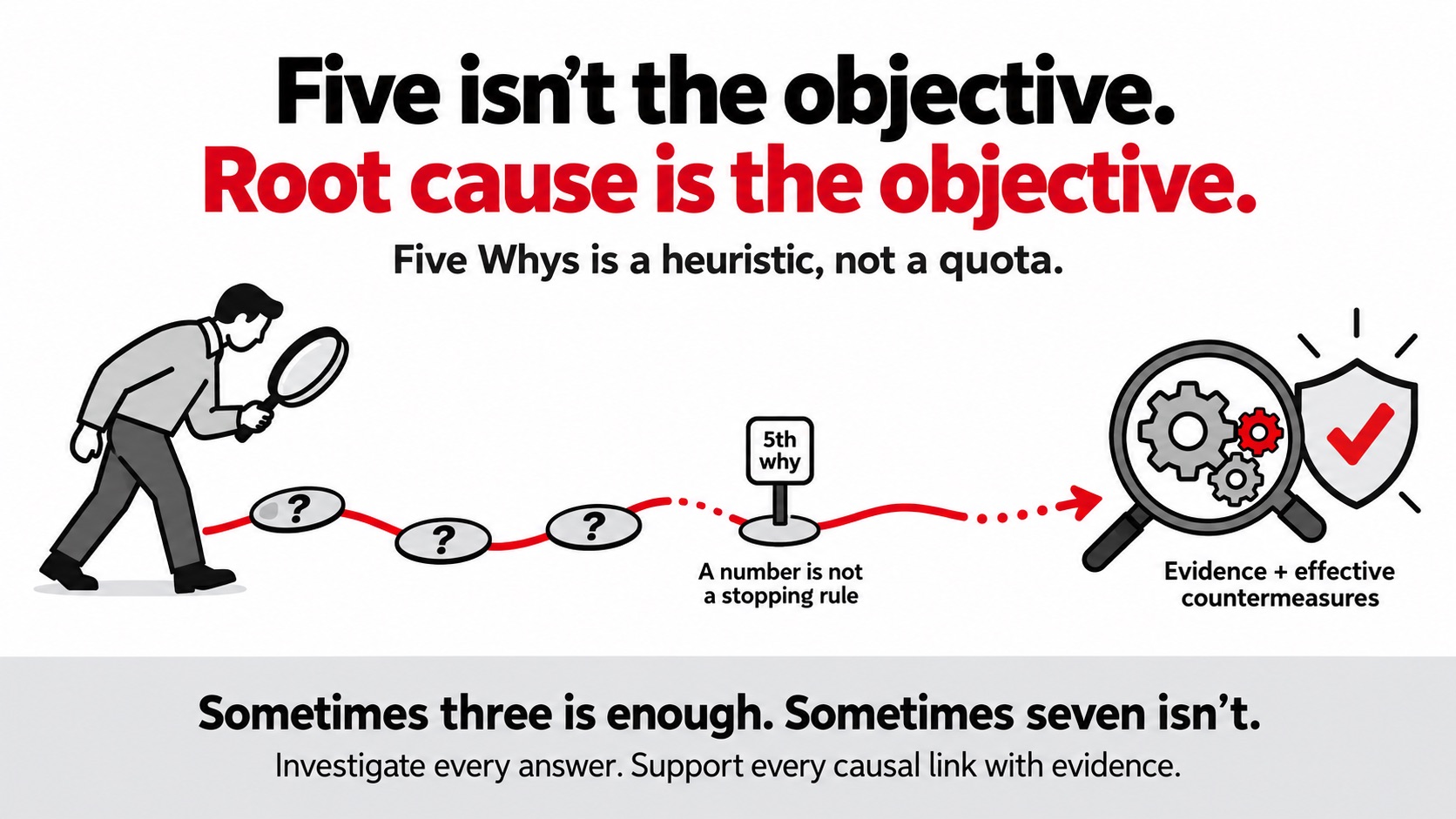
Five Whys is a heuristic, not a quota. Sometimes three is enough. Sometimes seven isn’t. The number helps remind us to probe beyond the first explanation; it does not tell us when the investigation is complete.
We stop based on evidence that we understand the causal mechanism and have identified where effective countermeasures can prevent recurrence. Reaching the fifth why does not establish that. Neither does continuing to ask why without investigating the answers.
In the coffee exercise, correcting the parts documentation addresses an established cause. Asking why that documentation was not updated opens a further investigation into the conditions that could allow the same failure elsewhere. The purpose determines the depth, and evidence must support every link.
A convincing explanation still needs testing
Each why creates a proposition that needs evidence. A plausible sequence of sentences is not enough.
In the exercise, replacing the 0.8 mm jet with the specified 1.5 mm jet provides a practical test: the screen remains clean and 30 consecutive cappuccinos are produced within specification.
That supports the proposed relationship under the tested conditions. We would still need to confirm sustained performance through repeated use, cleaning, and maintenance cycles.
One observation remains unexplained: performance returns after the machine sits idle. Until we establish how that recovery occurs, our causal explanation is incomplete. Replacing the jet and producing 30 conforming drinks supports the proposed relationship under the tested conditions, but it does not explain every observation. Recognizing that gap and continuing the investigation is part of the discipline this exercise teaches.
Likewise, updating a document is not evidence that recurrence has been prevented. We need to check that people can access the correct information, that it matches the machine, and that future modifications trigger the necessary updates.
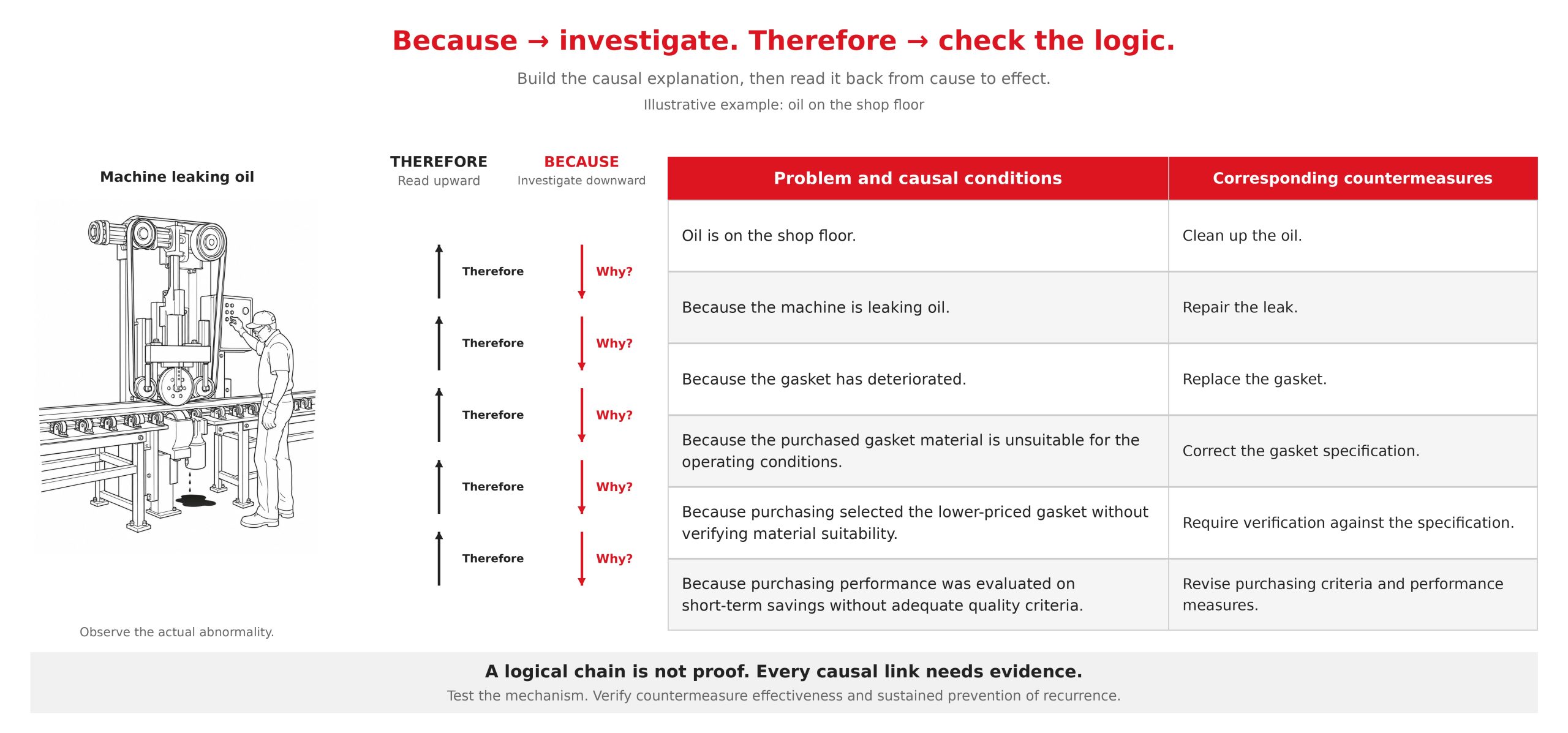
We can also read the causal chain back using “therefore.”
- Does each established condition explain the next?
- Are there missing links?
- Does the proposed countermeasure interrupt the mechanism that produces the problem?
These questions require more effort than completing a template. They also give us a much stronger basis for action.
Leaders must allow this work to happen
Imagine a manager interrupting the coffee investigation: “Just clean it. We don’t have time for all this.”
Cleaning may be necessary to restore service immediately. But if the investigation ends there, the conditions producing the problem remain.
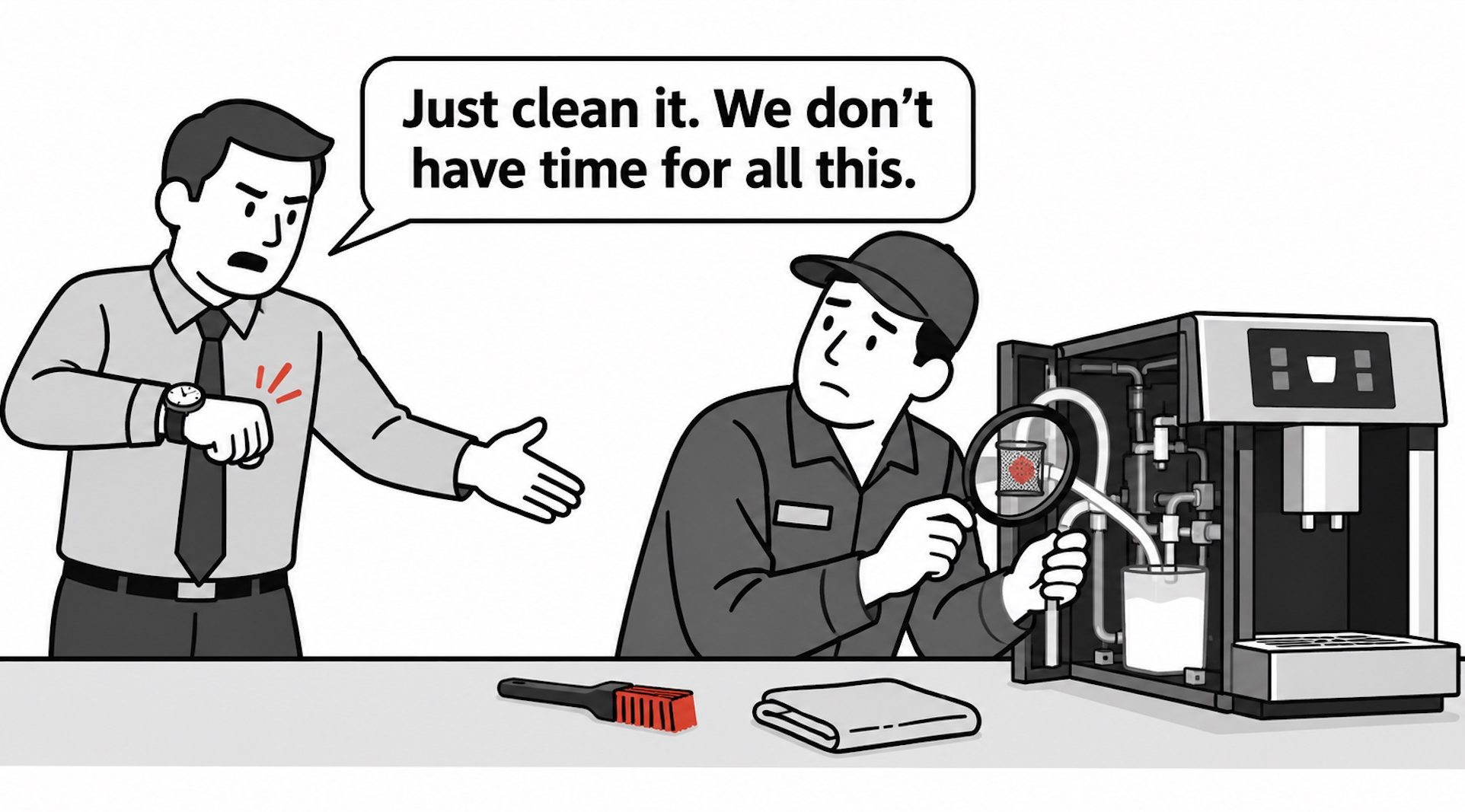
This is how organizations become trapped in recurring problems. They repeatedly reward the person who restores performance while giving little time or recognition to the person investigating why it keeps failing.
Effective problem solving requires leaders to distinguish immediate containment from the work needed to prevent recurrence. It requires time to observe, access to evidence, and the ability to challenge assumptions without being treated as obstructive.
My experience at Toyota taught me to take that responsibility seriously. Coaching develops people’s thinking by asking them to explain the facts, their reasoning, and what they need to investigate next.
Companies that want this capability must make those behaviors part of daily management.
Sending people to a class while continuing to demand premature answers will limit what they can apply.
What participants took away
One participant told me that this simple coffee machine exercise caused him to question everything he had learned over years of quality work using A3s. He described the mental gymnastics involved and said the learning was incredible.
Another participant said she now truly understood how to define a problem — something she had found challenging in the past. Recognizing how to quantify the problem was, in her words, a “mic drop moment.”
During the class, I made a point about communicating with leaders: the first sentence you utter when you walk into a leader’s office should immediately establish why they should care. Quantify the gap and make its significance clear.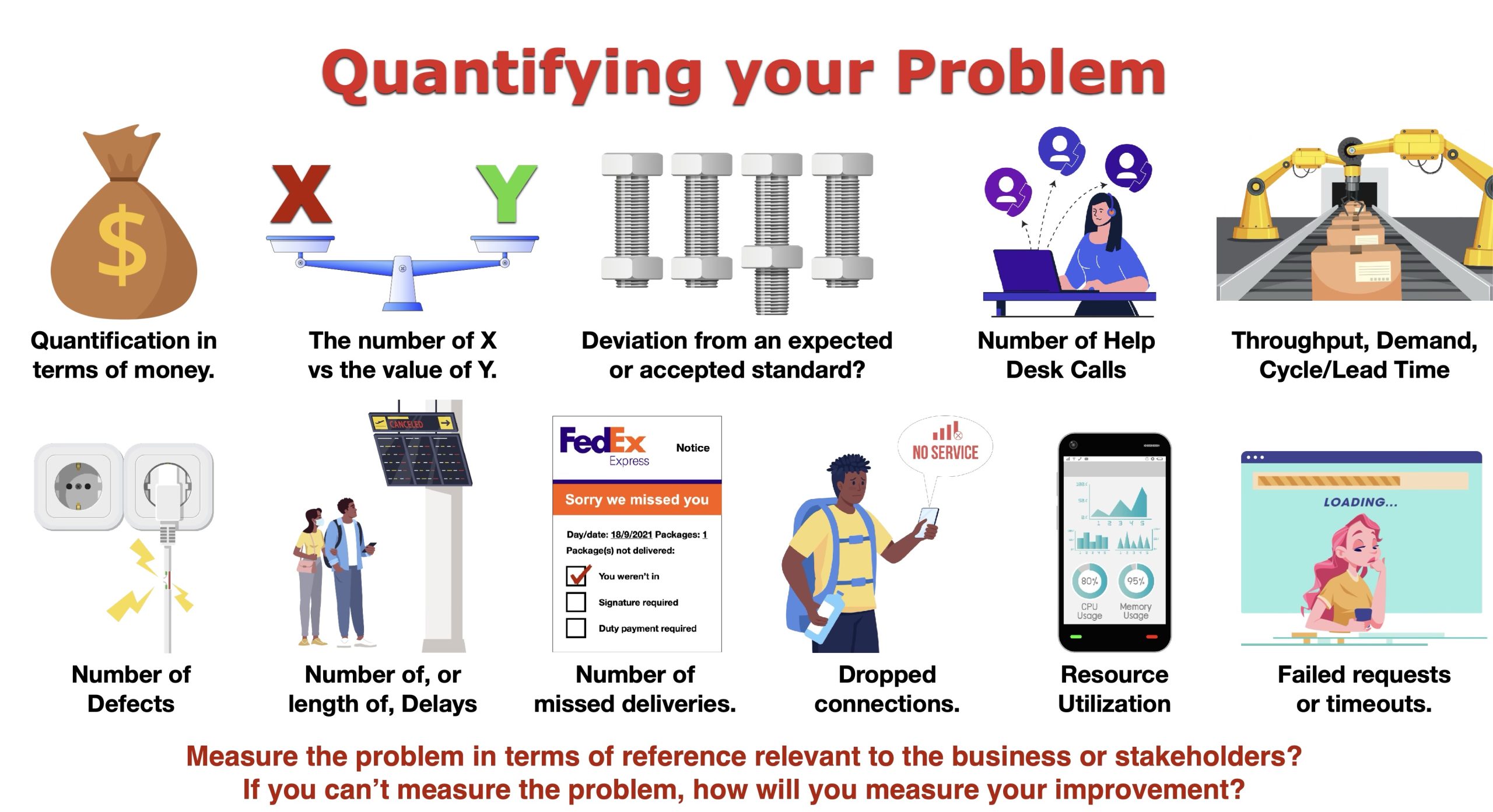
“The coffee machine makes bad coffee” gives a leader very little to work with. “Of 200 drinks sampled, 28 — 14% — fell below the minimum acceptable volume of 240 ml” immediately establishes the scale of the problem. In a business setting, connect that gap to the relevant consequence — customer impact, missed commitments, quality, cost, or safety — using evidence.
That clarity gives the investigation a defined starting point and helps a leader understand why it deserves attention.
These participant reflections capture why I teach at this depth.
Experienced practitioners can recognize the A3 steps yet discover significant gaps when they have to apply them, explain their reasoning, and support it with facts.
What my A3 problem solving class develops
The coffee machine is deliberately simple. The thinking applies to late orders, service failures, rework, equipment faults, and many other operational problems.
The recurring gaps are recognizable: vague problem statements, causes embedded in the definition, insufficient breakdown, analysis conducted away from the point of cause, assumptions treated as facts, and countermeasures that restore performance without addressing recurrence.
These are the skills we practice in my A3 problem solving class.
Participants work through clarifying the gap, breaking it down, selecting a priority, observing the process, distinguishing potential causes from direct and root causes, testing causal relationships, and developing countermeasures whose effectiveness can be checked.
The depth of my Toyota training informs the questions I ask, the distinctions I teach, and the level of evidence I expect. I use exercises and coaching to make participants apply the thinking, explain their reasoning, and recognize where they have moved beyond what the facts support.
If you have learned the A3 steps but still find that problems return, this class will help you strengthen the investigation between the initial complaint and an effective countermeasure.
If you lead others, it will also help you recognize when to ask better questions and what conditions your people need to conduct that investigation properly.
Enroll in my next A3 Problem Solving class and practice the skills needed to define the right problem, investigate it at the point of cause, and develop countermeasures that address recurrence.
Click here for the current training class schedules and booking page.