When Optimizing the Parts Makes More Sense Than Optimizing the Whole
“Optimize the whole, not the parts” is one of the most important ideas to come out of systems thinking and system optimization. It’s also an idea that needs qualification.
For decades, thinkers such as W. Edwards Deming and Russell Ackoff helped us understand why improving individual components of an organization does not necessarily improve the organization itself.
They were right. But… I think the next question is one we don’t ask often enough.
What happens when the whole itself cannot be sufficiently known, bounded or predicted to be optimized?
That question becomes increasingly important as we move from relatively predictable systems into complex adaptive systems and as organizations grow across geographies, technologies, markets, organizational boundaries and thousands, or hundreds of thousands of interacting people.
It leads to a principle that I think is more useful than simply telling leaders to optimize the whole:
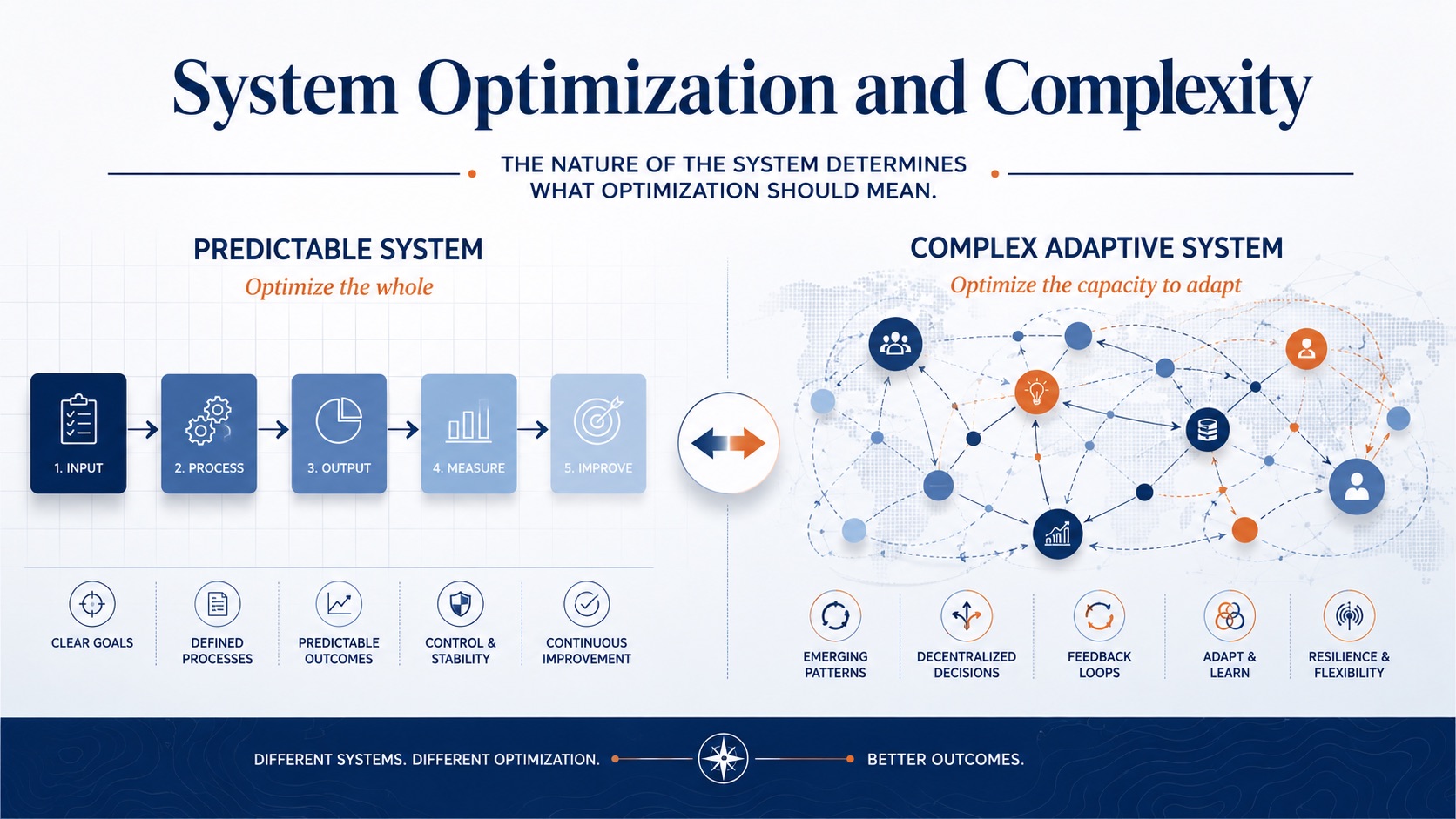
The nature of the system determines what optimization should mean.
In a sufficiently predictable system, optimize the whole. In an unpredictable and complex adaptive system, optimize the parts.
In a complex adaptive system, the whole is continually changing through interaction and adaptation. The task therefore shifts toward improving the capabilities, interactions, constraints and methods of combination that allow the system to continually respond to what emerges.
It’s not local optimization. It’s is a different conception of optimization altogether.
Key Takeaways for Leaders
- In predictable systems, optimize the whole.
- In complex adaptive systems, optimize the capacity to adapt.
- The nature of the system determines what optimization should mean.
- Standardize what you know will repeat, and build the capability to adapt to what you know will not.
- The whole matters, but in a complex adaptive system the whole doesn’t hold still.
- Optimize at the level of granularity where the system is sufficiently coherent and predictable to make optimization meaningful.
Table Of Contents
Deming’s Essential Contribution
Deming described a system as a network of interdependent components working together toward an aim.
He was unequivocal about the importance of that aim:
“A system must have an aim. Without an aim, there is no system.” — Deming, W. Edwards. The New Economics for Industry, Government, Education. 3rd ed. MIT Press, 2018, p. 36.
This was an enormously important shift in management thinking because an organization could not sensibly be improved by treating purchasing, manufacturing, engineering, sales, finance and people as independent entities. They were interdependent, meaning the performance of one inevitably affected the performance of others, and a decision that appeared optimal within a single department could easily create greater costs, longer delays or poorer outcomes elsewhere in the system.
Deming therefore moved management away from optimizing isolated functions and toward managing the performance of the system as a whole. His definition is worth examining carefully because he explicitly framed this discussion around man-made systems: systems with an aim, made up of interdependent components whose relationships management must understand well enough to influence their collective performance.
That remains exceptionally powerful thinking, but it also rests on some important assumptions. The system can be meaningfully identified, its aim can be articulated, and the relationships between its components can be understood to a sufficient degree. There is also some practical ability to manage the system toward that aim. Where those conditions hold, optimizing the whole makes considerable sense.
Ackoff Took the Argument Further
Russell Ackoff attacked the same problem from another direction.
One of his most memorable observations was:
“The performance of a system is not the sum of the performance of its parts taken separately, but the product of their interaction.” — Ackoff, Russell L. The Democratic Corporation: A Radical Prescription for Recreating Corporate America and Rediscovering Success. Oxford University Press, 1994, p. 23.
That one sentence destroys much conventional management logic. If the performance of the system comes from interaction, then taking every component and making it independently “better” cannot guarantee a better system.
Ackoff illustrated this with automobiles.
Take the best engine, the best transmission, the best suspension, the best brakes and the best steering system from different cars and assemble them. You don’t get the world’s best car. You may not get a functioning car at all. The parts have to work together.
Ackoff, Russell L. “Systems Thinking, Learning, and Problem Solving.” Video lecture.
Ackoff’s argument was not simply that parts matter less than the whole. It was that the properties we care about emerge from their interaction. Consequently, improving parts independently can leave the whole unimproved, or even make it worse.
This is the foundation of the argument against local optimization. And I agree with it entirely.
I Am Not Advocating Local Optimization
This point needs to be absolutely clear. When I argue that we cannot optimize the whole in a complex adaptive system, I am not proposing that we return to optimizing individual parts independently. That would simply take us back to the problem Deming and Ackoff helped expose.
Imagine an organization in which:
- Sales optimizes sales.
- Engineering optimizes engineering.
- Operations optimizes operations.
- Finance optimizes finance.
- HR optimizes HR.
Every function can hit its targets (think OKRs and KPIs) while the overall organization becomes slower, more expensive and less capable of meeting customer demand, but that’s local optimization, and is precisely what we want to avoid. The argument I am making is different.
I am not asking Should we optimize the parts or optimize the whole?
I am asking:
What can actually be optimized, at what level of granularity, given the nature of the system we are dealing with?
That becomes especially important once we move into complexity.
Standing on the Shoulders of Deming and Ackoff
There is a temptation here to say that Deming and Ackoff were dealing with simpler systems.
I don’t think that is historically fair.
Ackoff, in particular, explicitly differentiated mechanical, living system and social systems. He understood organizations as purposeful social systems populated by people capable of choice, and he recognized that systems exist within larger systems.
So this is not an argument that they somehow failed to understand organizations. It’s quite the opposite, and their work gives us the foundation for what comes next.
Deming and Ackoff delivered an essential correction to reductionist management:
You cannot understand or improve a system simply by taking it apart and improving each component independently.
Complexity thinking adds another correction:
You cannot assume that the whole is always a sufficiently stable, bounded and knowable object that somebody can stand outside it, understand it and optimize it.
Systems thinking tells us to pay attention to the whole while complexity thinking forces us to question whether the whole can ever be completely known.
Those ideas are complementary, not contradictory.
The Whole Doesn’t Hold Still
This is where the work of Dave Snowden and complexity science becomes particularly useful. Deming and Ackoff taught us to understand the relationships between the components of a system and to resist the temptation to optimize those components independently. Snowden takes us further into the particular problem presented by complex adaptive systems: the relationships themselves are dynamic, the actors within the system adapt, and the future state of the system cannot simply be derived from its current state. Snowden is, coincidentally, a fan of Ackoff—or so he tells me.
From Causality to Disposition
Snowden describes this as a dispositional state. Rather than assuming linear cause and effect, we are dealing with “a set of possibilities and plausibilities in which a future state cannot be predicted.” In other words, we may be able to understand the tendencies of a system, the constraints acting upon it and the directions in which it appears more or less likely to move, but we cannot assume that a particular intervention will reliably produce a predetermined outcome. Cynefin Co
This is significant for any attempt at optimization. Conventional optimization depends upon some degree of repeatable causality. It’s how traditional 5 Why analysis works. If I understand how the components interact and can reasonably predict the consequences of changing them, I can compare alternatives and determine which configuration produces better performance. But in a complex adaptive system, the intervention itself changes the system. People respond, relationships shift, new information appears and adaptations occur. What happens next is partly created by what has just happened.
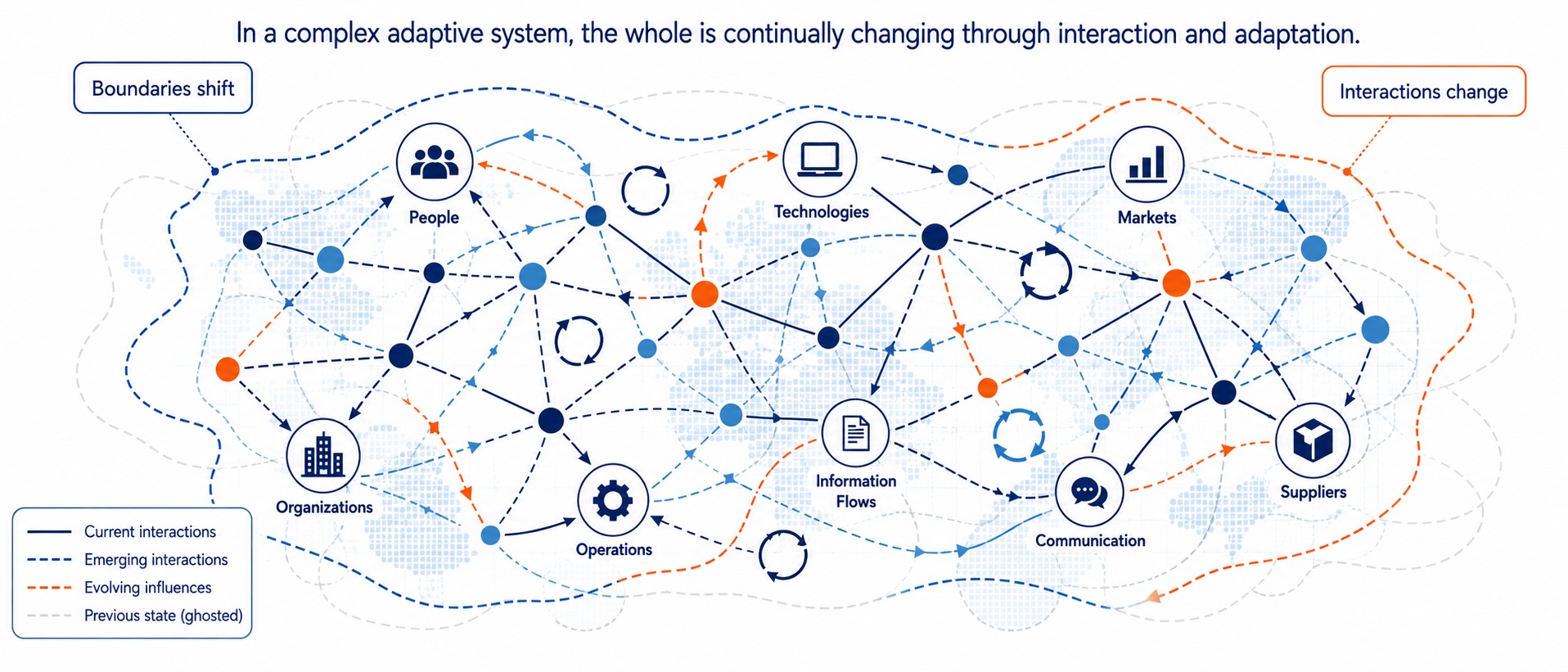
Stay aware of the whole without assuming it can be fixed, sully known, or permanently optimized.
No One Sees the Whole
Snowden also draws attention to another characteristic of complex adaptive systems that becomes particularly important as organizations grow in scale: “the elements are not aware of the whole.” Individual people, teams and functions operate with partial knowledge of the system around them. They see the interactions closest to them, respond to the information available to them and adapt according to their local circumstances, but none possesses a complete representation of everything occurring across the wider system.
The Limits of Holistic Thinking
This creates a fundamental limitation on the idea that a sufficiently large complex organization can simply be understood and optimized as a whole. Knowledge is distributed across thousands of people, technologies, locations, suppliers, customers and informal networks, while those relationships are themselves continually changing. Snowden makes the point particularly sharply when he challenges the idea that we can simply “think holistically,” observing that “you can’t; there is too much information.” The problem is not merely that leaders have failed to collect enough data. At sufficient complexity and scale, complete knowledge of the whole is structurally unavailable.
That applies to everyone in the system, including those at the top. The individual employee sees only part of the organization, the team sees a larger but still incomplete part, and executive leadership operates from another partial perspective assembled from reports, measures, conversations and abstractions.
- No organization chart captures every relationship,
- no process map captures every adaptation,
- no dashboard represents every interaction that matters.
The people attempting to manage the system are themselves participants within it, not detached observers standing outside it with a complete view. Organizational Blindness
This doesn’t mean that we abandon the whole and return to reductionism. Snowden explicitly argues the opposite: complex adaptive systems cannot be understood using a conventional reductionist approach. The distinction is subtler. We must remain aware of the whole without pretending that we can completely know, predict or optimize it. Systems thinking remains essential as a way of seeing relationships and interdependence; what becomes problematic is treating the whole as a fixed object that can be comprehensively understood and engineered toward an optimum state.
Manage the Present, Not an Ideal Future
That changes what management can reasonably attempt to do. Rather than designing an ideal future state and then engineering the organization toward it, complexity thinking starts with the present and asks what possibilities exist from here. Snowden describes this as managing the evolutionary potential of the present—understanding current dispositions, making interventions, observing what changes and adapting again. The objective is no longer to calculate the one best future configuration, but to influence the conditions from which more desirable possibilities can emerge.
Granularity and Recombination
Granularity therefore becomes extremely important. Snowden argues that the elements within a complex system need to exist at a level where they are meaningful enough to matter but sufficiently fine-grained that they can be combined and recombined as circumstances change. This fits directly with the distinction I’m making about optimization. We can identify areas of the organization that are sufficiently coherent and predictable to improve or optimize, while ensuring that those capabilities can continue to interact, adapt and recombine within the much larger system.
Complex adaptive systems are dynamic, continuously learning to adapt to external forces, and emerge to new states when necessary to meet unique environmental needs and can’t be predicted by the characteristics of the parts.

Complex adaptive systems scale by decomposition (to the lowest level of coherent granularity) and through recombination. They do not scale by imitation or replication.
A Different Optimization Question
So when I say the whole doesn’t hold still, I don’t mean that the whole doesn’t matter. It matters enormously. I mean that in a complex adaptive system the whole is continuously being recreated through the interactions of the elements within it. Its relationships shift, its boundaries may move, people adapt to one another, and every significant intervention alters the conditions from which the next set of interactions emerges.
That makes the conventional optimization question far less useful.
What is the optimal configuration of this system?
Instead start asking:
What capabilities, constraints and interactions will improve this system’s ability to respond as circumstances evolve?
This is the bridge from systems thinking to complex thinking. Deming and Ackoff taught us not to optimize the pieces while ignoring their interactions. Snowden helps us see why, under conditions of complexity, we must also resist the assumption that all of those interactions can be known in advance, represented from a single perspective and assembled into a permanently optimized whole.
The whole matters. But the whole doesn’t hold still.
Snowden, D. (2017). “Inclinations & dispositions.” The Cynefin Co.
Snowden, D. (2023). “Granularity, abstraction & coherence 2 of 2.” The Cynefin Co.
Snowden, D. (2015). “The evolutionary potential of the present.” The Cynefin Co.
Scale Changes What Is Knowable
There is another dimension to this that I believe modern management frequently underestimates: Scale.
Complexity is not the same as scale. A small group can form a complex adaptive system, while a very large engineered process can remain predominantly predictable. But as scale increases, so does the difficulty of understanding the whole, because the number of interactions, dependencies, communication paths and possible adaptations grows rapidly.
Consider a multinational organization with:
- 100,000 people;
- operations across 40 countries;
- thousands of suppliers;
- millions of customers;
- hundreds of products;
- thousands of software systems;
- multiple regulatory environments;
- acquisitions and partnerships;
- formal organizational structures;
- informal networks;
- and millions of conversations and decisions taking place every day.
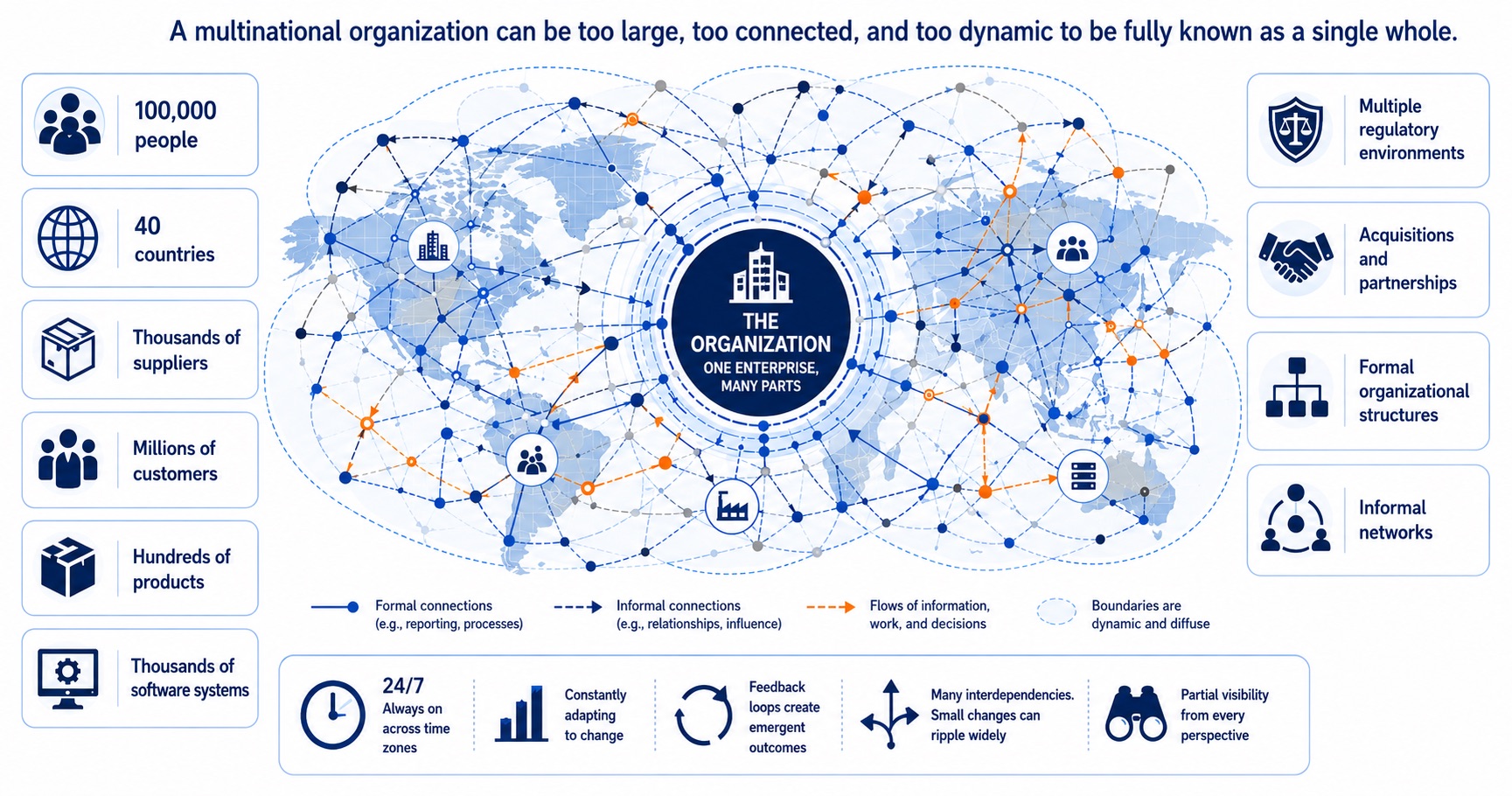
So, where exactly is the whole that you intend to optimize? The legal boundary of the corporation?
Customers are outside that boundary, but their behavior changes the organization.
- Suppliers are outside it.
- Regulators are outside it.
- Partners are outside it.
- Capital markets are outside it.
Technology platforms may be controlled by other companies altogether, and inside the organization, nobody possesses complete knowledge.
- No CEO knows every interaction.
- No executive committee knows every dependency.
- No enterprise architecture map captures every technology relationship.
- No organization chart captures the real communication network.
- No process map represents every workaround.
- No KPI system captures every important signal.
The organization is not only enormous but the knowledge about it is distributed. The people trying to manage the system are themselves inside the system they are trying to understand.
Catering Versus Fine Dining
This is where a catering and fine-dining example becomes useful. Note: My wife is a chef.
Catering – Standardized Menus and Repeatable Service
Imagine catering dinner for 500 people. You know roughly how many people are coming, what they will eat as choice is fixed, the portion sizes, when dinner must be served, the recipes, the equipment available, the preparation times and most of the sequence of work. Variation still exists, but enough of the system is predictable for us to optimize the whole.
We can balance capacity, synchronize preparation, improve flow, identify bottlenecks, reduce unnecessary movement, and organize preparation and cooking around the required serving time. This is exactly where the systems-thinking instruction to optimize the whole rather than the individual parts works beautifully.
Now consider fine dining.
The restaurant knows its menu and has some idea of expected demand, but it does not know the exact configuration of tonight’s service. One table may order four completely different dishes, another may have allergies, another may arrive late, someone may change an order, a steak may be returned, and another table may eat faster than expected. At the same time, dishes with completely different preparation times still need to arrive together. The actual configuration of the system therefore emerges during service.
So what does the restaurant optimize?
Not every possible version of tonight’s service, because it can’t. Instead, it develops highly capable chefs, excellent preparation, reliable techniques, clear information, effective communication, useful constraints, well-designed stations, good interfaces between those stations, and methods that allow those capabilities to be rapidly combined and recombined around the demand that actually appears.
The aim is not maximum efficiency at every station. That would simply be local optimization. The aim is to create capable elements that can interact effectively as circumstances change.
Standardize what you know will repeat, and build the capability to adapt to what you know will not.
Stability Is Not the Same as Predictability
This is also where a definition of stability becomes useful.
A stable system is one that can consistently meet demand.
Notice that I didn’t say: A stable system is one in which everything is predictable.
The fine-dining kitchen can be stable. It can consistently provide excellent food at the required time, yet the exact sequence of events during tonight’s service remains uncertain. Its stability partly comes from its ability to adapt.
The catering operation may achieve stability predominantly through planning and predictability. The fine-dining restaurant achieves stability through a combination of preparation, capability, coordination and adaptation. Both consistently meet demand, but they do so differently.
Therefore:
The nature of the system determines what optimization should mean.
Systems Thinking Remains Essential
None of this makes systems thinking obsolete, and in fact, complexity makes systemic awareness even more important.
- We still need to understand interactions.
- We still need to understand dependencies.
- We still need to understand feedback.
- We still need to recognize that changing one thing can have consequences elsewhere.
- We still need to avoid local optimization.
- We still need to understand flow.
But there is an important distinction between thinking systemically and believing we can optimize the entire system as a single object.
The first remains essential, while the second becomes increasingly questionable as complexity and scale increase.
Systems thinking therefore becomes a way of seeing, rather than an assertion that the observer possesses sufficient knowledge to engineer the optimum state of the whole.
Find the Appropriate Level of Granularity
So what do we do instead? Well, we look for the appropriate level of granularity.
Inside an enormous complex adaptive organization, there will be many things that are sufficiently bounded and predictable to optimize.
- Payroll may be one.
- Invoice processing may be another.
- A manufacturing cell may be another.
- A particular technical deployment process may be another.
- A logistics operation might be another.
Within those boundaries, whole-system optimization remains appropriate, but as we move outward and interactions become increasingly dynamic, the optimization problem changes.
We become less concerned with designing the optimum configuration of the entire organization and more concerned with:
- building capability;
- improving interactions;
- reducing unnecessary dependencies;
- improving information flow;
- creating useful constraints;
- preserving optionality;
- improving feedback;
- enabling distributed decisions;
- developing learning capacity;
- and allowing resources and capabilities to be recombined quickly.
The principle therefore isn’t optimize the parts because you cannot optimize the whole.
It’s:
Optimize what is sufficiently predictable to optimize, while designing the wider system for adaptation.
And that’s a critical nuance.
From Systems Thinking to Complexity Thinking
This is where I distinguish systems thinking from complexity thinking.
Systems thinking made the essential move from the component to the relationships between components and the performance of the whole. Complexity thinking asks us to make another move by asking us:
- What if those relationships themselves are continually changing?
- What if we cannot know all of them?
- What if the system contains autonomous actors who respond to our interventions?
- What if boundaries are porous?
- What if information and decision-making are distributed?
- What if there is no single person capable of knowing enough to optimize the whole?
Now the management problem changes and instead of asking How do we design the optimum organization? we instead ask: How do we create an organization capable of continually adapting itself as circumstances change?
One seeks the best configuration. The other seeks the capacity for continuous reconfiguration.
Final Thoughts
Perhaps Optimization Was Never the Ultimate Goal. Deming and Ackoff taught management an enormously important lesson.
Stop improving pieces independently and expecting the system magically to improve.
- Look at relationships.
- Look at interaction.
- Look at interconnections.
- Look at the whole.
We should retain all of that, but complexity asks us to take the next step.
- The whole may not be fixed.
- Its boundaries may not be obvious.
- Its future state may not be predictable.
- Its actors may have agency.
- Knowledge may be distributed across thousands of people.
And at sufficient scale, the idea that somebody at the center can possess enough information to continually optimize the entire enterprise becomes unrealistic.
So the objective changes.
In predictable environments: Optimize the whole.
In complex adaptive environments: Optimize the capacity to adapt.
And within those complex systems, continually look for areas where relationships become sufficiently coherent and predictable that conventional whole-system optimization becomes useful again. That’ll give us something more nuanced than either local optimization or an indiscriminate instruction to optimize everything as one enormous system. It’ll give us an optimization philosophy based on context. And ultimately that brings us back to the principle at the center of this argument:
The nature of the system determines what optimization should mean.
Deming and Ackoff taught us to see the system. Complexity thinking reminds us that sometimes the system we see will not stay still long enough for us to optimize it.