Why It Is Time to Put Total Quality Management Back at the Center
Lean has been spoiled. Not because the underlying thinking suddenly stopped working, but because we have increasingly mistaken a set of improvement principles and methods for the wider management system. That is why I think it is time to put Total Quality Management back into the conversation.
- Flow matters.
- Quality matters.
- Waste matters.
- Standardized work, where appropriate, matters.
- Seeing problems quickly matters.
- Developing people capable of understanding and improving their work matters.
The problem is what has been done to Lean.
Underneath all of this sits a leadership problem. Tools do not create alignment, capability, accountability or learning. They do not decide what matters, where authority should sit, what signals deserve attention, or whether improvement in one part is making the whole system worse. Those are leadership responsibilities. A management system can support them, but it cannot replace them. And that is why this conversation has to be bigger than Lean tools.
Over several decades, something that emerged from a much broader system of management has progressively been reduced to a collection of tools, methods, certifications, workshops, maturity assessments and branded approaches.
We got:
- Tools and techniques — 5S, kanban, value-stream mapping, A3, standard work and kaizen.
- Management routines — daily management, visual management, gemba and kata.
- Programs and transformations — packaged approaches designed to “deploy Lean” across an organization.
Then Lean was cross bred with Six Sigma and acquired belts, certification schemes, DMAIC projects and armies of specialists. And DMAIC is NOT better than PDCA.
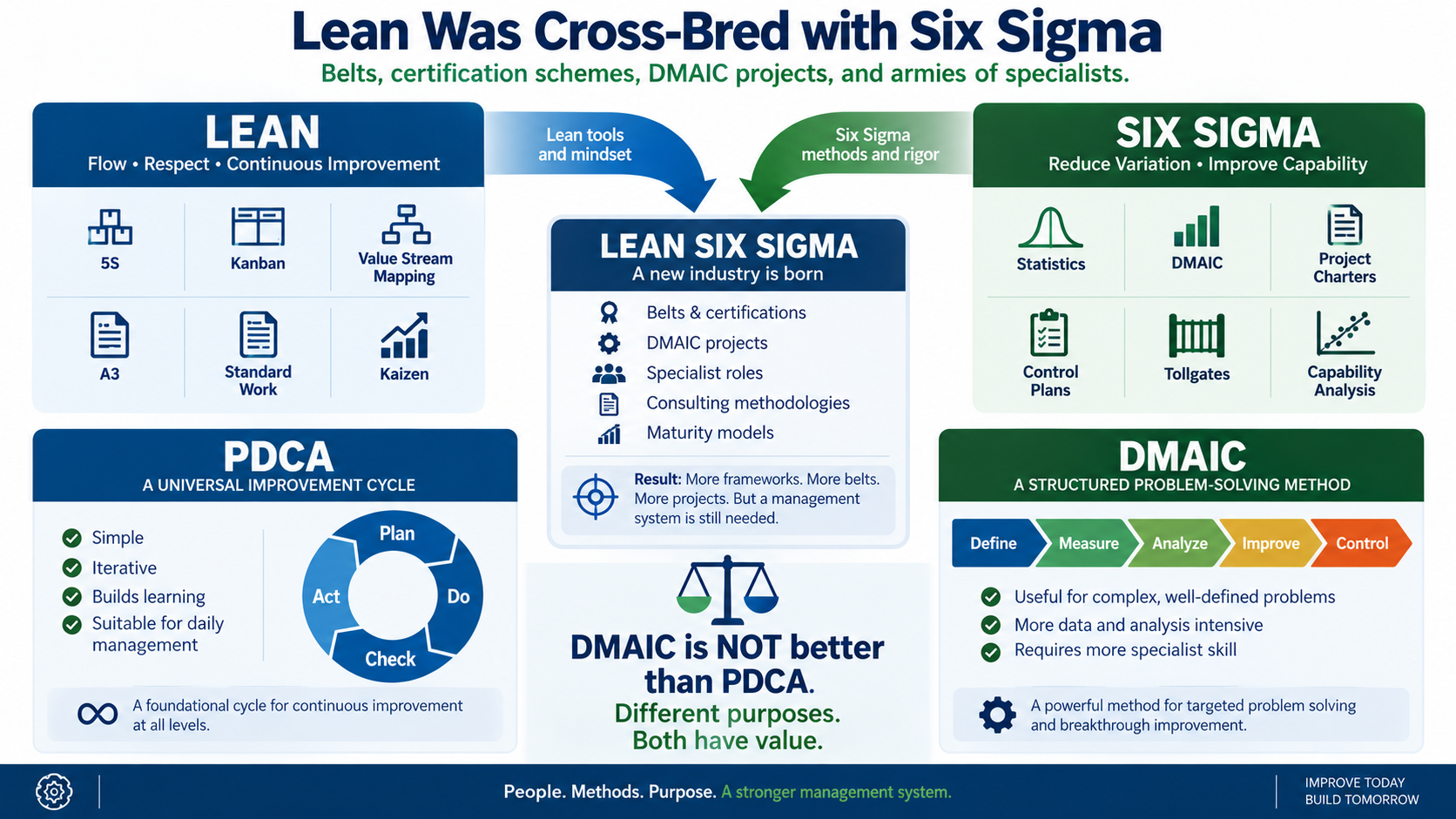
Agile borrowed from it. Operational Excellence absorbed it. Consulting firms packaged it. Training companies certified it. Academics classified it. Practitioners divided themselves into factions arguing about which interpretation constitutes real Lean. And now AI has arrived.
Today we can generate extraordinarily polished Lean houses, temples, pyramids, operating models, maturity frameworks and transformation roadmaps in seconds. Ask an AI for twenty Lean principles, seven pillars, four foundations and a five-stage implementation model and it will happily oblige.
The diagrams have never looked WORSE.
But has management improved? Perhaps we have reached the point where we need to ask a more fundamental question.
Was Lean ever the point? Or did we take highly visible elements of a much broader Japanese management system, give them a Western name, commercialize them and gradually lose sight of the system around them? Because the history is considerably more interesting than the mythology, and it takes us back to something many people now regard as belonging to another era.
Something we call — Total Quality Management.
Key Takeaways for Leaders
- Leadership owns the management system. Quality, Lean, HR, consultants, technology, and AI can all support the work, but leadership cannot outsource responsibility for how the organization is managed.
- The system, not the tool, is the unit of improvement. Local improvements, higher utilization, automation, or better metrics can still make the overall system worse if leaders fail to understand the whole.
- Purpose has to connect to daily work. Strategy only matters when people can see how it translates into priorities, decisions, authority, and the work happening today.
- Problems must be allowed to surface. Strong leadership creates the conditions for weak signals, quality issues, delays, and uncomfortable information to become visible early rather than being hidden by reporting structures or targets.
- Capability matters more than compliance with a method. The goal is not to “do Lean,” achieve a maturity level, or deploy another framework. It is to build an organization capable of learning, responding, and improving continuously.
- Cross-functional management matters. Many of Toyota’s early TQC problems were not technical problems but management problems: weak horizontal communication, poor coordination, unclear responsibility, and inconsistent interpretation of policy.
- Continuous improvement must be part of management, not a separate activity. If improvement only happens through projects, specialists, or workshops, it is disconnected from the real management system.
Table of Contents
We Have Been Telling the Toyota Story Backwards
We have a tendency to tell Toyota’s story backwards.
We see Toyota’s performance. We identify the Toyota Production System. We identify practices associated with TPS. We bundle them and call it Lean. And then we attempt to reproduce Toyota’s performance by deploying those practices somewhere else.
But Toyota did not build Toyota by launching a Lean transformation.
Toyota did not even invent the term Lean. “Lean production” was coined by John Krafcik while working with MIT’s International Motor Vehicle Program in the late 1980s and was subsequently popularized through The Machine That Changed the World. (Lean Enterprise Institute)
Toyota had the Toyota Production System.
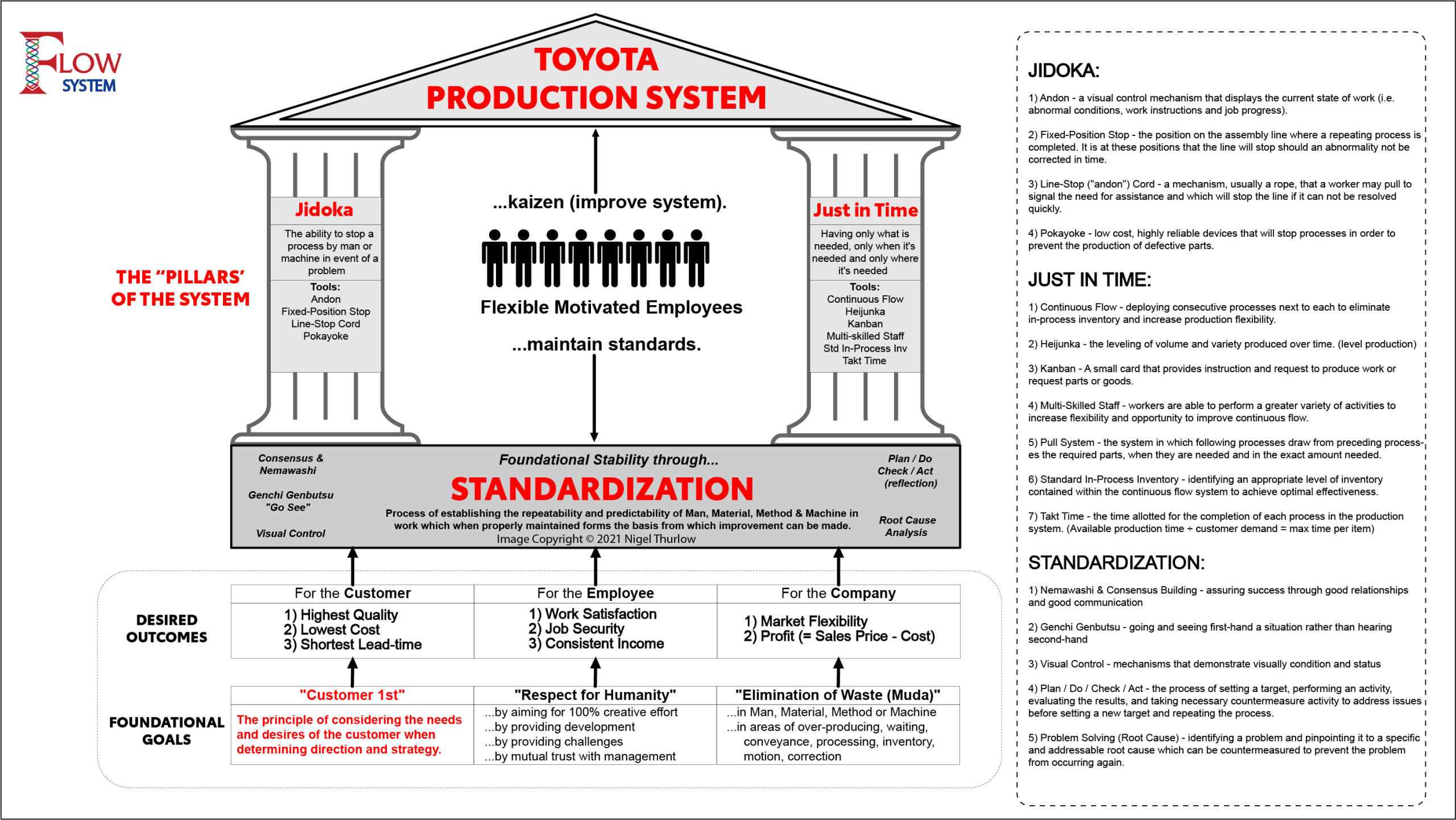
Yes, This is an OFFICIAL Visual (See Here)
Toyota today describes TPS as a production system centered on eliminating waste, shortening lead times and delivering quickly, at low cost and with high quality. Its two foundational pillars remain jidoka and Just-in-Time, supported by continuing incremental kaizen. (Toyota Global)
TPS is extremely important, but while what became TPS was developing, something else was happening inside Toyota that receives far less attention in today’s Lean conversations. Toyota was also working deliberately on the management of the enterprise as a whole.
Its own historical record says that Toyota began investigating statistical quality control in 1949. By 1961 it had decided to introduce Total Quality Control — TQC — specifically “for the managing of the company’s business as a whole.”(Toyota Global)
That sentence deserves much more attention. Not managing manufacturing as a whole. Not managing quality as a whole.
Managing the company’s business as a whole.
TQC, TQM and an Important Distinction
Toyota called what it introduced in 1961 Total Quality Control — TQC. JUSE, the Union of Japanese Scientists and Engineers, explains that the Japanese development of TQC later became known internationally as Total Quality Management — TQM, with Japan subsequently adopting the TQM terminology as well. (JUSE The Development of Quality Control in Japan)
So when I talk about TQM here, I am not talking about the corporate quality programs that many Western organizations experienced during the 1980s and 1990s, and I am certainly not talking about a Quality Department. I mean the wider concept of company-wide management through quality: connecting purpose, management policy, customers, people, processes, cross-functional cooperation, capability development, daily management, problem solving and continuous improvement.
This clear distinction matters because once we understand TQM in that sense, the relationship with Lean looks very different.
Lean is not the management system. Lean thinking and Lean methods can contribute significantly to the management system, but they are not the whole of it.
Why Toyota Introduced TQC Should Sound Very Familiar
Toyota’s own account of why it introduced TQC is fascinating because the problems it describes could have been written about any modern organization.
Toyota had been growing rapidly. Between 1955 and 1960, annual vehicle production increased 6.7 times, from 21,909 to 146,207 units. Its workforce almost doubled, from 5,162 to 9,950 people. Toyota says that, as growth accelerated, less attention was being given to quality and training and warranty claim costs began to rise. (Toyota Global)
Eiji Toyoda later described what management had observed. Quality improvement was failing to keep pace with productivity. Training was inadequate. Managers lacked sufficient ability and experience. And Toyota had what Eiji Toyoda called “poor horizontal communication.” (Toyota Global)
That last phrase is particularly important.
Toyota was describing the problem we would now call organizational silos: weak communication and cooperation across functional boundaries.
Management concluded that it needed two things. Top management had to establish clearer quality objectives and ensure they were understood throughout the organization. It also needed what Toyota described as a “system to improve functional cooperation between departments.” (Toyota Global)
Its response was to expand conventional quality control into a company-wide initiatives, and Toyota was very clear about its purpose.
TQC was intended to “improve business management through full employee participation.” (Toyota Global) Again, that is worth thinking about for a moment.
Toyota was confronting:
- Rapid growth exposing weaknesses in management and training.
- Quality and capability failing to keep pace with productivity.
- Functional silos and poor communication across departments.
- Difficulty translating management intent into coordinated daily work.
We have invented an enormous amount of new management vocabulary since 1961 and I’m not sure we have invented many new management problems.
And Toyota’s response was not another production tool. It was to improve the management system.
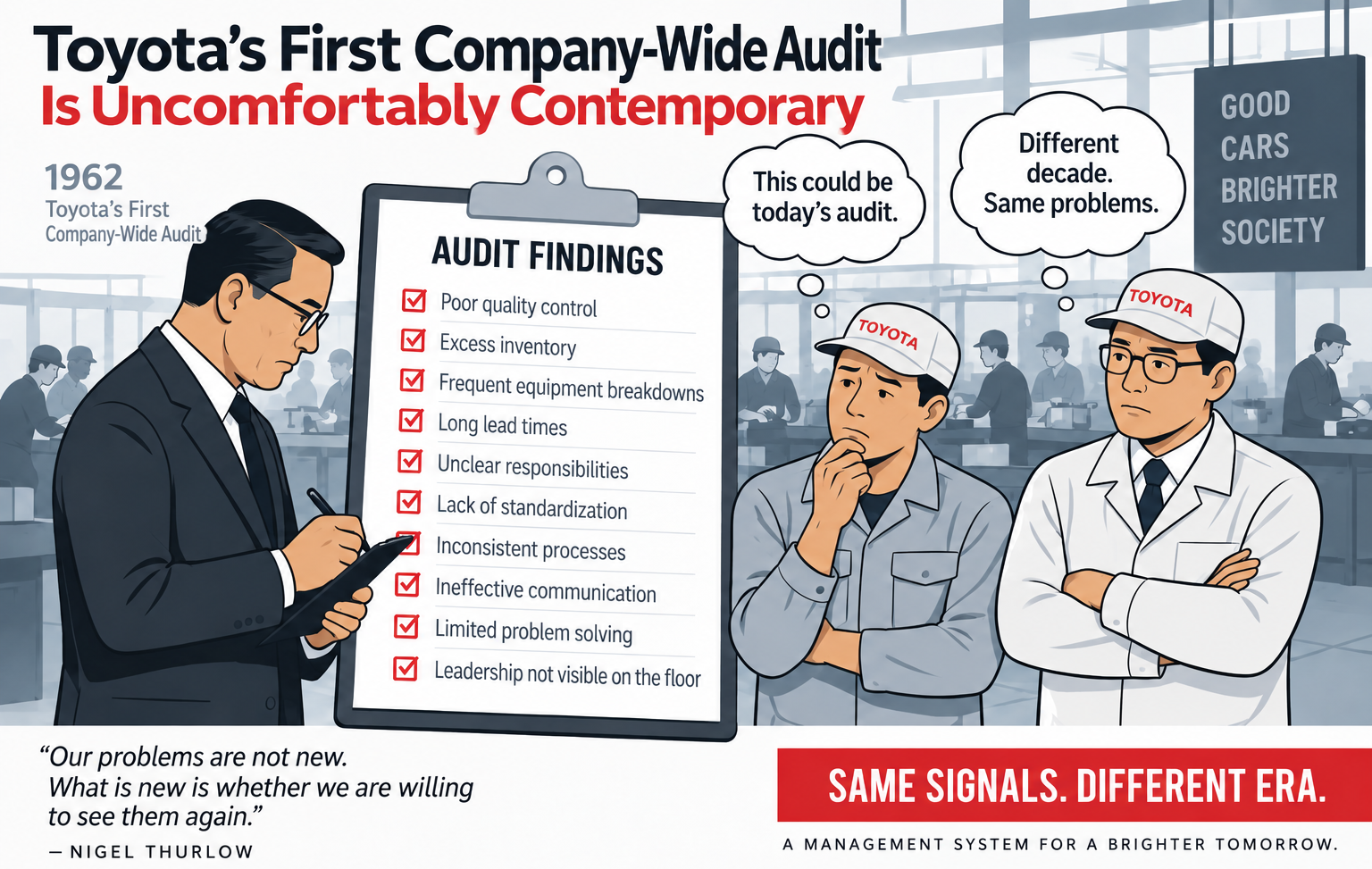
Toyota’s First Audit Is Uncomfortably Contemporary
A year after introducing TQC, Toyota conducted its first company-wide audit. Senior executives inspected departments and examined how management systems were actually operating and what it found should sound equally familiar.
Corporate policy was not sufficiently understood, so different departments were interpreting it in different ways. Long-term planning was weak. Decisions were not consistently grounded in facts and data. And horizontal quality control remained weaker than vertical control, with insufficient cooperation between departments. (Toyota Global)
That was 1962. The same year I was born!
Strip away the historical terminology and ask yourself how many organizations would receive essentially the same diagnosis today.
- Strategy was not translating cleanly into the work.
- Functions were interpreting objectives independently.
- Vertical management was stronger than horizontal cooperation.
- Decision making was not sufficiently grounded in evidence.
In other words, Toyota was discovering that improving individual processes was not enough. The way the organization was managed as a system also had to improve.
And that leads to another important distinction.
Quality Did Not Mean Inspection
The word quality is probably one of the reasons TQM became misunderstood. Mention quality management today and many executives immediately think about defects, inspection, compliance, audits, ISO or the Quality Department, but is way too narrow and Toyota’s early TQC experience demonstrates precisely the opposite.
After TQC was introduced, Toyota records that the belief that product quality could be improved through more thorough inspection gradually shifted toward “building quality into the process.” At the same time, individual departments began cooperating toward common objectives. (Toyota Global)
And the idea was not confined to manufacturing. Toyota’s history records that quality-control management methods were also deployed into its Administrative and Engineering Groups, while the company worked deliberately to improve coordination between groups. (Toyota Global)
This is a fundamentally different conception of quality.
Quality becomes a property of the system: not only the quality of the product or service, but also the quality of the process, the information, the decisions, the management, and the relationships between functions.
Viewed through that lens, TQM stops looking like an old quality program and starts looking like something much more relevant:
A way of thinking about the capability of the organization itself.
The Results Toyota Described Were Management Results
Toyota received the Deming Application Prize in 1965. (Toyota Global), but the interesting part is not simply that it won an award, but more how Toyota subsequently described what had changed.
Shoichiro Toyoda identified obvious business outcomes: improved product quality, increased market share and exports, and achievement of cost-reduction targets. But then he went much further.
- He said managers learned management methods.
- Human relationships across the company improved.
- Suppliers, Toyota Motor Sales and manufacturing could cooperate toward a common objective.
- Responsibility and authority became clearer.
- People became able to hold more frank discussions.
- Processes were standardized.
Toyota says these changes established “a set management system.” (Toyota Global)
That is a remarkable description. Toyota was not saying, “We now have better quality tools.” It was describing an improvement in the corporate capability to manage. And Toyota’s next stated policy is even more relevant to us today.
Following the Deming Prize, it committed to establishing “simple and effective management systems without being preoccupied by form.” (Toyota Global)
Read that again – Without being preoccupied by form. But nearly sixty years later, how much of the improvement industry has become preoccupied by form?
- The format of the A3.
- The appearance of the board.
- The layout of the obeya.
- The maturity level.
- The correct template.
- The correct vocabulary.
- The correct color belt.
- The number of kaizen events.
- The correct definition of Lean.
The form became increasingly visible. The management system became less so.
We Exported What We Could See
This is where I think much of the Lean movement went wrong. We became fascinated by Toyota’s visible mechanisms, which is understandable to a degree as the Lean books lauded Toyota’s methods as the great differentiating tools.
- A kanban card can be photographed.
- An andon can be demonstrated.
- Standard work can be documented.
- Inventory can be counted.
- Setup time can be measured.
- A value stream can be mapped.
Those things travel remarkably well, but management philosophy does not.
- Developing managers capable of thinking systemically is harder than teaching somebody to facilitate a workshop.
- Creating conditions in which problems surface safely is harder than installing a visual management board.
- Changing decision rights is harder than introducing an A3 template.
- Understanding variation is harder than coloring a dashboard red and green.
- Managing horizontally across organisational boundaries is harder than improving one department.
- Building capability is harder than delivering training.
Changing the system is harder than copying the tools.
So the tools travelled. Too often the management system did not.
Lean Became an Industry
Over time, Lean acquired an industry around itself as it relentlessly developed:
- Products — frameworks, books, maturity models, assessments, and proprietary methodologies.
- Credentials — certifications, qualifications, and increasingly specialized practitioner roles.
- Infrastructure — Lean offices, centers of excellence, transformation programs, and consulting ecosystems.
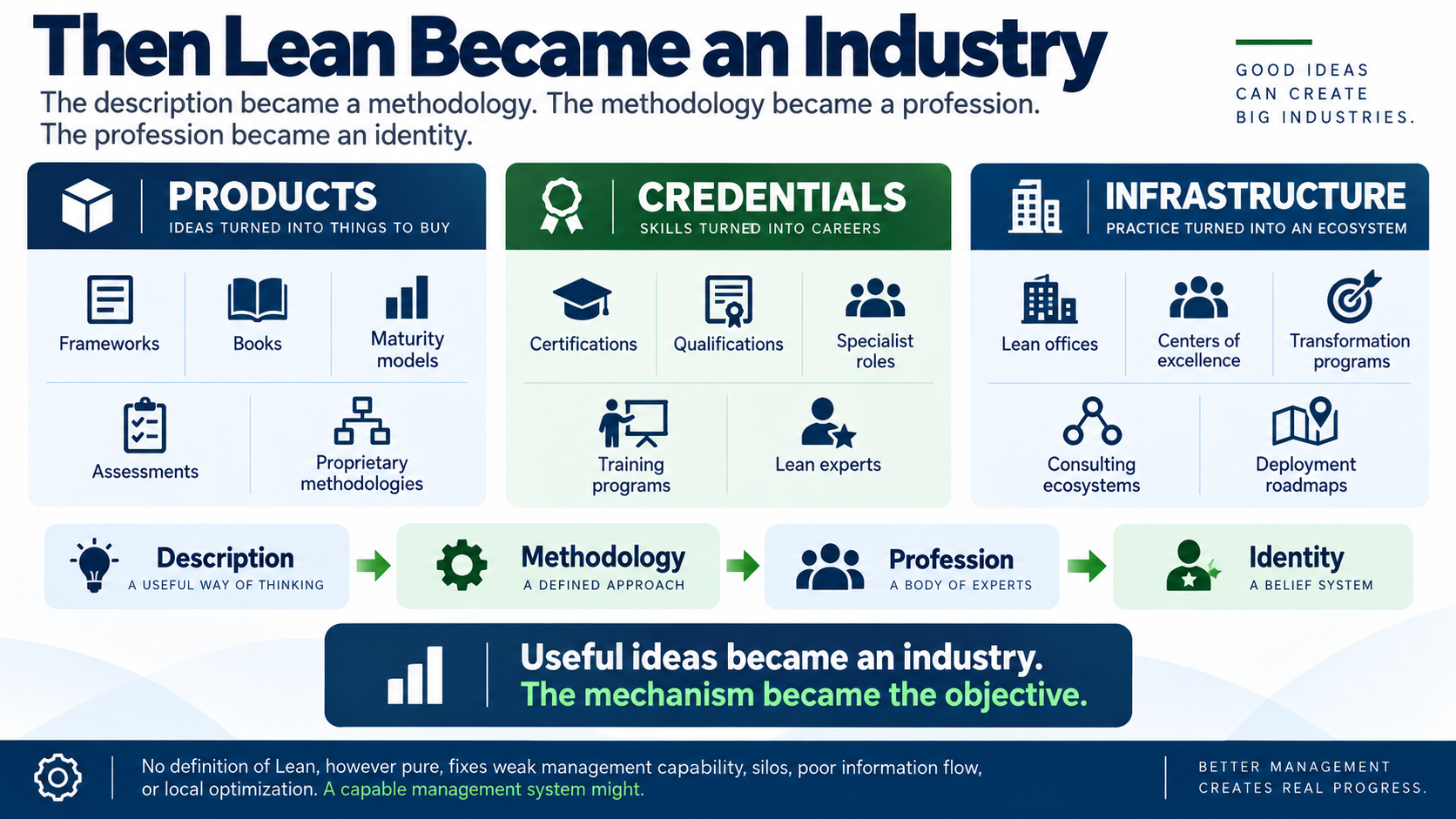
On the surface, none of those things is inherently bad, but the problem begins when the mechanism becomes the objective, and we start asking whether an organization is “doing Lean.” We assess Lean maturity, count practitioners, create deployment roadmaps, and launch Lean transformations. Eventually Lean becomes something an organization implements, rather than a way of understanding and continually improving the system through which value is created.
Then comes the argument about who properly understands Lean and that is an issue for us all, particularly because Toyota was not calling what it was doing Lean in the first place. We created the label.
- Over time, the description became a methodology.
- The methodology became a profession.
- The profession became an identity.
And once something becomes an identity, people inevitably start defending their interpretation of it.
We can then spend enormous amounts of energy arguing about what is and is not “real Lean” while organizations continue struggling with weak management capability, silos, poor information flow, local optimization, and slow decision making.
No redefinition of Lean, however pure, fixes those problems.
A capable management system might.
Then We Bundled Six Sigma
My criticism here is not a criticism of statistical thinking as understanding variation is fundamental to good management, and Toyota itself began investigating statistical quality control in 1949, initially using machining as a model area, before expanding quality-control practices much more widely. (Toyota Global)
The problem came when Lean and Six Sigma became increasingly packaged as deployable products. Lean Six Sigma gave organizations something management tends to find irresistible — structure.
Six Sigma brought:
- Specialists and credentials — belts, certification and dedicated improvement roles.
- Projects and governance — DMAIC, tollgates, sponsors and project pipelines.
- Measures and reporting — dashboards, savings calculations and program metrics.
Again, none of those things is inherently wrong.
DMAIC can be useful. But it is not some superior replacement for PDCA. It is a more structured method suited to particular kinds of problems, while PDCA remains a fundamental cycle of learning and improvement.
The bigger issue is what happened to improvement itself. It could now be packaged, governed, reported, and assigned to specialists. Problems became projects. Learning became something that happened inside formal improvement activity rather than through the everyday management of the work. The people doing the work could increasingly become participants in improvement rather than the people continuously improving it. And management could begin to treat continuous improvement as something being handled elsewhere.
That is the part I that upsets me the most.
Continuous improvement became an activity instead of a characteristic of the management system.
So, What Exactly Is TQM?
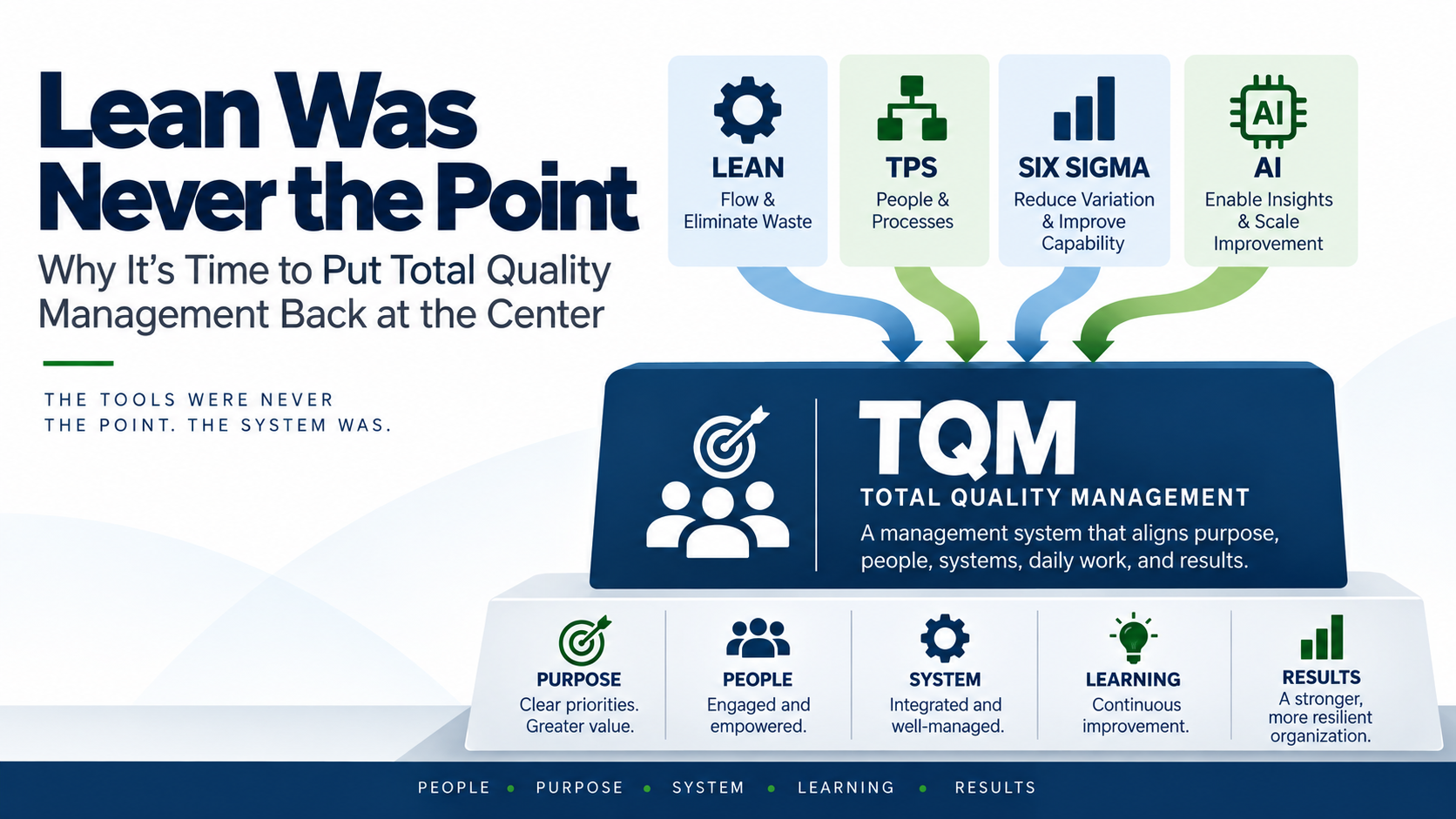
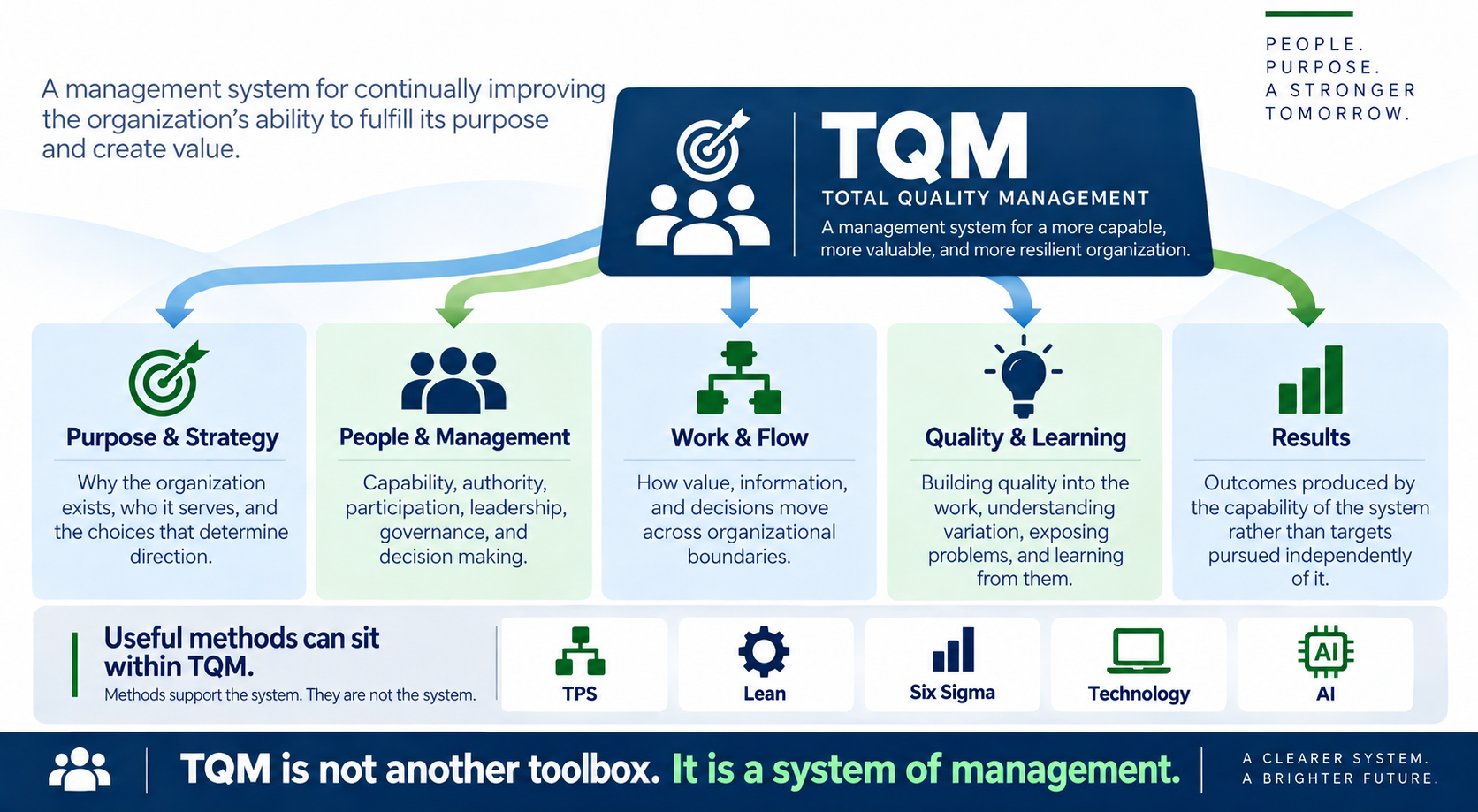
This is where I want to be very clear. TQM is not Lean with some extra things added to it. It is not another toolbox competing with the Lean toolbox. It operates at a different level and properly understood, TQM is a system of management through which an organization continually improves its ability to fulfill its purpose and create value.
It connects the following:
- Purpose and strategy — why the organization exists, who it serves and the choices that determine direction.
- People and management — capability, authority, participation, leadership, governance and decision making.
- Work and flow — how value, information and decisions actually move across organizational boundaries.
- Quality and learning — building quality into work, understanding variation, exposing problems and learning from them.
- Results — outcomes produced by the capability of the system rather than targets pursued independently of it.
This is not merely a historical interpretation. Look at how JUSE describes TQM today.
Its current Deming Prize guidance explicitly includes policy management, daily work management, cross-functional activities, problem solving and small-group improvement. It then connects these to wider management systems including quality assurance, cost management, delivery, safety, business operations and organizational strategy. Most importantly for this argument, JUSE tells organizations to describe Toyota Production System, Six Sigma or TPM if they are being practiced as TQM activities. (JUSE Guide to The Deming Prize)
Think about the hierarchy implied by that. TPS is not positioned as a competing management philosophy. Six Sigma is not positioned as a competing management philosophy. They can be activities within TQM, and that’s the relationship I think we have lost.
Lean rightly draws our attention toward flow, value, waste, and improvement. Those things matter enormously. But management has to deal with a wider set of questions: purpose, strategy, capability, authority, decision making, cross-functional cooperation, information, variation, learning, and how all of those things connect to daily work.
Those are not Lean-tool questions. They are management-system questions.
That is why I think TQM gives us the bigger and more useful frame. It changes the conversation from Which tools should we implement to What system of management do we need?
And perhaps the simplest test becomes: Does this help us understand, manage, and improve the system?
The System, Not the Tool, Is the Unit of Improvement
You can have all the Lean tools and still have a badly managed system. I have seen organizations with substantial Lean infrastructure, CI departments, coaches, kaizen blitzes, and they remain fundamentally badly managed.
- They have visual management boards while the information that really matters remains invisible.
- They hold daily meetings while nobody in the room has the authority to act.
- They run kaizen events while their incentive system encourages completely different behavior.
- They map value streams while budgeting and organizational structures reinforce silos.
- They teach problem solving while managers continue demanding predetermined answers.
- They remove waste from one function and create a larger queue somewhere else.
- They maximize utilization while destroying flow.
- They hit every target while making the customer experience worse.
- They automate activities without understanding the system through which the work flows.
- And they celebrate continuous improvement while announcing another transformation every few years.
There is no contradiction here. The tools can be present. But the management system can still be missing.
This connects directly with something I have been also writing about increasingly when discussing AI and agentic systems, and I have argued: The system, not the agent, is the unit of analysis. The same principle applies here. The system, not the tool, is the unit of improvement.
A locally successful intervention does not necessarily improve the whole. A team can increase throughput and create a downstream bottleneck. A manager can increase utilization and increase lead time. Automation can accelerate work directly into a constraint. Procurement can reduce unit cost while increasing total cost. Every part can appear to improve while the system performs worse. That is the danger of local optimization.
And no collection of tools protects us from it if we fail to understand the system in which those tools are being applied. So the unit of analysis has to be the system.
And therefore: The system, not the tool, must also become the unit of improvement.
Purpose → System → Work → Learning → Results
For me, this provides a useful way of thinking about TQM without turning it into yet another methodology.
- Start with purpose. Understand the system required to fulfill that purpose, and understand how the work actually happens within that system.
- Make that work and its conditions visible enough for meaningful signals to emerge, and enable/allow people to respond where they can.
- Escalate what cannot sensibly be resolved locally, and use that to learn from what happens.
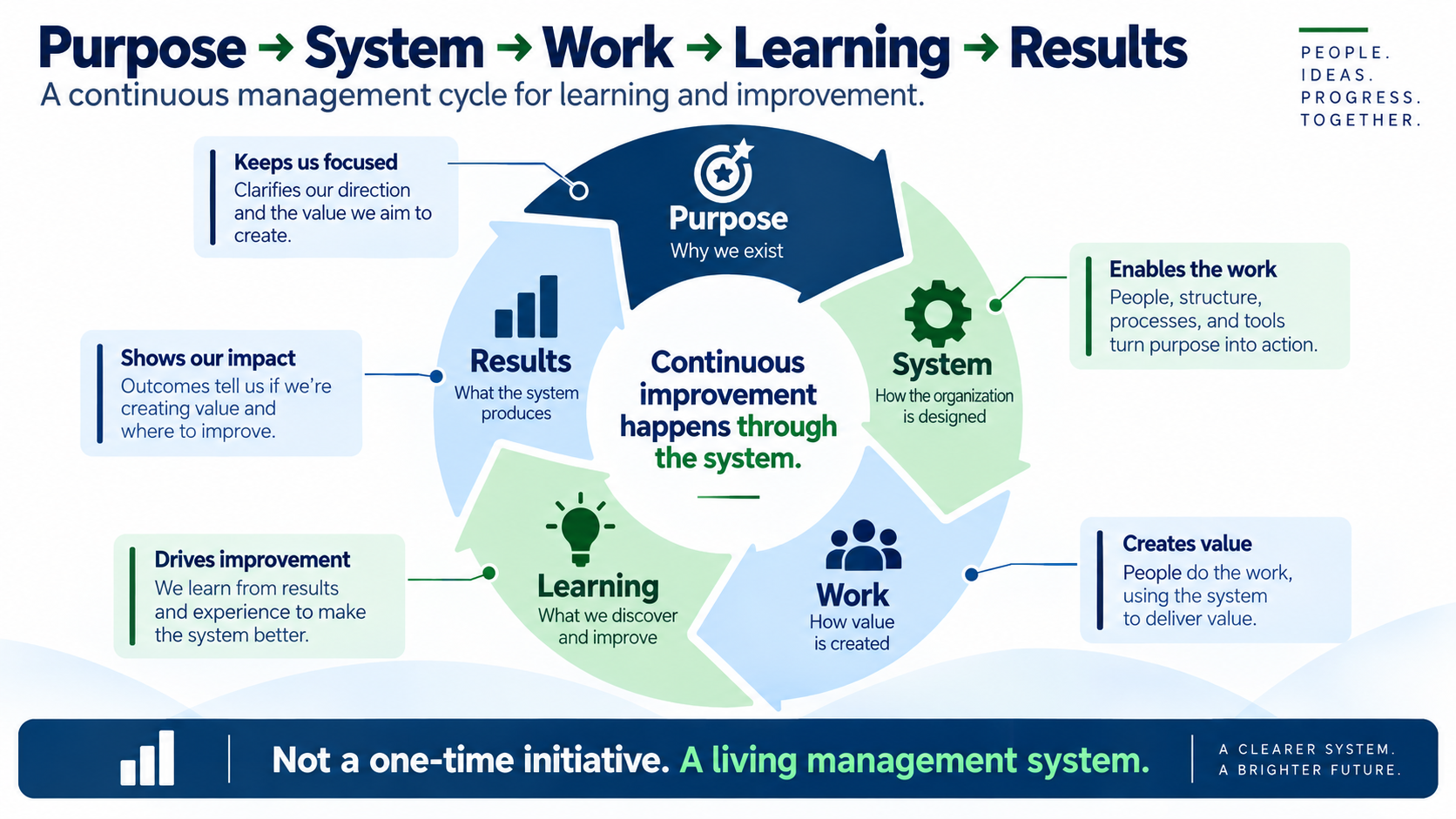
Image and idea copyright Nigel Thurlow 2026
Change the system and observe the results.
Then repeat. Purpose → System → Work → Learning → Results.
Continuous improvement is therefore not something periodically done to the organization. It is the mechanism through which the organization learns.
Then leaders may stop asking if “we are doing Lean” and might, if we are lucky, start asking.
- Do people understand the purpose of the system and how their work contributes to it?
- Can we see how work, information and decisions actually flow across organizational boundaries?
- Can meaningful signals and emerging problems surface quickly enough for us to act?
- Do people have the capability and authority to respond, with clear escalation when they cannot?
- Do our measures help us understand the system, or encourage optimization and gaming of individual parts?
- Does what we learn actually change the way the system works?
I would learn more about the health of an organization from the answers to those questions than from any Lean maturity assessment I have ever seen.
Daily Management Is Where This Becomes Real
None of this works if TQM becomes another layer of activity added on top of the work. If people have to step outside the real management system to participate in the improvement system, we have already lost. Improvement and management have to become the same conversation.
This is why JUSE’s inclusion of daily work management matters. Daily management is not merely a fifteen-minute meeting in front of a board. It is how purpose and policy connect with what is actually happening in the system today — how meaningful signals surface, how people respond, how issues escalate, and how learning changes the work. (JUSE Guide to The Deming Prize)
The huddle, the board, or the software dashboard is simply the mechanism.
The form is not the purpose.
Total Quality Management Failed Too
There is probably a loud objection to all of this. We tried TQM before!
And yep, that’s true.
In many Western organizations, TQM itself became corrupted. It became slogans, quality councils, mission statements, manuals, training programs, awards, and consultants.
In other words, TQM suffered much the same fate that Lean subsequently suffered. We took an idea about how an organization should be managed and turned it into a program to be implemented inside the organization.
So I am not advocating a new TQM transformation and, if that is where this ends up, we will simply have missed the point all over again.
JUSE also explicitly warns against this kind of standardized model. Its Deming Prize guidance says organizations are not required to conform to a model supplied by the Prize Committee. They are expected to understand their own circumstances, establish their own objectives and improve themselves organization-wide. (JUSE The Development of Quality Control in Japan)
I think that sounds remarkably different from buying a maturity model and working your way through the levels.
TQM should not be something management deploys. TQM should be about continually improving management itself.
Management Cannot Outsource Management
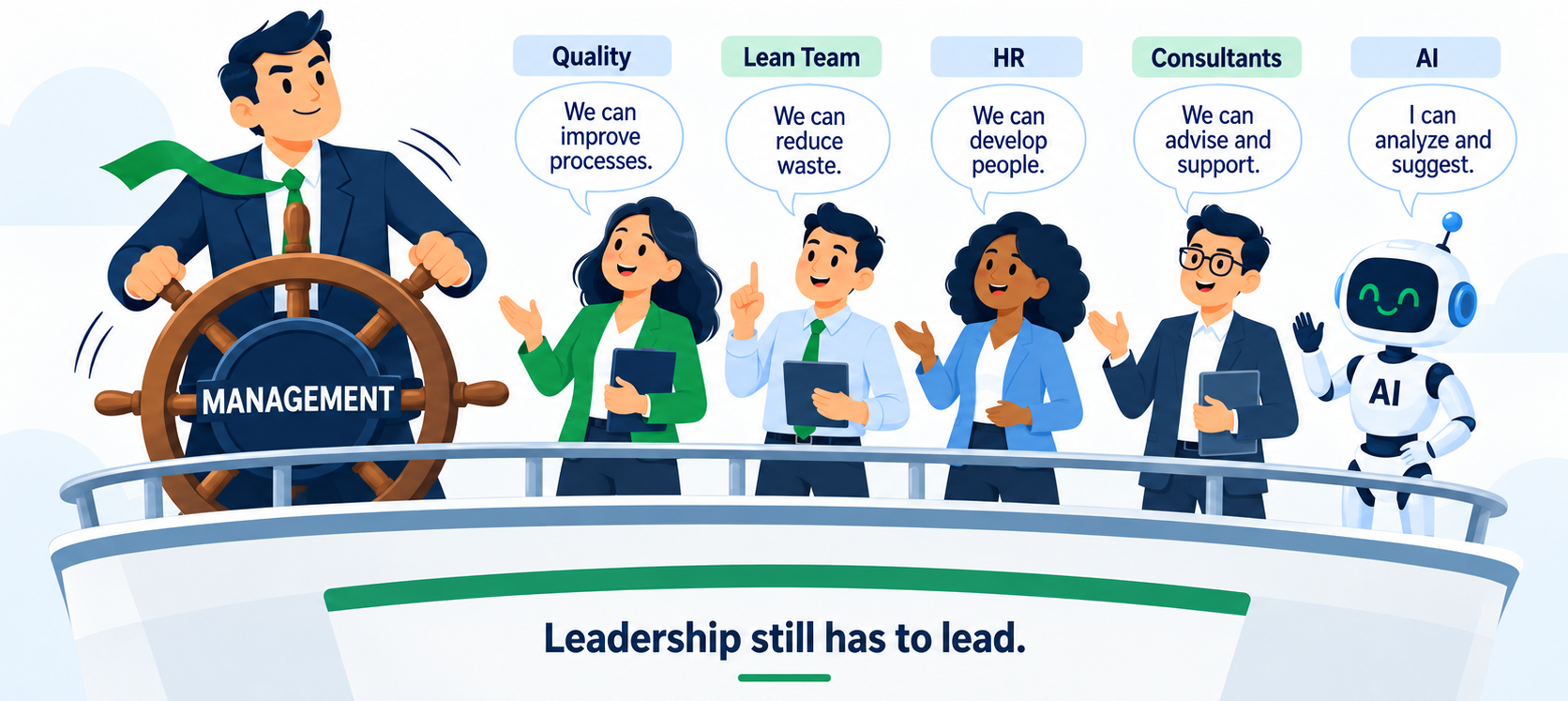
Perhaps this is ultimately the most important point. Management cannot outsource management.
- It cannot delegate quality to Quality.
- It cannot delegate improvement to the Lean team.
- It cannot delegate culture to HR.
- It cannot delegate transformation to consultants.
And it cannot now delegate thinking to AI.
- Specialists can help.
- Methods can help.
- Statistics can help.
- Technology can help.
- AI will undoubtedly help.
But someone still has to understand the system.
- Someone has to establish purpose.
- Someone has to understand the relationships between the parts.
- Someone has to decide where authority should sit.
- Someone has to create conditions in which uncomfortable information can surface.
- Someone has to distinguish meaningful signals from noise.
- Someone has to understand whether an intervention actually improved the whole or simply moved the problem somewhere else.
That is management.
And management itself has to become capable of continuous improvement.
It’s Time to Bring Back Actual TQM
So the three letters that many people consigned to management history deserve another look. T – Q – M.
- Not as a certification.
- Not as a department.
- Not as another transformation.
- Not as a maturity model.
And certainly not as another toolbox.
Take the words seriously.
Total. Because the whole system matters.
Quality. Because quality applies to products, services, processes, information, decisions, relationships, work and management itself.
Management. Because this is ultimately about how the organization is run. Every day.
Toyota’s history makes this very clear. When rapid growth exposed weaknesses in quality, training, managerial capability and cross-functional cooperation, Toyota deliberately expanded quality control into a company-wide approach intended to improve business management through participation. Its subsequent account describes clearer authority and responsibility, better cooperation, improved management methods, standardized processes and the creation of a coherent management system. (Toyota Global)
At the same time, Toyota continued developing the production system that would become globally known as TPS. Toyota today describes TPS around jidoka, Just-in-Time, waste elimination, lead-time reduction and daily incremental kaizen. (Toyota Global)
These were not competing ideas, and one does not require us to reject the other. The mistake is assuming that the production and improvement methods constitute the whole management system.
Even today, JUSE’s TQM framework makes room for the Toyota Production System and Six Sigma as activities within the broader practice of TQM. (JUSE Guide to The Deming Prize)
Perhaps we have spent so much time studying the tools and techniques that we have neglected the wider management system within which they made sense.
Lean Was Never the Point
I am not suggesting Lean has nothing left to offer. Of course it does, and I advocate for it daily, and the principles behind much of it remain enormously valuable.
What I question is whether the thing we now call Lean has become so burdened by tools, brands, certifications, transformations, methodologies and competing factions that we have lost sight of what we were trying to accomplish in the first place.
We do not need another argument about who understands Lean correctly. What we need therefore is better organizations.
- Organizations that can see.
- Organizations that can learn.
- Organizations that can respond.
- Organizations that develop their people.
- Organizations that improve the flow of value rather than optimize isolated pieces.
- Organizations in which problems surface rather than disappear into reports.
- Organizations capable of adapting without periodically declaring another transformation.
Toyota’s own historical record provides an important clue. When growth exposed weaknesses, the company did not simply reach for another production technique. It confronted shortcomings in management capability, training, quality and cooperation between functions, and broadened its quality activities into a company-wide management initiative. (Toyota Global)
Maybe that is the part of the story we should be paying much more attention to.
So rather than asking: How do we bring Lean back to its roots? I think there is a more useful question: How do we build a management system capable of continually improving the way the organization creates value?
And for me, it’s the reason to put Total Quality Management back at the center of the conversation. Not because TQM is a better brand than Lean. Not because we need another three-letter acronym. And certainly not because we need another movement. But because it gives us a bigger and more useful frame.
Purpose. System. People. Work. Learning. Results.
- The tools are useful.
- Statistical thinking has merit.
- Lean gives us purpose.
- TPS is foundational.
But none of them should become the object of devotion. They exist to help us understand and improve the organization.