Seeing Variation: The Leadership Skill That Changes Everything
Drawing on more than three decades of experience helping organizations improve performance—including serving Toyota in leadership—this article explores why leaders routinely misdiagnose delay and how learning to see process variation changes everything.
“If I had to reduce my message for management to just a few words, I’d say it all had to do with reducing variation.”
— W. Edwards Deming Out of the Crisis, MIT Press, 1986.
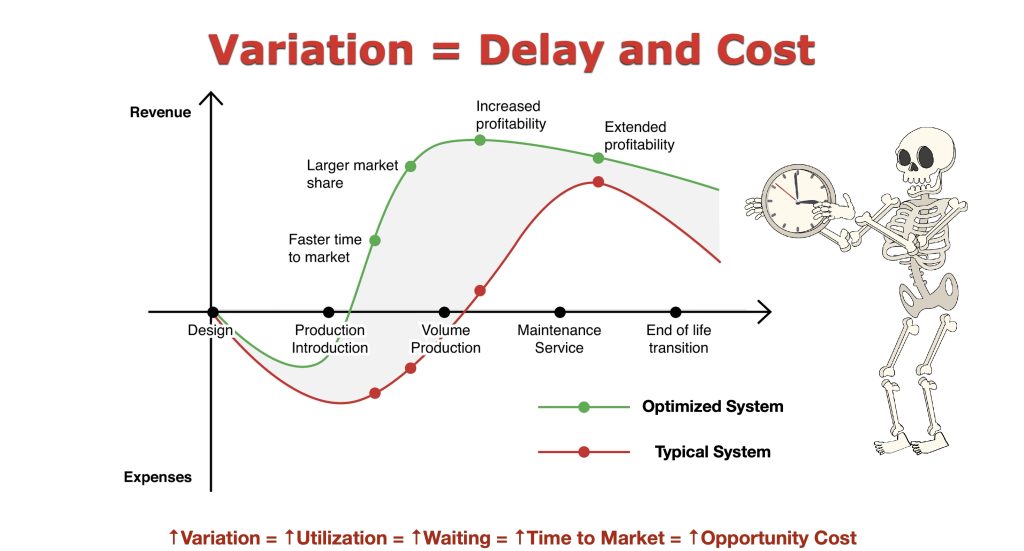
Most leaders respond to delays by increasing pressure, adding controls or demanding more accurate forecasts. Yet the deeper problem is rarely effort or commitment. It’s variation moving unnoticed through the system.
This article explains why variation creates queues, delay, rework and waste, why forecasts can become more accurate without improving performance, and why learning to see variation is one of the most important disciplines of leadership.
Note: Waste is the term we use generically for anything non-value-added in work or process.
Estimated reading time: 30–35 minutes
Key Takeaways for Leaders
- Variation is not the same as poor performance. Every system varies. The leadership challenge is to distinguish normal fluctuation from evidence that something meaningful has changed.
- Most recurring performance problems are created by the system. Pressuring or blaming individuals for predictable system outcomes often adds instability without addressing the underlying cause.
- Averages hide the experience of variation. Two processes can report the same average while producing very different levels of consistency, reliability and customer trust.
- Long time horizons can conceal chronic instability. Aggregating performance over longer periods may smooth away meaningful variation, making recurring dysfunction appear normal.
- Variation creates queues, delays, rework and waste. What appears to be an isolated problem is often the downstream effect of instability introduced much earlier in the system.
- High utilization undermines flow. Systems operating near full capacity have little ability to absorb normal disruption, so small fluctuations quickly become long delays.
- Limiting work in progress improves speed and predictability. Starting more work does not create more progress. It increases queues, coordination demands and completion times.
- Forecasting delay is not the same as reducing it. Better analytics can improve predictions, but only changes to the system can remove the conditions repeatedly creating uncertainty.
- Standardization should support learning, not rigid compliance. A stable baseline makes abnormal conditions visible and allows teams to determine whether a change produced genuine improvement.
- AI will amplify the system into which it is introduced. It can accelerate valuable work, but it can also spread unclear priorities, weak decisions and unnecessary complexity more quickly.
- Leadership begins with seeing before solving. A leader’s first responsibility is to help the organization recognize variation, understand its causes and improve the system before problems become crises.
Table Of Contents
1. Why Leaders Misunderstand Variation
Most leaders believe they understand why work takes longer than expected. Ask an executive why a project is running late and you will usually hear familiar explanations.
- A supplier failed to deliver on time.
- Customer requirements changed unexpectedly.
- A critical engineer resigned.
- The market shifted.
- A software rollout introduced defects.
- One department failed to meet its commitments.
- Someone made a mistake.
Each explanation sounds entirely plausible because viewed in isolation, each is true. The problem is that these explanations describe events, not causes. They tell us what happened, but they rarely explain why remarkably similar problems continue to emerge across different teams, different industries and different decades.
- Projects overrun.
- Costs escalate.
- Lead times increase.
- Customers become frustrated.
Managers then respond with new initiatives, new reports, new meetings and new controls, yet the same problems return wearing different disguises.
After more than thirty years working with organizations around the world, I have become convinced that many leaders spend their careers solving visible problems while overlooking one of the most important characteristics of every system they manage.
That characteristic is variation.
Mention variation and many people immediately think of statisticians, control charts or Six Sigma specialists armed with sophisticated software. Somewhere along the way, one of the most important ideas in management became wrapped in mathematics, leaving many leaders believing it belonged to someone else.
It doesn’t. Variation is not primarily a statistical concept. It is a leadership concept.
Every organization lives with variation every day.
- Customers place orders unpredictably.
- Suppliers deliver with differing levels of reliability.
- Transport is impacted by weather and other delays.
- Decisions vary in their quality and effectiveness.
- Demand rises and falls as markets and seasons change.
- Equipment performs differently under changing conditions.
People bring different skills, experience and judgement to every situation. Even the most carefully designed systems behave differently from one day to the next.
The question is therefore not whether variation exists. The question is whether we recognize how it moves through our organizations and how our own management decisions either absorb it or amplify it.
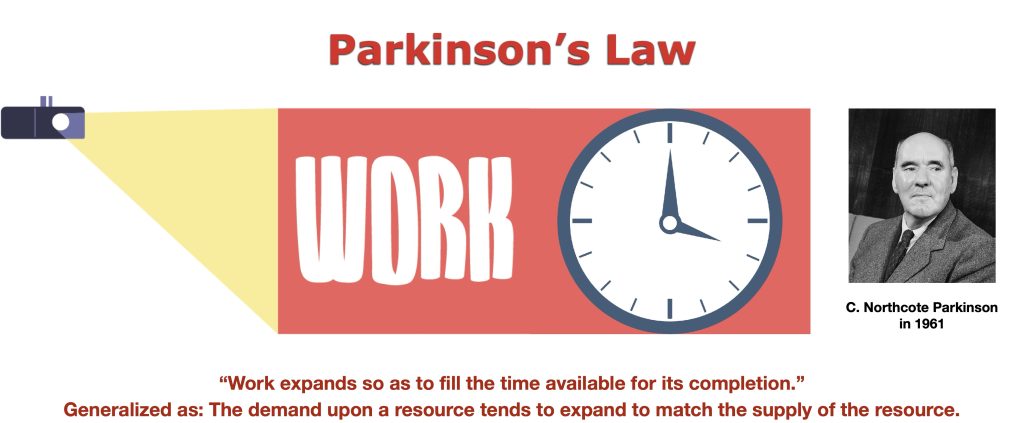
This is where many organizations begin to struggle.
Leaders notice delivery dates slipping, queues becoming longer and costs steadily increasing. They see teams working harder while outcomes become less predictable. Their instinct is understandable.
- More meetings are scheduled.
- Additional reporting is introduced.
- New governance processes appear.
- Planning cycles become longer.
- Layers of approval multiply.
Each intervention is intended to create greater certainty. Collectively, they often achieve the opposite. The organization becomes busier, but not faster. More disciplined, but not more adaptable. More controlled, but frequently less capable of responding to change.
The irony is that many of these well-intentioned interventions introduce even more variation into the system they were supposed to stabilize. Understanding variation changes requires leaders to ask different questions.
- Instead of asking why this particular project failed, they begin asking why similar failures repeatedly emerge across apparently unrelated work.
- Instead of treating every delay as an isolated incident, they start looking for the conditions that make delays inevitable.
- Instead of blaming individuals, they begin examining the system those individuals work within.
It may seem like a small change in perspective, but it fundamentally changes how leaders understand and respond to problems.
2. Learning to See What Others Miss
One of the greatest lessons I learned during my years at Toyota had nothing to do with Kanban, standard work or continuous improvement.
It was learning to see.
That may sound almost disappointingly simple, yet it is one of the most demanding disciplines in leadership. Improvement does not begin when we solve problems. It begins much earlier, when we become capable of seeing problems that have gradually become invisible to everyone else.
Most organizations are remarkably good at observing activity. An old boss used this refrain whenever management was approaching: “Heads down, tails wagging.”
- They see people working.
- They see meetings taking place.
- They see projects progressing.
- They see products being shipped and customers being served.
What they often fail to notice are the countless interruptions quietly accumulating beneath the surface.
- A machine waits while an operator searches for a tool.
- An engineer loses two days waiting for an approval.
- A customer request sits unread because no one is quite sure who owns it.
- A purchase order is returned because information was entered in a slightly different format.
- A meeting ends without a decision because another meeting is required first.
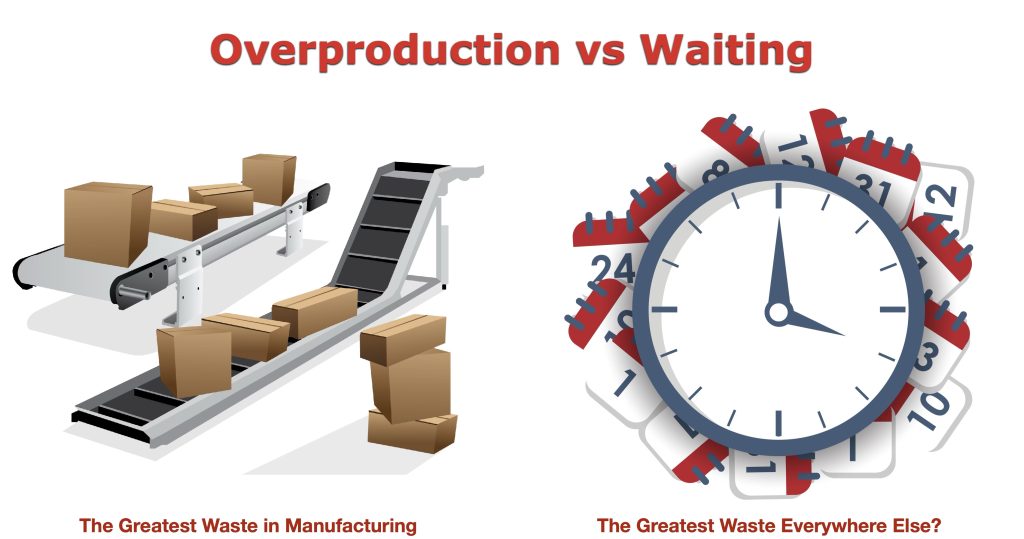
None of these events appears particularly significant. None will usually appear in a board report. None will trigger an executive review. Yet together, they determine whether work flows smoothly or spends most of its life waiting. This is what we call the cost of delay.
Ohno taught us that overproduction is the greatest waste in manufacturing because it leads to all other forms of waste. I have come to believe that, away from the plant, waiting is the greatest waste of all.
One distinction is key.
Organizations rarely eliminate waste by attacking waste directly. They eliminate it by understanding the conditions that continually recreate it.
Variation is one of those conditions.
Once you learn to recognize it, you begin seeing the same patterns everywhere. Different industries may use different language, different technologies and different operating models, but the underlying dynamics remain remarkably similar. Small inconsistencies accumulate into larger delays. Minor interruptions propagate through interconnected systems. Local inefficiencies become organization-wide constraints.
The waste is easy to see. The variation that created it is often hidden in plain sight.
Toyota taught me that the first responsibility of leadership is not to provide answers. It is to improve the quality of what the organization is capable of observing. Until we can all see variation clearly, we have very little chance of managing it intelligently. And once you see waste you can never unsee it. The next time you look at a queue for Starbucks you will realize what I mean.
3. We Live in a Variable World
Having established the importance of variation, it is tempting to conclude that the solution is simply to eliminate it, but that would be a mistake as variation is not inherently bad. In fact, some forms of variation are essential.
- Customers are different.
- Markets evolve.
- Technology advances.
- Competitors innovate.
- Scientific discoveries reshape industries.
Creative thinking depends upon experimentation, and experimentation inevitably introduces variation. Organizations that eliminated every form of variation would eliminate innovation itself. PDCA thrives on variation, and all those agile initiatives could not survive without it.
The challenge for leaders is therefore not to remove variation, but rather to distinguish between variation that creates value, and variation that quietly destroys it.
Consider a restaurant. Every customer ordering something different is a form of variation, but it is valuable variation because it reflects individual choice. No successful restaurant would dream of eliminating that, but too much choice could debilitate it.
Now imagine a different kind of variation.
- Every chef prepares the same meal differently.
- Every waiter follows a different process.
- Bills are calculated differently depending on who serves the table.
- Food reaches customers in unpredictable order.
- Payment takes a different amount of time every evening.
None of this improves the dining experience. It simply introduces inconsistency, delay and unnecessary complexity. If your diners are complaining, this is were you should start looking.
One form of variation creates value. The other consumes resources without creating any.
Many organizations confuse the two. They attempt to standardize creativity while tolerating inconsistency in routine work. They invest enormous effort trying to make people think alike while accepting wildly different ways of performing tasks that should be predictable.
Toyota approached the problem from the opposite direction.
Routine work became highly stable, not because conformity was the goal, but because stability created the conditions for learning. When routine work behaves consistently, abnormalities become visible. Experiments become easier to evaluate. Improvements become easier to measure.
Standardization, properly understood, does not suppress creativity, one of the complaints software developers state. It creates the stable platform from which creativity can flourish. This distinction remains just as important today as it was when the Toyota Production System was first being developed.
4. From Shewhart to Deming: Understanding Common and Special Causes
Long before Toyota became synonymous with operational excellence, an engineer working at Bell Telephone Laboratories quietly changed the way we understand performance.
In the 1920s, Walter A. Shewhart made an observation that now seems almost obvious, yet at the time it represented a profound shift in thinking.
Every process varies.
Whether manufacturing telephone components, treating patients, processing insurance claims or developing software, no process produces exactly the same result every single time. Small differences are inevitable because every system is influenced by countless factors, many of which are impossible to control completely.
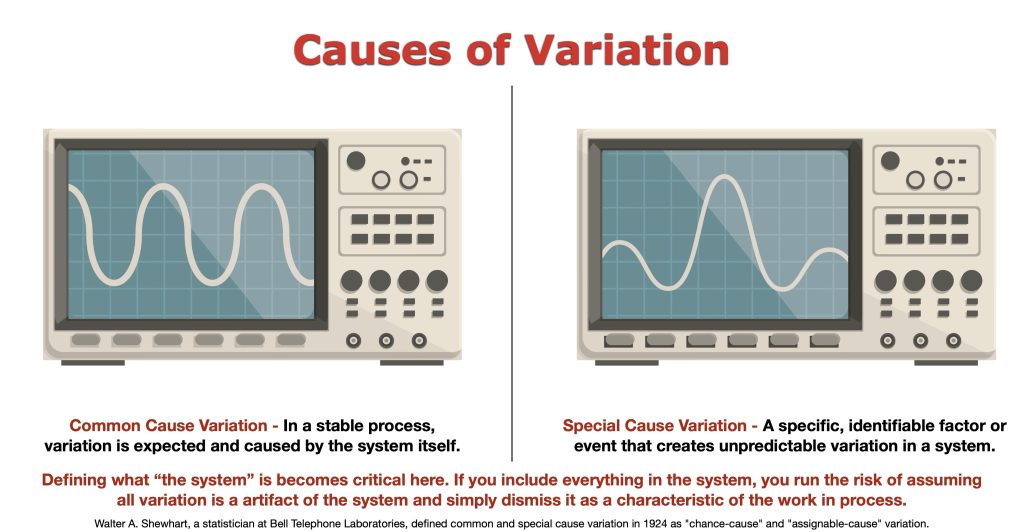
The real breakthrough, however, was not recognizing that variation exists. It was recognizing that not all variation has the same origin. Shewhart distinguished between what he called “chance causes” and “assignable causes”. Deming later reframed these as common causes and special causes, the terms most people use today.
Common Causes
Common causes are the natural behavior of a stable system, the countless small influences built into the system itself. Every process exhibits some degree of inherent variability. Individual observations differ slightly, but they remain within the capability of the system itself. They are the natural behavior of the process. Minor differences in material, slight changes in temperature, small differences in technique, fluctuations in demand and hundreds of other factors combine to create the everyday variation we should expect.
Special causes are different.
- A machine breaks down.
- A supplier ships defective material.
- A cyberattack interrupts operations.
- A software update introduces an unexpected defect.
Something unusual has happened that lies outside the normal behavior of the system. This distinction changed management forever because it changed the questions leaders should ask.
If a process is operating normally, reacting aggressively to every fluctuation often makes performance worse rather than better. Every intervention introduces another disturbance into a system that was already behaving exactly as expected. Conversely, when genuine abnormal variation appears, ignoring it allows the problem to spread through the organization until the consequences become impossible to ignore.
The challenge is not deciding whether performance has changed. It’s deciding whether the system has changed. That’s a much more difficult question. It also happens to be the one that matters.
Deming Changed the Conversation
If Shewhart gave us the scientific foundation, W. Edwards Deming transformed it into a philosophy of leadership. Deming understood that organizations had become remarkably skilled at managing the visible symptoms of poor performance while paying comparatively little attention to the systems producing those outcomes.
His famous observation that around 94 percent of problems belong to the system has been quoted so often that many people have forgotten its significance. The precise percentage is almost irrelevant. It’s the principle that matters.
If the system largely determines performance, then continually rewarding or blaming individuals while leaving the system untouched can never produce lasting improvement. That idea challenged many of the assumptions upon which twentieth-century management had been built.
- Poor quality was often attributed to careless workers.
- Late projects were blamed on weak project managers.
- Customer complaints became evidence of poor customer service.
- Sales shortfalls triggered changes in personnel.
Deming encouraged leaders to pause before reaching those conclusions.
- What if the individuals were not the primary cause?
- What if intelligent, committed people were simply responding to the conditions the organization had created?
The implications are uncomfortable because they move responsibility upward, so instead of asking, “Who made the mistake?”, the better question becomes, “Why did our system make that mistake possible?”
That single shift in approach changes the role of leadership completely. Leaders become architects rather than judges. Their responsibility is no longer confined to monitoring performance. It becomes designing better systems in which good performance is the natural consequence of the way work is organized.
This is one of Deming’s greatest gifts.
He moved the conversation away from people and towards systems. Away from blame and towards understanding. Away from isolated events and towards recurring patterns.
His work still underpins almost every serious discussion about quality, operational excellence and organizational learning today. Yet, despite his influence, many organizations continue behaving exactly as he warned against.
- They reward individuals for outcomes they did not create.
- They punish people for failures the system made almost inevitable.
- They explain results instead of redesigning the conditions that produced them.
Understanding variation requires us to do something much harder. It requires us to become students of the system itself, and leaders seem to find this tremendously hard.
5. Donald Wheeler and the Cost of Misunderstanding Variation
If Shewhart established the science of variation and Deming transformed it into a philosophy of management, Donald J. Wheeler performed another equally important service. He showed leaders how remarkably easy it is to misunderstand the evidence sitting in front of them. That may sound surprising in an age overflowing with dashboards, analytics and artificial intelligence, but Wheeler’s central message has become even more relevant over time.
Organizations rarely suffer from a shortage of data. They suffer from a shortage of understanding.
Consider this familiar pattern. A metric falls. Someone demands an explanation. A recovery program is launched. The following month the numbers improve, and leadership concludes that the intervention worked. Very often, nothing meaningful changed. The system simply continued behaving as it always had.
This misunderstanding quietly drives management decisions every day. Sales decline slightly and strategy changes. Customer satisfaction rises for a quarter and executives declare an initiative successful. A software team completes less work during one sprint and leadership reorganizes the team. The following month, performance returns to its previous level. The organization credits the intervention. In reality, the system may simply have varied.
Deming also cautioned us to understand what type of variation we are dealing with before assigning cause.
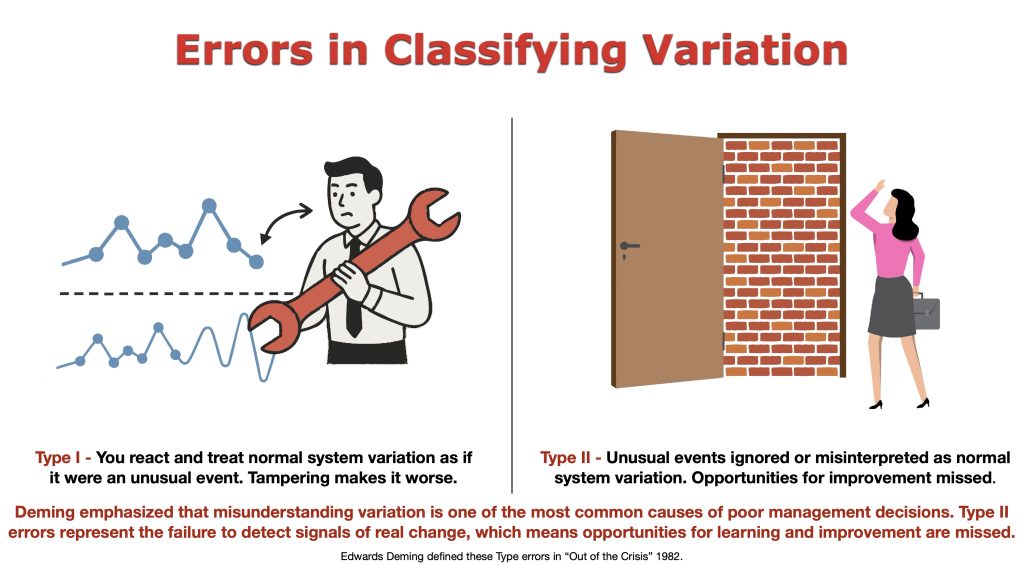
Wheeler has spent decades demonstrating that one of the greatest dangers in management is confusing ordinary fluctuation with meaningful change. The irony is that leaders who react to every movement in performance often become another source of instability themselves.
- Every new initiative interrupts existing work.
- Every emergency meeting delays something else.
- Every hastily introduced process adds complexity.
- Every demand for an explanation consumes capacity that could have been used to improve the system.
In trying to control variation, leaders frequently create more of it. Wheeler’s response is deceptively simple. Before reacting, ask one question:
Has the system actually changed?
That question lies at the heart of the Process Behavior Chart, more commonly called a control chart. Contrary to popular belief, its purpose is not to turn managers into statisticians. It is to improve judgement.
Note: Donald Wheeler prefers the term Process Behavior Chart because its purpose is to understand how a process behaves rather than simply to control it. The chart is still more commonly known as a control chart.
A Process Behavior Chart helps distinguish the ordinary movement of a stable system from a genuine signal that something unusual has happened. Without that distinction, every upward movement looks like success, every downward movement looks like failure, and every fluctuation invites another intervention. Making the distinction requires patience and intellectual discipline.
Human beings are extraordinary pattern-recognition machines. We instinctively search for causes, even when no meaningful cause exists. Random events become convincing stories. Coincidences become trends. Temporary fluctuations become evidence that a decision succeeded or failed. This is known as Apophenia — perceiving meaningful patterns or connections in random events.
Leadership intensifies this tendency.
- Boards expect answers.
- Investors expect confidence.
- Employees expect direction.
Few executives feel comfortable saying “I don’t yet know whether anything has actually changed”, yet that may be the most honest and disciplined answer available.
This is where Wheeler’s contribution extends far beyond quality management. He reminds us that leadership begins with humility, something leaders truly need to master!
- Before changing a process, understand how it normally behaves.
- Before celebrating an improvement, establish whether performance genuinely changed.
- Before criticizing an individual or team, determine whether the outcome represents an abnormal event or the predictable behavior of the system in which they work.
Only then should intervention begin.
This whole philosophy described by Wheeler resonates deeply with what I experienced inside Toyota.
Problems were never ignored. Quite the opposite. Genuine abnormalities were treated with enormous urgency. The discipline lay in distinguishing those abnormalities from the ordinary rhythm of the system. That prevented people from chasing noise while ensuring that meaningful signals received immediate attention.
Many organizations reverse those priorities. Every fluctuation becomes urgent. Every dashboard drives another meeting. Every movement in performance demands another explanation, and leaders become overwhelmed with information while understanding surprisingly little.
Wheeler leaves us with a powerful reminder that the purpose of measurement is not to generate activity, it is to improve understanding. Only when we understand how a system normally behaves can we recognize when something important has changed. Only then can leadership direct its energy where it creates the greatest value, not reacting to every fluctuation, but improving the system that produces it.
6. Toyota Turned Theory into Practice
When I joined Toyota, I didn’t find people debating statistical theory on the factory floor. Nobody was walking around quoting Shewhart. Deming’s name was never mentioned in everyday conversation, and Donald Wheeler’s books certainly weren’t lying open beside production lines, and I doubt many reading this have ever heard of him.
What I found instead was something way more powerful, at least in manufacturing circles. An organization that had quietly embedded those principles into the way it worked. Variation wasn’t an abstract concept. It was something people expected to encounter, with systems designed to make it visible, where people learned to respond to it every day. Many people assume the Toyota Production System was built around a collection of tools. It wasn’t.
The tools, I prefer methods, were simply expressions of a much deeper way of thinking. Standard work reduced unnecessary variation in routine activities, making abnormalities immediately visible rather than allowing them to hide inside inconsistent ways of working.
Kanban limited work entering the system so production remained connected to actual customer demand instead of forecasts and optimistic planning assumptions. Heijunka smoothed production, reducing the dramatic peaks and troughs that create instability throughout supply chains, and Jidoka ensured abnormalities stopped the process instead of quietly flowing downstream where they became larger, more expensive problems.
Visual management allowed everyone, not just managers, to recognize when the system had deviated from standard. None of these ideas existed independently, each reinforcing the others. Together they created an operating system designed to absorb ordinary variation while exposing extraordinary variation as quickly as possible.
That is a very different objective from simply becoming more efficient.
Many organizations have copied Toyota’s visible practices while missing the thinking that connects them. Kanban boards become electronic task management systems. Visual management becomes colorful dashboards. Standard work becomes compliance documentation. Daily stand-ups become meetings that consume fifteen minutes without benefitting anything. The appearance survives while the purpose quietly disappears.
Toyota was never trying to create rigid compliance. It was trying to make learning possible and that distinction changes everything. Learning only becomes possible when people can distinguish between normal behavior and abnormal behavior. If every operator performs the same task differently, every project follows a different sequence and every team invents its own process, leaders lose the ability to determine whether performance changed because of an improvement or simply because people worked differently today than they did yesterday.
People don’t manage variation by intuition – they manage it because the system makes it visible.
Standardization therefore has very little to do with control and everything to do with learning. A stable process provides a reliable baseline and only against that baseline can improvement be observed with confidence.
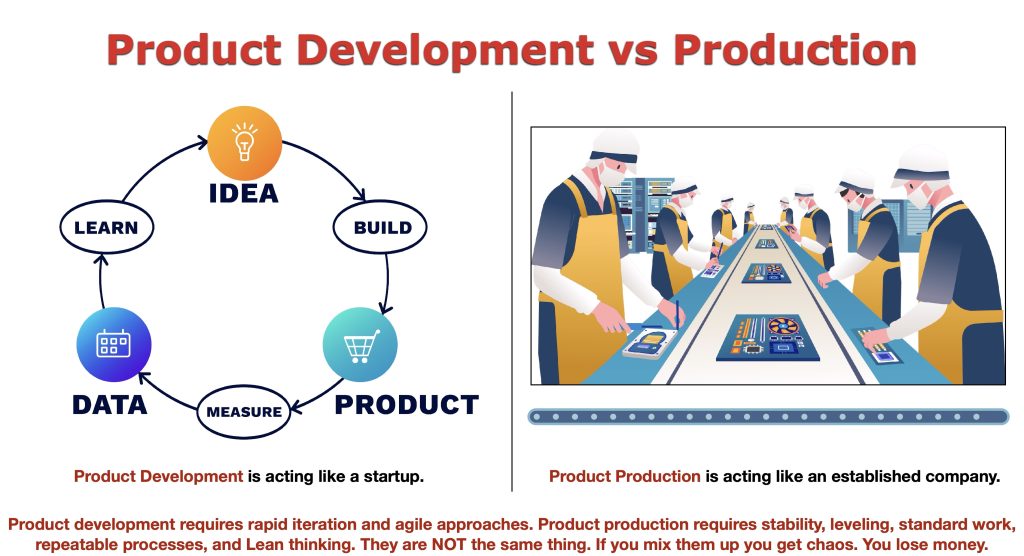
Many organizations invest heavily in increasingly sophisticated planning systems, predictive analytics and artificial intelligence while paying surprisingly little attention to the stability of the operating system itself.
- Forecasts become more accurate.
- Dashboards become more detailed.
- Reports become more impressive.
Yet the underlying variation continues creating delays, rework, missed commitments and frustrated customers, and even though the technology improves, the system does not. Toyota understood something that many organizations still overlook.
You cannot forecast your way out of instability.
You have to reduce the unnecessary variation creating the instability in the first place. Only then does prediction become easier because the system itself has become more predictable. This understanding provides the bridge between the pioneers of statistical thinking and the practical reality of operational excellence.
- Shewhart taught us that every process varies.
- Deming showed us that most of that variation belongs to the system.
- Wheeler warned us not to mistake ordinary variation for meaningful change.
- Toyota demonstrated what happens when an organization is deliberately designed around those principles.
The next question naturally follows. If variation creates instability, what does that instability actually do to the flow of work?
To answer that, we need to leave the factory floor for a moment and visit another thinker whose work quietly explains why organizations become slower even as everyone works harder, Prof. John Little.
7. John Little on Why Work Takes Longer Than We Think
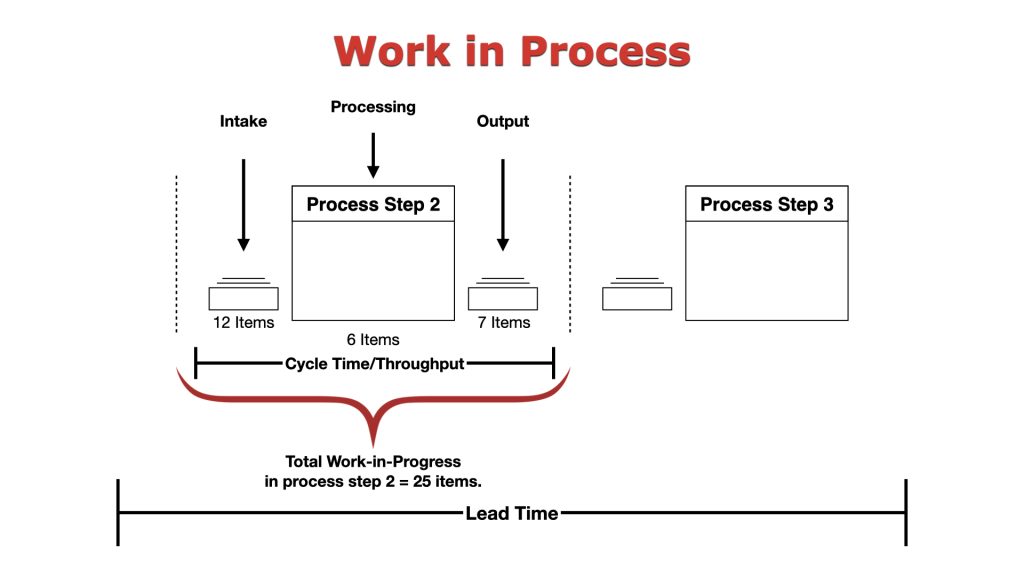
As a professor at the Massachusetts Institute of Technology, Little was interested in a deceptively simple question: How does work move through a system? His answer became known as Little’s Law, one of the most elegant and enduring relationships in operations management. Although it is often presented as a mathematical equation, its implications are remarkably intuitive.
Every system contains three inseparable and obvious characteristics:
- The amount of work inside the system.
- The rate at which work is completed.
- The time work spends inside the system.
Whether the system is manufacturing cars, treating patients or developing software makes remarkably little difference. The relationship remains the same. As the amount of work inside the system increases, the time required to complete that work also increases. Read that last line again.
Most executives nod when they hear this as it sounds obvious, and then they return to work and unintentionally behave as though they don’t believe it.
It means this: Reducing work in process will increased productivity and shorten lead times.
New initiatives are launched before existing ones are finished. Strategic priorities multiply. Product roadmaps expand. Departments proudly report that everyone is fully utilized and everyone appears busy yet everything takes longer. Spinning more plates debilitates organizations.
Little’s Law explains why.
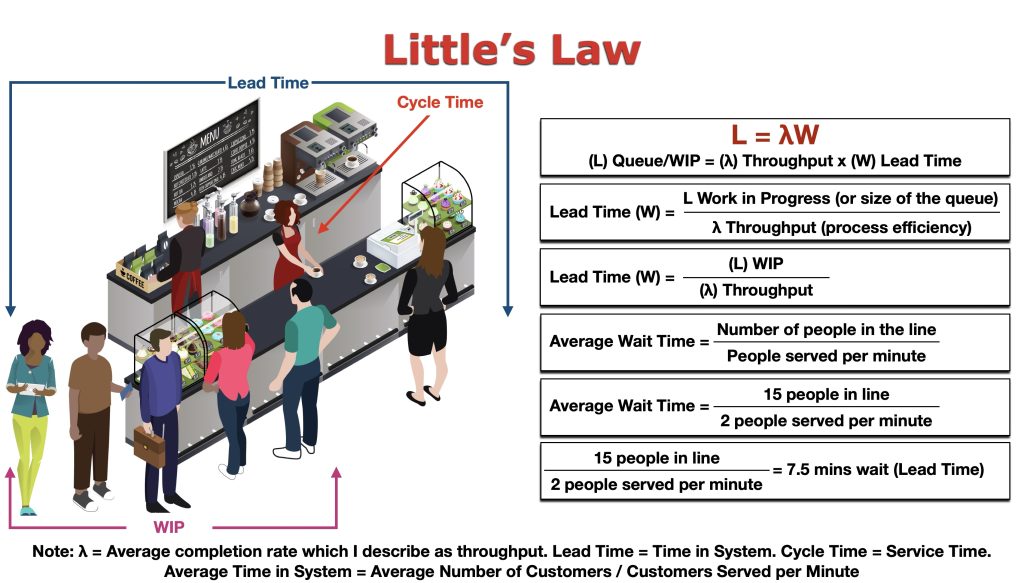
The average time in the system is equal to the average time in the queue, plus the average time it takes to receive service.
The system is attempting to process more work than it can comfortably absorb. Nothing magical has happened. Nobody suddenly became less capable. The organization has simply overloaded itself and that observation challenges one of management’s oldest assumptions. Traditional management often equates starting work with making progress.
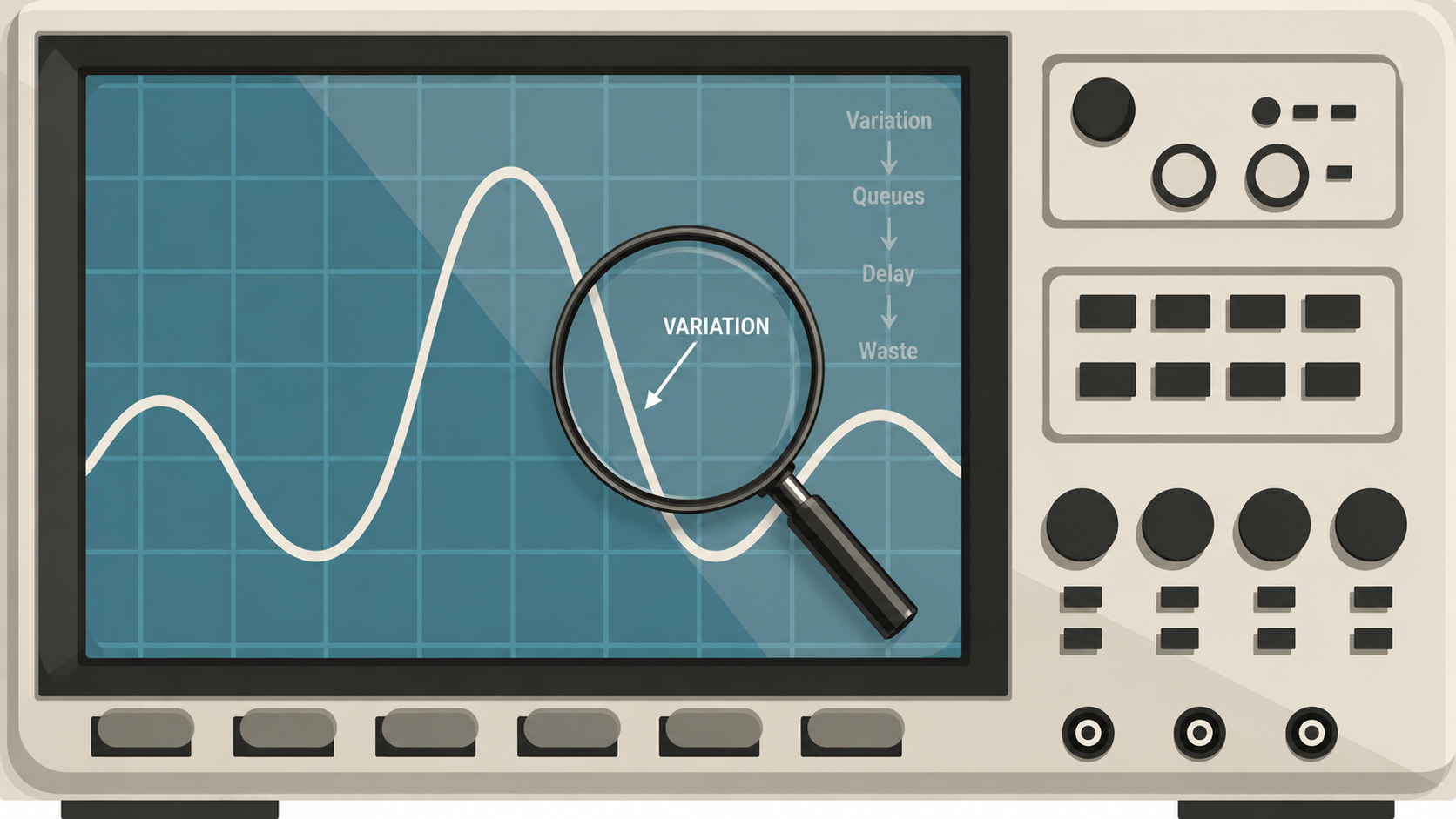
Variation increases WIP. More WIP increases Lead Time. Longer Lead Time creates delay, cost and uncertainty.
However, systems thinking recognizes that unfinished work is not progress. It’s inventory. And like every other form of inventory, it carries a cost.
- Every unfinished project competes for attention.
- Every open initiative creates additional coordination.
- Every unresolved decision generates uncertainty.
- Every delayed approval creates another queue.
Gradually, the organization becomes trapped beneath the weight of its own commitments.
Toyota understood this instinctively. Kanban was never introduced simply to organize work visually. Its deeper purpose was to limit work in progress and protect the flow of value through the system, but many organizations adopted Kanban as a scheduling mechanism whereas Toyota used it to protect flow, and that difference is huge.
Once leaders understand Little’s Law, they begin asking very different questions.
- Instead of asking how to make people work faster, they ask why so much work has been started in the first place.
- Instead of measuring success by activity, they measure it by completion.
- Instead of maximizing utilization, they begin protecting the flow of work through the entire system.
Those questions naturally lead to another realization that variation and work in progress reinforce one another.
- Variation creates queues (waiting).
- Queues increase work in progress.
- More work in progress lengthens lead times.
- Longer lead times increase uncertainty.
- Greater uncertainty encourages managers to release even more work into the system.
The cycle repeats.
Organizations become busier while delivering less predictably.
- People work harder.
- Customers wait longer.
- Executives demand greater urgency.
- The system responds by slowing down even more.
Understanding this feedback loop is one of the most important insights in modern management because it reveals that many organizations are not suffering from a people problem. They are suffering from a system problem, and that brings us to one of the most persistent misconceptions in business.
Most leaders believe waste is the disease, but in reality, waste is usually the symptom. The disease is the variation moving silently through the system that created the waste in the first place.
Stop treating the symptoms and instead focus on eliminating the causes.
8. Variation Is What Creates Waste
Most organizations spend enormous energy trying to eliminate waste but Toyota approached the problem differently. It recognized that much of what we call waste is not the problem itself but instead it’s the visible consequence of variation moving through the system.
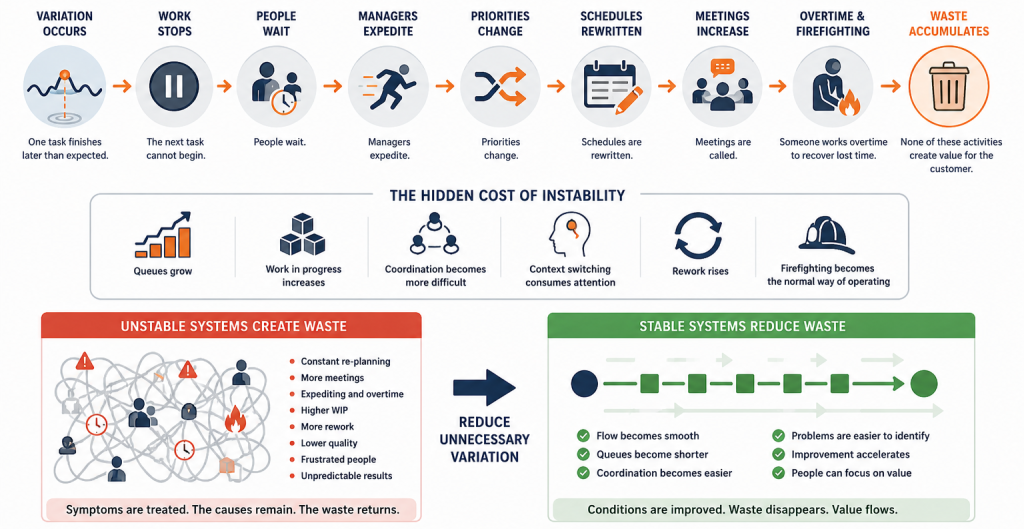
Consider what happens when work becomes unpredictable.
- One task finishes later than expected.
- The next task cannot begin.
- People wait.
- Managers expedite.
- Priorities change.
- Schedules are rewritten.
- Meetings are called.
- Someone works overtime to recover lost time.
None of these activities create value for the customer. They exist only because the system became unstable. The longer variation remains unmanaged, the more waste accumulates.
- Queues grow.
- Work in progress increases.
- Coordination becomes more difficult.
- Context switching consumes attention.
- Rework rises.
- Eventually, firefighting becomes the normal way of operating.
Many organizations mistake this constant activity for responsiveness while in reality, they are paying the hidden cost of instability.
Toyota understood that sustainable improvement does not begin by attacking every visible form of waste. It begins by creating stable, predictable processes that reduce unnecessary variation. As stability improves, many forms of waste disappear without being targeted individually. This is one of the reasons Lean is so frequently misunderstood.
Organizations often attack waste directly while leaving the conditions that generate it untouched.
- The waste returns.
- New improvement programs are launched.
- More tools are introduced.
- Yet little changes because the system continues producing the same variation.
This is why Deming insisted that management’s responsibility was to improve the system rather than blame the people working within it.
People respond to the conditions they inherit.
- When variation is reduced, work flows more smoothly.
- Queues become shorter.
- Coordination becomes easier.
- Problems become easier to identify.
- Improvement accelerates because the system is no longer fighting itself.
Waste did not disappear through harder work. It disappeared because the conditions that created it were removed. That understanding changes the entire purpose of improvement.
The objective is not simply to eliminate waste. It’s to create systems that produce less of it in the first place.
9. Every Queue Has a Story
Queues (waiting) are the clearest indicators that variation exists inside a system, but most people see only the queue itself. Systems thinkers ask a different question: Why did the queue form in the first place?
A queue is never the problem. It’s evidence that demand has temporarily exceeded the system’s ability to respond. Sometimes that happens because demand genuinely increased but more often it happens because variation disrupted the flow of work.
Consider a supermarket checkout.
If customers arrive steadily and every cashier serves customers at roughly the same rate, queues remain short. If several families arrive together, and one register slows because of a price check, and another cashier takes a break, the queue quickly grows. Nothing is wrong with the customers. The queue simply reflects variation moving through the system.
Exactly the same phenomenon appears inside organizations.
- A proposal waits for executive approval.
- A software release waits for testing.
- A customer waits for a decision.
- A contract waits for legal review.
The queue is visible but the conditions that created it are usually invisible. That is why organizations often attack queues rather than understanding them.
- They authorize overtime.
- Add another approval team.
- Increase staffing.
- Escalate priorities.
Occasionally those actions help but mostly they simply move the queue somewhere else. The constraint has not disappeared. It has merely changed location.
Toyota approached queues differently.
A queue was treated as information. It signaled that something upstream deserved investigation. The goal was not simply to shorten today’s queue, it was to understand why the queue repeatedly appeared, and it’s of the most important habits leaders can develop.
Whenever you encounter waiting, ask what conditions made the waiting inevitable.
- What variation entered the system?
- Where did flow begin to slow?
- What assumption allowed the queue to develop?
Those questions shift leadership away from treating symptoms and toward understanding causes. Remember, every queue tells a story. Leaders who learn to read those stories stop seeing delays as isolated problems. They begin seeing them as windows into how the entire system behaves. This is the art of managing constraints.
10. Why Average Performance Misleads Leaders
One of the most persistent mistakes in management is treating averages as though they describe reality. They don’t!
Averages describe the center of a range of experiences while concealing the variation that surrounds it.
Suppose a customer service department has an average call wait time of two minutes. That sounds impressive, but the average alone does not reveal the range of individual experiences: many callers may be answered immediately, while others wait much longer.
One department might answer 80 percent of calls immediately while leaving the remaining 20 percent waiting ten minutes. Another might answer every call in exactly two minutes. Both have an average response time of two minutes, yet the second provides a far more consistent and predictable customer experience.
The same principle applies everywhere: an average can conceal substantial differences in variability and individual outcomes.
- Projects finish, on average, within budget.
- Products are delivered, on average, on time.
- Patients wait, on average, twenty minutes.
- Software features are completed, on average, every two weeks.
The average sounds reassuring, but variation determines what people actually experience and this distinction changes how leaders evaluate performance. When organizations celebrate average improvements while ignoring increasing variability, they often create systems that appear healthier than they really are.
Customers experience inconsistency. Employees experience uncertainty. Managers experience surprises. Yet the dashboard still reports improvement.
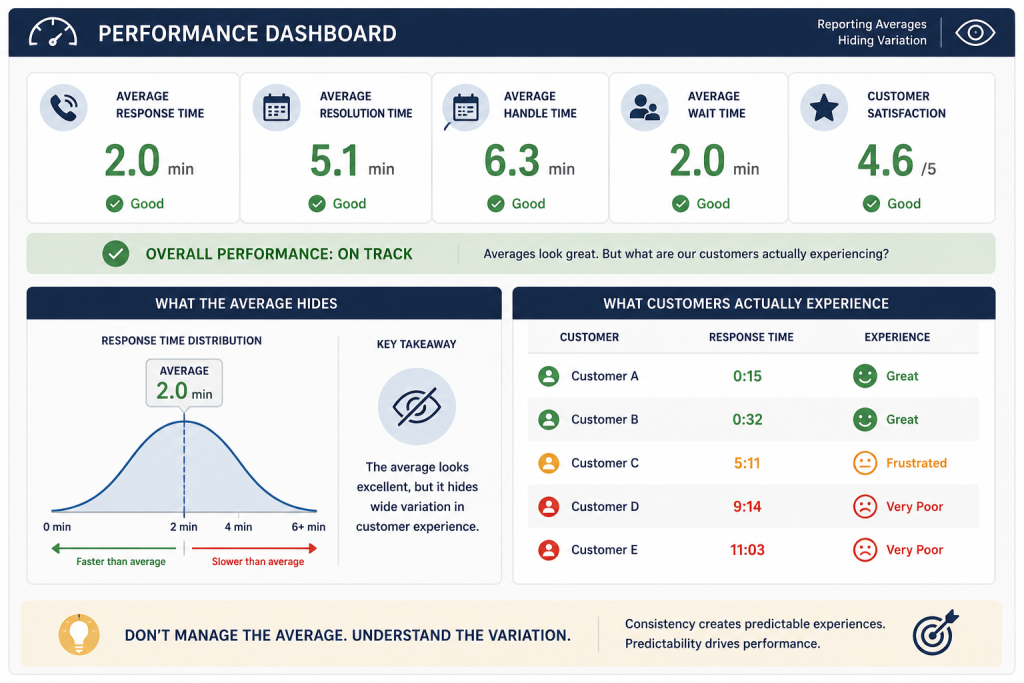
Toyota understood that consistency matters as much as speed because a stable process that performs predictably is easier to improve than one producing erratic results, even if both report the same average and that insight reaches far beyond manufacturing.
In knowledge work, software development, healthcare and government, predictability allows better planning, smoother coordination and earlier detection of genuine problems yet variation obscures all three. This is why Shewhart, Deming and Wheeler all focused on understanding the behavior of the system rather than chasing individual results. This about that when you’re next reviewing your incentives programs
The average provides useful context but it should never become the whole story as leadership begins to change when leaders stop asking, “What was our average?” and begin asking, “How consistently does the system perform?”. That small shift transforms the conversation from reporting outcomes to understanding capability. It moves attention away from isolated results and toward the behavior of the system that produced them.
11. Why High Utilization Slows Organizations Down
Few ideas appear more sensible than keeping people busy. For generations, organizations have measured performance by utilization. Machines should never sit idle and employees should always have work to do and all resources should be fully occupied.
These assumptions are often associated with Taylorism and the pursuit of maximum efficiency, although Taylor’s own thinking was more nuanced than the simplified version that management inherited, and the modern pursuit of near-total utilization is a simplified interpretation of Taylor’s work.
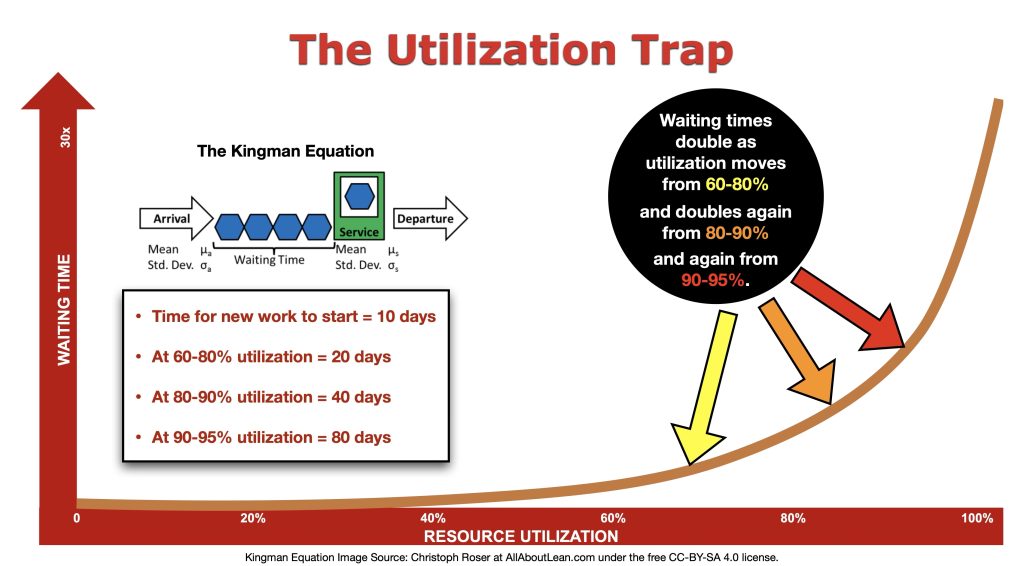
On the surface, the logic seems undeniable. If people are busy, productivity must be increasing, yet systems thinking reveals a very different reality. As utilization approaches one hundred percent, waiting times increase disproportionately. Small interruptions that would normally disappear begin to accumulate. Queues grow and lead times lengthen as variation becomes amplified rather than absorbed.
Kingman’s Equation below explains why waiting times increase dramatically as utilization approaches 100 percent. Even small amounts of variability in arrivals or processing times can cause queues to grow exponentially when a system has little spare capacity. The implication for leaders is one they should not dismiss.
Maximizing utilization may appear efficient on a dashboard, but it often has the opposite effect on the flow of work. As utilization rises, variability has less opportunity to be absorbed, queues lengthen, lead times become unpredictable and the system becomes increasingly difficult to manage.
This phenomenon is often referred to as the Utilization Trap. Organizations pursuing ever-higher resource utilization frequently create the very delays, bottlenecks and firefighting they are trying to eliminate.
The highest utilization rarely produces the highest throughput. It usually produces the longest queues.
Anyone who has stood in a grocery store with every checkout occupied has experienced this phenomenon. The system appears fully productive. Customers experience only delay, and the same dynamic exists in knowledge work.
- An engineer assigned to multiple projects spends increasing amounts of time switching context.
- A manager whose calendar is completely full has little capacity to make timely decisions.
- A product team working on too many initiatives struggles to complete any of them quickly.
Everyone appears busy but flow steadily deteriorates.
Toyota understood that spare capacity is not necessarily waste. The objective is not to keep every person or machine busy every minute of the day, but to create stable systems that allow work to move predictably through the value stream. It’s what often allows the system to remain resilient when variation inevitably occurs.
Capacity absorbs disruption and without it, even small fluctuations cascade into delays throughout the organization. This is what we might refer to as “buffers” in the system. Not padding projects with fake time, but adding a cushion into a well oiled machine to allow for variation in demand or other factors. This is the concept of leveling.
This idea feels uncomfortable because traditional management rewards visible activity. Idle time appears inefficient. Waiting customers, delayed projects and expanding backlogs are accepted as unavoidable but in reality, many of those delays are the predictable consequence of driving utilization too high.
Waiting time is waste to the customer. Idle time is often protective slack (resource buffer).
Not all idle time is waste. We build slack into the system to balance for demand.
Instead of leaders asking how to keep everyone busy, leaders begin asking how much capacity the system needs to maintain reliable flow.
The objective is no longer maximum utilization, it is maximum capability. Organizations that understand this stop optimizing individual resources in isolation and instead they optimize the performance of the whole system.
It’s a distinction lies at the heart of systems thinking and explains why so many organizations become slower precisely when they believe they are becoming more efficient.
12. The Time Horizon Fallacy
The danger does not end with averages. It becomes even greater when we extend the time horizon over which those averages are calculated. Over the years, I have come to think of this management error as the Time Horizon Fallacy.
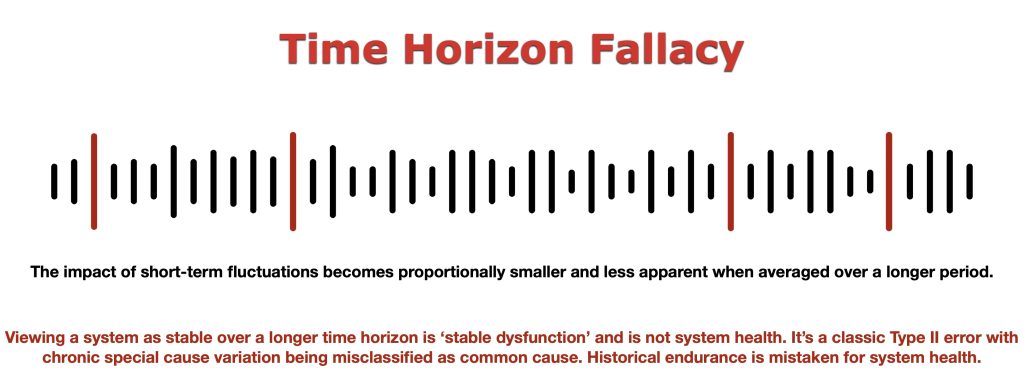
As organizations become larger and more complex, they naturally begin measuring performance over progressively longer periods.
- Annual reports replace quarterly reviews.
- Quarterly averages replace monthly observations.
- Monthly averages replace daily behavior.
At first glance, this appears entirely sensible as longer time horizons smooth apparent volatility and performance appears more stable. Forecasts appear more reliable as executives gain confidence that they understand how the system is performing. Statistically, this is exactly what we should expect, but you are hiding variation.
The Central Limit Theorem tells us that as observations are aggregated into averages, those averages become increasingly tightly clustered around the true population mean. Short-term fluctuations become proportionally smaller when viewed over longer periods. The maths is entirely correct but the managerial conclusion often is not.
By extending the time horizon, organizations frequently smooth away precisely the variation they should be investigating.
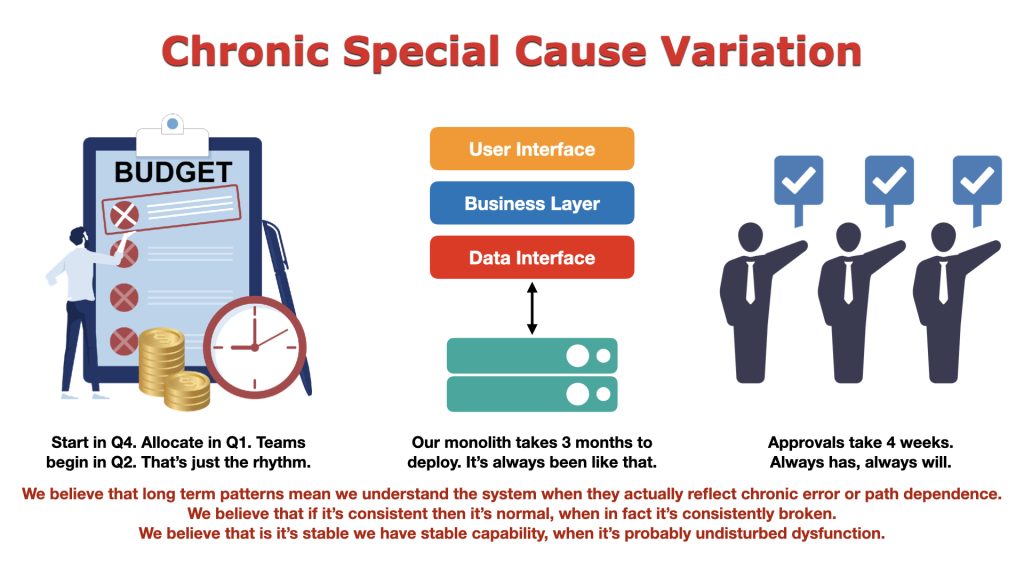
A recurring delay that occurs every few weeks disappears into an annual average. Repeated expedites become invisible inside quarterly reporting. Persistent interruptions begin to look like ordinary system behavior simply because they have occurred for so long and the organization concludes that the process is stable.
In reality, it may simply have become accustomed to stable dysfunction. Historical endurance is mistaken for system health.
What was once recognized as unusual, gradually becomes accepted as “the way things are.” Chronic instability is institutionalized. Managers stop asking why the system behaves this way because the behavior has become familiar.
From a statistical perspective, this is analogous to a Type II error in management. A genuine signal exists, but it is dismissed as ordinary system behavior. Chronic special-cause variation is quietly reclassified as common cause, not because the system has improved, but because the time horizon has become so long that the variation no longer appears remarkable.
The consequence is massive. The very analytical techniques intended to improve understanding can inadvertently suppress the signals that indicate something is fundamentally wrong.
- The forecasts become smoother.
- The dashboards become calmer.
- The confidence intervals become narrower.
Yet the underlying system continues producing the same queues, delays, rework and waste. I see this exacerbated in software development by the misuse of probability forecasting, and I will address that shortly.
Leadership’s purpose is not to become increasingly accurate at describing chronic dysfunction. It is to recognize that stable dysfunction is still dysfunction and to redesign the system so that those patterns no longer occur.
13. Learning to See Systems Instead of Events
Human beings are naturally drawn to events when a customer complains, a project misses its deadline, a key employee resigns, a machine fails or a major client leaves.
These moments capture our attention because they are immediate, visible and emotionally compelling and leadership often responds in the same way.
- An investigation begins.
- A recovery plan is launched.
- New procedures are introduced.
- Someone is held accountable.
Sometimes those actions are necessary, but often they treat the event rather than the conditions that made the event possible.
Systems thinking prompts us to ask different questions. Instead of asking, “What happened?”, ask “What made this outcome likely?”, and this shifts our view as the event is no longer the primary object of attention. It becomes evidence.
The real work lies in understanding the patterns, relationships and structures that repeatedly produce similar outcomes. Toyota demonstrated this discipline every day as problems were investigated, but rarely in isolation. The objective was not simply to restore performance but to understand why the system behaved as it did so that the same conditions would not continue producing the same result. It’s why they are obsessed with root cause analysis.
This way of thinking demands patience but it also demands humility.
Most organizational problems do not originate with a single decision, a single individual or a single mistake. They emerge from interactions that have developed over time as policies reinforce one another, measures influence behavior, priorities compete for attention and small delays accumulate into larger queues. Variation spreads through the system until the consequences become impossible to ignore and by the time leaders notice the event, the conditions that produced it have often existed for months or years.
This is why so many improvement efforts disappoint. Organizations respond energetically to visible problems while leaving the underlying system largely unchanged and the symptoms disappear for a while, but they soon return.
Leaders who learn to see systems instead of isolated events respond differently. They become less interested in assigning blame and more interested in understanding capability and look for recurring patterns instead of isolated incidents while asking what conditions made the outcome predictable rather than who happened to be involved this time.
That is the beginning of systems leadership. The leader’s task is not simply to solve today’s problem. It is to improve the system so that tomorrow’s problems become less likely to occur.
14. The Probability Paradox
Several years ago, I found myself asking what seemed like an almost absurd question. If organizations have become so dependent on increasingly sophisticated probability models, Monte Carlo simulations and predictive analytics to forecast when work might be completed, why are so few investing the same energy in reducing the unnecessary variation that makes those forecasts necessary in the first place?
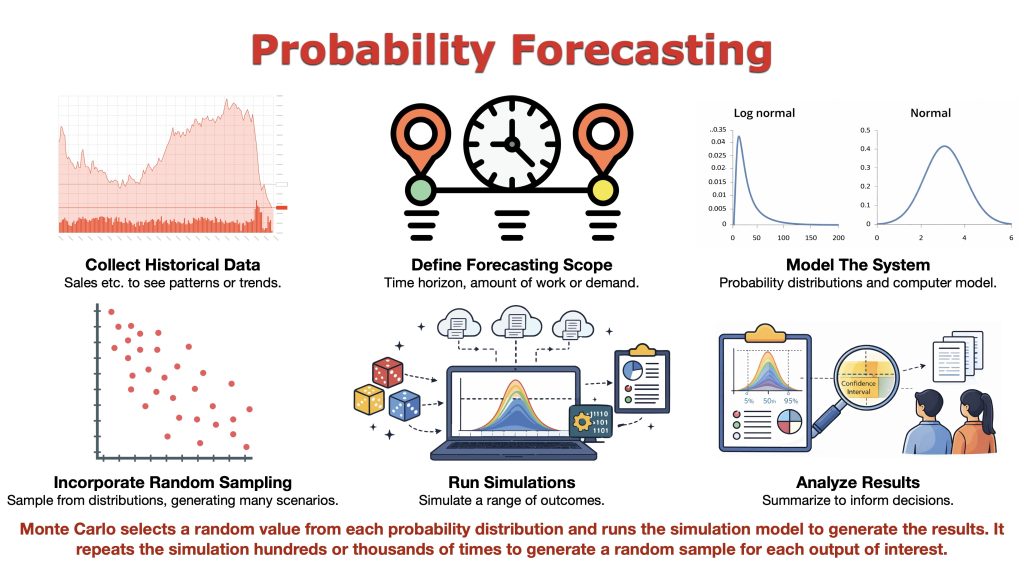
The question has stayed with me ever since because it exposes a curious contradiction in modern management. Organizations spend enormous sums of money becoming better at predicting delay but very few invest comparable effort in understanding why the delay exists. I have encountered this repeatedly during my career.
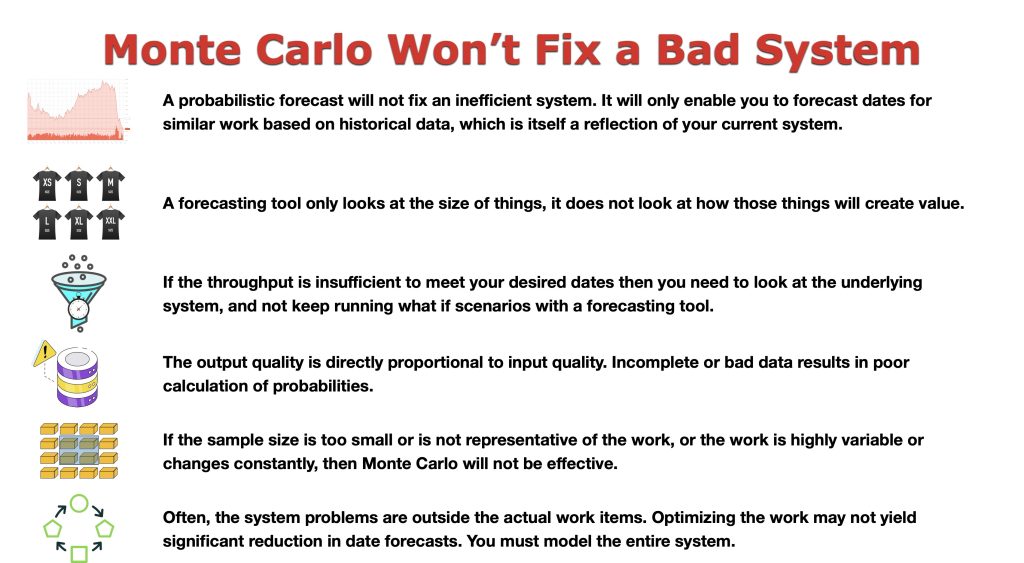
A project is overloaded with work, priorities change constantly, decisions take too long and dependencies multiply across the organization. Rather than addressing those conditions, considerable effort is directed toward building a more sophisticated model of when the work might eventually be completed.
The forecast becomes more credible as the organization becomes more confident, but the underlying system remains unchanged.
And do not mistake my argument for criticism of probability theory. Probability remains a great intellectual achievement. It helps us understand uncertainty, evaluate risk and make better decisions in situations where certainty is impossible. Modern forecasting techniques are extraordinarily valuable, particularly in environments such as pharmaceutical research, aerospace, software development and product innovation, where genuine uncertainty can never be eliminated. And your investment portfolio!
I have used and advocated many of these techniques myself but my concern begins when the model becomes a substitute for confronting the system.
The paradox.
Too often, organizations become fascinated by improving the prediction while quietly accepting the conditions that created the uncertainty.
Imagine visiting a physician who proudly explains that they have developed an exceptionally accurate model for predicting heart attacks but shows little interest in helping patients reduce the behaviors that cause them. Most of us would immediately recognize the flaw, and even though we recognize prediction is valuable, prevention is even more valuable.
The same logic applies inside organizations.
Forecasting tells us what is likely to happen if the current system continues behaving as it does today but improvement asks a completely different question: How do we change the system so tomorrow behaves differently from today? Those are not competing ideas. They are complementary.
Forecasting helps us make responsible commitments in the presence of uncertainty. Improvement helps us remove the unnecessary uncertainty that should never have been there in the first place. Unfortunately, many organizations devote far more attention to the former than the latter.
Every year, forecasting models become more sophisticated. More historical data is collected. Machine-learning models become more accurate. Monte Carlo simulations become increasingly realistic. Confidence intervals become narrower, yet delivery dates continue slipping.
- Projects remain overloaded.
- Work spends more time waiting than moving.
- Decisions still arrive too late.
- Priorities still change faster than teams can respond.
- The reports become better, but the system does not.
That should concern every leader, so why doesn’t it? There is a particular danger here because sophisticated forecasting creates an appearance of managerial control. The organization may become exceptionally good at calculating the consequences of its own dysfunction without ever challenging the dysfunction itself.
A precise prediction of poor performance is still poor performance.
Monte Carlo simulations are often described as tools for predicting the future, but they do not forecast events directly. They estimate a range of possible outcomes based on assumptions about how a system behaves. Those assumptions are frequently derived from historical performance, so the results are most reliable when the future resembles the past. When conditions change, the simulation may provide precise-looking numbers without providing an accurate picture of what will actually happen.
- Knowing with greater confidence that a project will be late does not make the project less late.
- Knowing that customers will probably wait longer does not improve their experience.
- Knowing that overloaded teams are unlikely to meet their commitments does not reduce the overload.
Forecasting should never become a substitute for improvement. Its purpose is to help us understand reality. Leadership’s purpose is to change reality.
15. Forecasting Is Not Improvement
A distinction that deserves far more attention than it usually receives because forecasting and improvement answer fundamentally different questions.
Forecasting asks, given the system we have today, what outcome should we expect? Improvement asks, how do we redesign the system so that a better outcome becomes normal? One accepts the current operating model while the other challenges it.
Consider two software organizations that both use sophisticated Monte Carlo forecasting to predict delivery dates. One becomes exceptionally accurate at forecasting that large initiatives will take eighteen months while the other redesigns how work flows through the organization. By doing so it reduces work in progress, removes unnecessary approvals, shortens feedback loops and simplifies decision-making.
One organization predicts delay more accurately while the other gradually eliminates much of the delay altogether. Which organization has learned more? Which one are you?
This is where leadership becomes fundamentally different from analytics. Analytics tells us what is happening. Leadership decides whether that reality is acceptable. Data can reveal problems. It cannot remove them. Only changes to the system can do that.
This is why I’ve often argued that organizations should be careful not to mistake increasingly sophisticated prediction for increasingly sophisticated management. The two are not the same. One measures uncertainty. The other seeks to reduce unnecessary uncertainty.
16. Standard Work
Toyota understood something that many organizations have quietly forgotten. The objective was never to become better at predicting production; it was to create production systems that behaved predictably. Stable systems require less forecasting because their behavior becomes easier to understand. Abnormalities become easier to detect because they stand out against a consistent background, while learning accelerates because experiments produce clearer results.
Imagine trying to diagnose a system issue. If every element behaves unpredictably, isolating the source of a fault becomes extraordinarily difficult. If every element behaves normally the abnormal behavior immediately attracts attention.
Organizations behave in exactly the same way. Stability is not valuable because it creates control; it’s valuable because it creates clarity. That is one of the reasons standard work occupies such an important place within the Toyota Production System.
Standard work establishes a precise and repeatable basis for performing work. In its traditional production context it is built around three elements:
- Takt time/Demand time: the rate at which we must produce to meet customer demand.
- Work sequence: the precise order in which we must perform the required tasks within that takt time.
- Standard inventory: the minimum amount of work in process, including anything we need, to keep the work flowing smoothly.
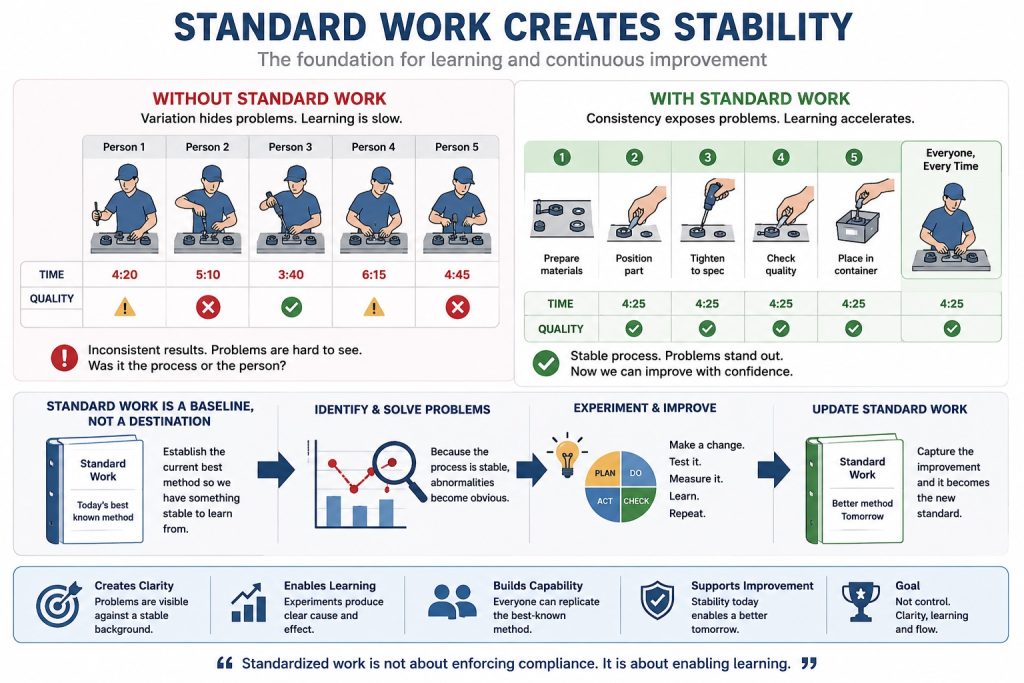
Once established, standard work is documented and displayed where the work takes place and everyone is trained. It creates a shared understanding of the current process across all staff, reduces unnecessary variability, makes training easier, can reduce strain and injury, and provides a baseline for improvement.
That last point is critical. Standard work is not intended to freeze the process permanently. It establishes today’s best-known method so that tomorrow’s improvement can be evaluated against something stable. Through kaizen, workers, engineers and front-line leaders study the work, identify problems, test changes and update the standard when a better method is found.
Without a standard, kaizen is not possible.
Unfortunately, standard work remains one of Toyota’s most misunderstood ideas. Many people assume it exists to enforce compliance, when its real purpose is to make learning possible. Without a stable baseline, learning becomes extremely difficult. If five different people perform the same activity five different ways, how can anyone determine whether a change genuinely improved performance? Did the experiment work, or did someone simply approach the task differently today than yesterday?
When everything changes simultaneously, cause and effect become almost impossible to separate. Toyota understood that learning depends upon stability, not permanent stability, but temporary stability. Just enough stability to make abnormalities visible and allow the next improvement to be understood with confidence.
The distinction is often lost in discussions about standardization. The goal is not rigid conformity or stifling creativity. It is clarity, learning and continuous improvement.
17. Knowledge Work Changes the Nature of Variation
At this point, many readers are probably thinking that manufacturing is fundamentally different from software development, consulting, healthcare, research or product design and in one key aspect, they are absolutely right. That aspect is knowledge work contains far greater inherent uncertainty.
- Customers change their minds.
- Engineers constantly evolve their thinking.
- Markets evolve.
- Technology advances.
- Competitors introduce new ideas.
- Scientific discoveries reshape priorities.
None of those things can be standardized away, and nor should they be. Innovation depends upon variation. Discovery depends upon experimentation. Learning depends upon trying things that may not work.
Those forms of variation are not the enemy. They are the source of competitive advantage but the challenge is recognizing that organizations often tolerate another form of variation that creates no value whatsoever.
- Different departments use different terminology for the same concept.
- Teams follow different approval processes.
- Software development standards are not followed.
- Customers receive different answers depending on who answers the telephone.
- Projects begin without consistent objectives.
- Information is stored in multiple places.
- Meetings follow no common structure.
- Priorities change every week.
None of this improves innovation and none of it delights customers. None of it creates a competitive advantage. It simply consumes capacity that could have been directed toward genuinely creative work. It’s one of the great ironies of modern management.
Many organizations devote enormous effort trying to standardize creative work while leaving routine administrative work remarkably inconsistent. Toyota did precisely the opposite. Routine work became increasingly stable. Human creativity was then directed toward improving that stable system and this remains one of the most important lessons I carried away from Toyota.
The purpose of standardization is not to eliminate human judgement. It’s to protect it.
By removing unnecessary variation from routine activities, we free people to apply their intelligence where it creates the greatest value, and that idea has become even more important as artificial intelligence begins reshaping how organizations operate.
18. AI Will Magnify Whatever System We Already Have
Artificial intelligence is forcing organizations to confront questions that many have avoided for years. Almost every conference promises that AI will transform productivity. Every software vendor claims their latest tools will make organizations faster, smarter and more efficient. New models appear almost weekly, each demonstrating capabilities that seemed impossible only months earlier, and I have little doubt that AI will become one of the defining technologies of our generation.
What concerns me is something else.
Too many organizations assume that accelerating work is the same as improving work, but it isn’t!
Artificial intelligence processes information at incredible speed. It drafts reports, analyses data, writes software, summarizes meetings and generates recommendations in seconds. Tasks that once consumed hours can now be completed almost instantly and that capability is remarkable, but it’s also dangerous if we misunderstand what AI is actually doing.
AI does not redesign organizational systems and constraints. It works within them.
If requirements are unclear, AI can generate unclear outputs more quickly. If priorities change constantly, AI allows those changes to ripple through the organization faster than ever before. If poor decisions enter the system, AI increases the speed of which their consequences spread.
Technology rarely eliminates organizational dysfunction. More often, it exposes it and sometimes it magnifies it.
The organizations that benefit most from AI will not necessarily be those with the most sophisticated technology. They will be those with the most stable operating systems.
Their leaders will understand which activities should be standardized, and which should remain adaptive where human judgement creates value that no algorithm can replace. That is why I think the conversation about AI is not really about artificial intelligence. It’s about leadership.
AI changes the speed of thinking. Leadership determines the quality of thinking. Confusing those two may become one of the defining management mistakes of this decade.
19. Seeing Just too Late
One of the reasons so many improvement initiatives disappoint is that they begin too late. They begin after customers have complained and after projects have slipped. They begin after costs have increased or after quality has deteriorated. They begin after employees have become frustrated, and by that stage, leaders are no longer improving the system, they are managing the consequences of a system that has already begun to fail.
Toyota taught me a very different way of thinking. The objective was never to become exceptionally good at solving problems, rather it was to become exceptionally good at recognizing the conditions that create problems. That may sound a bit subtle, but it’s not really.
Organizations often celebrate people who rescue failing projects.
- The executive who negotiates the impossible deadline.
- The engineer who works through the weekend.
- The project manager who somehow delivers despite overwhelming obstacles.
Those stories are inspiring but they’re also revealing. This is the hero culture.

Every heroic recovery should provoke a difficult question. Why was heroism necessary? If extraordinary effort has become an ordinary requirement, then the organization is no longer relying on capability, it’s relying on sacrifice.
- A hero culture stunts an organization’s ability to scale-up and become more efficient.
- Heroes do not develop the people who report to them.
- Heroes expose businesses to risk because heroes are often the sole source for that deep tribal knowledge.
- Hero work is not sustainable as heroes eventually burn-out; the sacrifice.
- Heroes tend to bottleneck business process because they alone, can handle their work.
- Heroes become the constraint!
When heroes are promoted for repeatedly rescuing the system, they stop doing the work that concealed its weaknesses. Performance then declines, not because the promotion caused the problem, but because the variation the hero had been absorbing finally becomes visible. By then, it is often too late.
Sustainable performance is built differently. It comes from designing systems where ordinary people can consistently achieve extraordinary outcomes because the system supports them rather than continually working against them.
Leaders stop asking, “Who made the mistake?” and instead ask, “What conditions made the mistake possible?”.
Instead of asking, “Why did this project fail?” they ask, “What variation accumulated long before failure became visible’?
And instead of asking, “Who should fix this?” they ask, “What should the organization learn?”
Those questions demonstrate an important change has occurred as leaders move attention away from blame and towards understanding, and that’s where meaningful improvement always begins.
20. Familiarity Masks Variation
There is another reason organizations struggle to recognize variation. Humans adapt extraordinarily quickly. The first time a meeting starts twenty minutes late, everyone notices, but six months later, people arrive expecting it.
The first time an approval takes three weeks, frustration is obvious, but a year later, every project plan quietly includes those three weeks.
The first workaround feels temporary but eventually it becomes standard practice, and this is how organizational blindness develops. Not because intelligent people stop thinking, but because repeated exposure quietly changes what they notice.
Psychologists refer to this reduced response to persistent or repeated stimuli as habituation. The ticking clock fades from awareness, background noise recedes, and a familiar smell becomes increasingly difficult to notice.
Organizations behave in exactly the same way.
- Delays become normal.
- Interruptions become expected.
- Queues become invisible.
- Waste becomes routine.
Eventually, nobody remembers why the work is performed that way, and people simply accept that it is.
That is one of the reasons outsiders often identify improvement opportunities within hours that insiders have overlooked for years. The outsider has not yet learned what the organization has unconsciously stopped seeing.
Leadership carries an important responsibility here. Not merely improving systems, but protecting organizations from becoming blind to them.
I wrote about Organizational Blindness here.
21. Improvement Starts With Better Observation
During my career I have worked with manufacturers, software companies, financial institutions, healthcare providers, governments, telecommunications companies and professional service firms. The technologies differ enormously. The customers differ. The markets differ. The regulations differ. But, human behavior does not.
- Every organization develops habits.
- Every organization normalizes certain forms of variation.
- Every organization quietly accepts conditions that once seemed unacceptable.
The organizations that improve most consistently are rarely those with the smartest people and they’re not always those with the largest improvement budgets. They’re the organizations that continue observing themselves honestly, that remain curious, that investigate recurring delays rather than accepting them. They question assumptions that everyone else has stopped noticing and they resist explaining away anomalies simply because they’ve happened before. Most importantly, they treat recurring problems as valuable information. They see opportunities vs problems.
- Waiting is information.
- Rework is information.
- Customer complaints are information.
- Queues are information.
- Variation is information.
Each reveals something about the system that created it. Leaders who learn to see those signals gain an incredible advantage. They improve the organization before failure demands it. They become the competitor everyone else is chasing.
22. The Real Role of Leadership
Over the years, I have become increasingly convinced that leadership has been defined far too narrowly. Popular management literature celebrates vision, charisma, confidence and the ability to inspire, while paying far less attention to a leader’s ability to understand the system, recognize variation and improve the conditions in which people work.
Those popular qualities certainly matter, but I have worked alongside remarkable leaders who possessed none of them in exceptional measure. Instead what they shared instead was curiosity. A genuine desire to understand how the organization actually behaved.
- Why work slowed down.
- Why decisions became difficult.
- Why people invented workarounds.
- Why apparently successful systems frustrated intelligent people.
They resisted simple explanations because they understood that complex systems rarely fail for simple reasons and their curiosity led them to better questions. Better questions improved observation. Better observation improved judgement. Better judgement gradually reshaped the system itself.
It’s amusing how most management training includes a section on asking better questions and the avoidance of cognitive biases. The irony!
Perhaps that’s the greatest lesson Deming and Toyota left us. Leadership is not primarily about making better decisions, it’s about creating better conditions for making decisions.
When leaders improve the quality of what an organization is able to observe, better decisions often follow naturally. Understanding comes before action. Seeing comes before solving. That’s easy to overlook, but it’s also the foundation of every organization that learns faster than its competitors.
23. Final Thoughts: Seeing Is a Leadership Discipline
Variation is not the enemy. It never has been. Variation exists wherever people learn, create, innovate and adapt. Without variation there would be no discovery, no experimentation and no progress. The real danger lies elsewhere.
It lies in the unnecessary variation that quietly accumulates inside every organization.
- The approval that follows a different path every time.
- The priorities that change without explanation.
- The inconsistent handoffs between teams.
- The information that arrives in different formats.
- The meetings that reach different decisions depending on who happens to attend.
Individually, these inconsistencies appear insignificant but together they determine whether an organization flows or struggles. Whether customers experience confidence or frustration and whether talented people spend their time creating value or navigating unnecessary complexity.
Toyota taught me many things but perhaps none has remained more valuable than this.
Before improving a system, learn to observe it.
Before redesigning a process, understand how variation moves through it, and before blaming individuals, examine the conditions in which they work.
Organizations rarely fail because people stop caring.
They fail because the system gradually teaches good people to accept conditions they should never have accepted.
- Delays become normal.
- Workarounds become routine.
- Queues disappear into the background.
- Waste becomes familiar.
- Variation becomes invisible.
This is Organizational Blindness.
It’s why the first responsibility of leadership is not to have all the answers, but to improve the quality of what the organization is able to see. Once leaders learn to see variation, they begin to understand why some organizations continually improve while others remain trapped in an endless cycle of firefighting. And the difference is rarely intelligence, nor is it rarely effort. More often than not, it is simply this.
One organization has learned to recognize variation before it becomes waste. The other is still managing the consequences.
Seeing is not simply another management skill. It is the first discipline of leadership.
If you are reading this, well done! You have just absorbed, at least partially, some of the most valuable lessons to enable continuous improvement.
I have studied and learned over the years from many brilliant minds, and so I present a few of their works below in the references for your future learning journey.
References and Further Reading
The ideas explored in this article build upon the work of many scholars, practitioners and organizations that have shaped our understanding of variation, systems thinking, operational excellence, organizational learning and leadership. Readers wishing to explore these concepts in greater depth may find the following works valuable.
Variation, Statistical Thinking and Quality
- Deming, W. Edwards. Out of the Crisis. MIT Press, 1986.
- Deming, W. Edwards. The New Economics for Industry, Government, Education. MIT Press, 1993.
- Shewhart, Walter A. Economic Control of Quality of Manufactured Product. D. Van Nostrand Company, 1931.
- Wheeler, Donald J. Understanding Variation: The Key to Managing Chaos. SPC Press, 1993.
- Wheeler, Donald J. Understanding Statistical Process Control. 3rd Edition. SPC Press, 2010.
Toyota Production System
- Ohno, Taiichi. Toyota Production System: Beyond Large-Scale Production. Productivity Press, 1988.
- Shingo, Shigeo. A Study of the Toyota Production System. Productivity Press, 1989.
- Monden, Yasuhiro. Toyota Production System: An Integrated Approach to Just-in-Time. 4th Edition. CRC Press, 2011.
- Liker, Jeffrey K. The Toyota Way: 14 Management Principles from the World’s Greatest Manufacturer. McGraw-Hill, 2004.
- Fujimoto, Takahiro. The Evolution of a Manufacturing System at Toyota. Oxford University Press, 1999.
- Sugimori, Y., Kusunoki, K., Cho, F., and Uchikawa, S. “Toyota Production System and Kanban System: Materialization of Just-in-Time and Respect-for-Human System.” International Journal of Production Research, 15(6), 1977.
Systems Thinking and Flow
- Little, John D. C. “A Proof for the Queueing Formula: L = λW.” Operations Research, Vol. 9, No. 3, 1961.
- Goldratt, Eliyahu M. The Goal. North River Press, 1984.
- Senge, Peter M. The Fifth Discipline: The Art and Practice of the Learning Organization. Doubleday, 1990.
- Ackoff, Russell L. Ackoff’s Best: His Classic Writings on Management. Wiley, 1999.
- Meadows, Donella H. Thinking in Systems: A Primer. Chelsea Green Publishing, 2008.
- Turner, John R., Thurlow, Nigel, and Rivera, Brian. The Flow System: The Evolution of Agile and Lean Thinking in an Age of Complexity. 3 Helix Publishing, 2023.
- Turner, John R., and Thurlow, Nigel. The Flow System Playbook. 3 Helix Publishing, 2023.
Sensemaking, Cognition and Decision-Making
- Snowden, David J., and Boone, Mary E. “A Leader’s Framework for Decision Making.” Harvard Business Review, November 2007.
- Weick, Karl E. Sensemaking in Organizations. Sage Publications, 1995.
- Kahneman, Daniel. Thinking, Fast and Slow. Farrar, Straus and Giroux, 2011.
- Klein, Gary. Sources of Power: How People Make Decisions. MIT Press, 1998.
- Klein, Gary. Seeing What Others Don’t: The Remarkable Ways We Gain Insights. PublicAffairs, 2013.
- Taleb, Nassim Nicholas. The Black Swan: The Impact of the Highly Improbable. Random House, 2007.
Leadership
- Drucker, Peter F. The Effective Executive. Harper & Row, 1967.
About This Article
While this article draws heavily upon the foundational work of the authors above, the interpretations, synthesis and conclusions presented here reflect my own experience leading operational transformation, organizational redesign and continuous improvement over more than three decades, including my time inside Toyota. Any errors or interpretations are entirely my own.