Why Keeping Everyone Busy Makes Knowledge Work Slower
High utilization in knowledge work is often treated as a sign of efficiency. Behind that is a deeply rooted assumption about productivity and resource utilization: if people are busy, the organization must be productive.
Idle time looks wasteful. A person without an immediate task appears underutilized. A team with spare capacity attracts more work. A department that is not operating close to capacity becomes an obvious target for an efficiency initiative.
So we fill the gaps. We add another project, pull forward another initiative, assign another customer request or reduce headcount until everyone appears fully occupied. On a spreadsheet this can look wonderfully efficient. In reality, we may just have made the organization slower, less predictable and considerably more fragile.
This is especially dangerous in knowledge work, where variability and uncertainty are unavoidable. Software development, engineering, product development, professional services and most other forms of knowledge work do not consist of identical units moving predictably through a machine.
- Problems turn out to be harder than expected.
- Customers change their minds.
- Dependencies fail.
- Production incidents happen.
- New information appears.
Assumptions prove wrong, and people discover things while doing the work that simply could not have been known before the work began.
Variability is not an exception to knowledge work. It is part of the work.
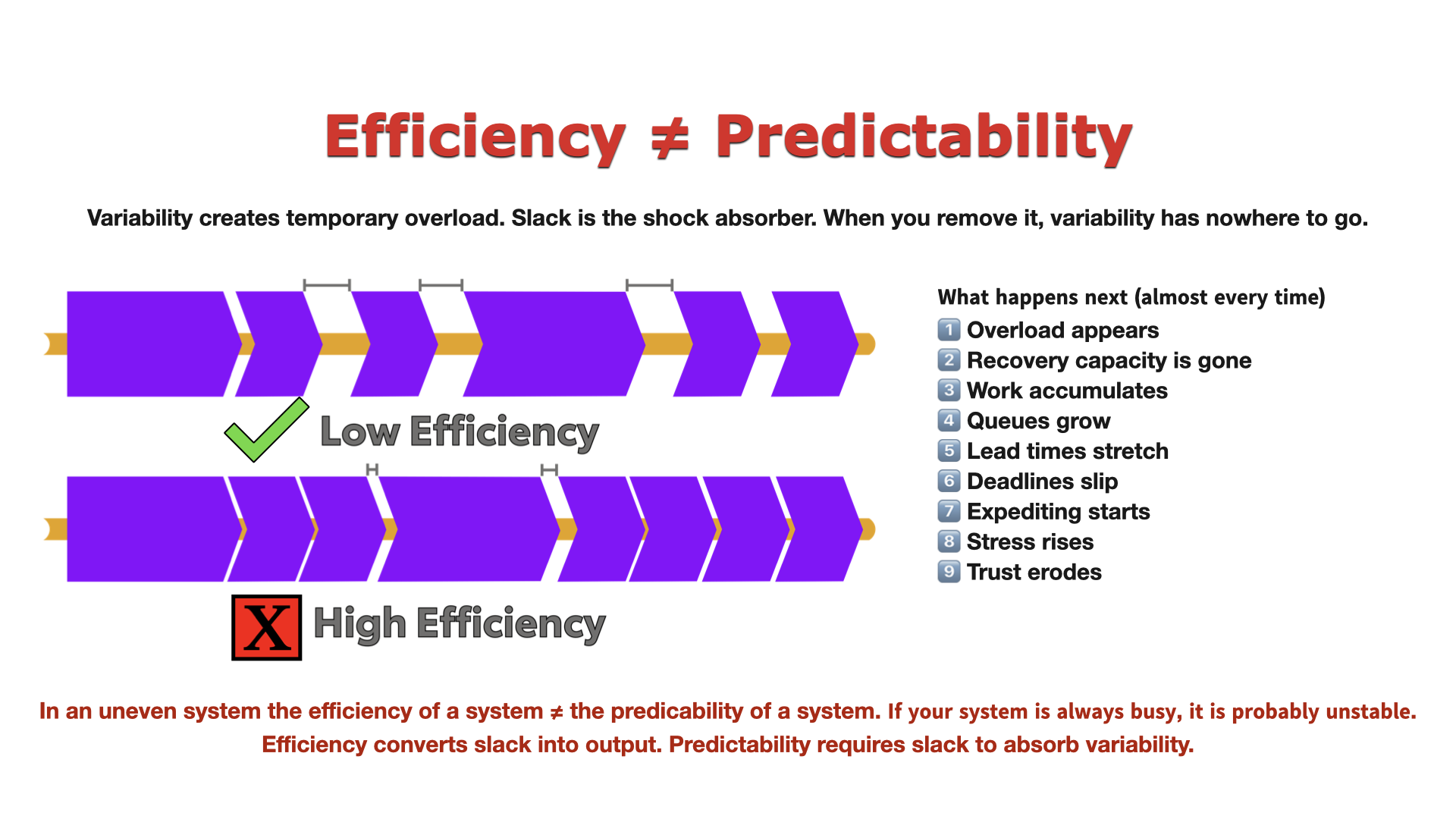
That is why efficiency does not equal predictability.
The Dangerous Pursuit of Full Utilization
The problem with high utilization in knowledge work is that there is nowhere for variability to go.
Imagine an organization where every specialist is booked at close to 100% of their available capacity. Every developer has work. Every engineer has work. Every product manager has work. Every architect, analyst and leader has a full calendar. Nothing appears to be sitting idle, so from a traditional resource-efficiency perspective this looks excellent.
Then something unexpected happens.
Perhaps a critical customer problem emerges, a production system fails, an urgent regulatory requirement appears, or a piece of work simply takes three days longer than expected. None of these things is particularly unusual. The problem is that there is nowhere for that variability to go.
If everyone is already fully occupied, dealing with the unexpected work means something else must wait. That delay affects another dependency. Priorities change. People switch between tasks. Expedites appear. Managers intervene and teams begin competing for scarce specialist capacity.
So called Kanban methods and their Classes of Service (CoS) are plagued by expedites that simply ignore the constraints in the system to enable “squeaky wheel” prioritization.
A relatively small disturbance quickly starts to propagate through the organization.
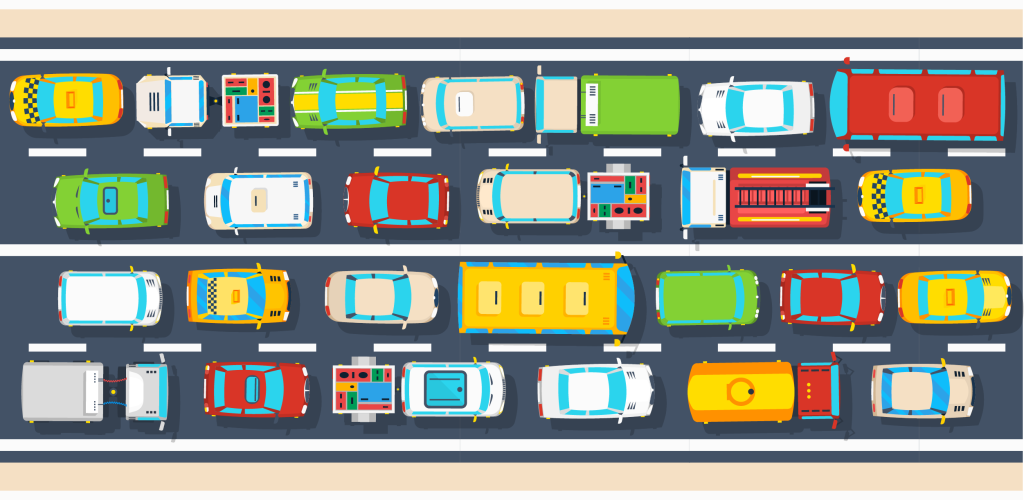
We have the capacity, so why does everything slow down?
We understand this intuitively when we look at a highway. When traffic is moderate, a vehicle changing lane, somebody braking or another car joining the road has little effect. There is space in the system to absorb the variation.
Run the same road close to its practical capacity at rush hour and a minor disturbance can create a queue stretching for miles. The road has not suddenly lost capacity. It has lost the space required to absorb variability.
Knowledge-work systems behave in much the same way.
An organization operating perpetually at or near full utilization should therefore not automatically be celebrated as highly efficient. It may instead be a system with almost no ability to absorb reality.
Resource Efficiency Is Not Flow Efficiency
High utilization in knowledge work can therefore improve local resource efficiency while damaging overall flow, and part of the problem is that we use the word efficiency to describe very different things. What many organizations actually measure is resource efficiency or utilization. They ask:
How much of this person’s available time are we using?
Flow efficiency asks a very different question:
How effectively does valuable work move through the system and reach the customer?
The first focuses on the utilization of the resource. The second focuses on the movement of the work. Those objectives are not typically aligned.
You can optimize the utilization of every individual in an organization while making the performance of the overall system significantly worse. In fact, it’s remarkably easy to do and I see it all the time in almost every client.
Give everybody enough work to ensure they are always busy and queues begin forming between them. Work no longer waits because people have nothing to do. It waits because the person or team it needs next is already occupied with something else.
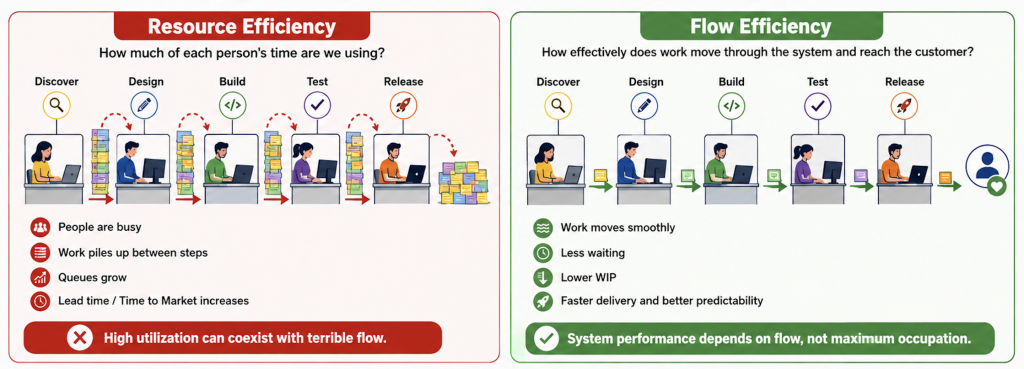
Keeping everyone busy can improve local utilization while making the whole system slower.
And back to Kanban software developers celebrate. You’ll see queues of work that are waiting areas between workflow steps on a board where tasks sit until downstream capacity opens up. Just that fact shows it is a push system vs a pull system. In a pull system the upstream never loads the downstream. There are no upstream queues in a pull system.
There is a distinction executives need to understand:
- Resource efficiency asks whether the people are busy.
- Flow efficiency asks whether the work is moving.
- System performance depends on delivering value, not simply maximizing the occupation of every resource along the way.
High resource utilization can therefore coexist with terrible flow. Indeed, it frequently causes it.
We eliminate visible idle time from people by creating invisible waiting time in the work, and waiting time is where lead time grows. Lead time is also known as Time to Market (TTM) in business terms.
I explored this distinction further in how lead time, flow efficiency and other Lean metrics actually measure system performance. See All About Lean Metrics
Would You Rather Have Idle People or Idle Work?
This leads to a deceptively simple question for executives:
Would you rather occasionally have a person waiting for work, or consistently have important work waiting for a person?
Most traditional management systems are designed to avoid the first condition.
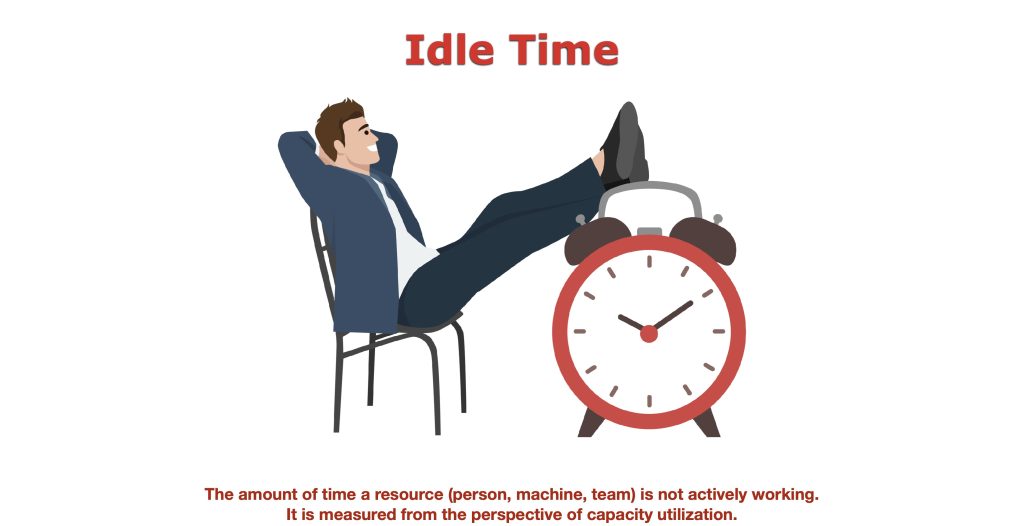
Managers can see somebody who appears not to be busy. That feels wasteful and therefore attracts attention. Work sitting in a queue is far easier to miss. The old phrase from an old boss is oft recalled when I think about this, “heads down, tails wagging”.
Consider a fairly typical knowledge-work system:
- A customer request waits three days for analysis.
- A product decision waits a week for approval.
- A development team waits four days for access to an architect.
- A release waits for testing capacity.
- A strategic initiative spends months moving between departments even though the actual work performed on it may total only a few days.
Everyone involved can truthfully say they were busy. Yet the work barely moved.
This is one of the great paradoxes of modern organizations: people can be extremely busy inside a system that is accomplishing remarkably little.
When leadership focuses on keeping resources occupied, idle time disappears from people’s calendars and reappears as waiting time in the work.
The waste has not disappeared. We have simply moved it somewhere less visible.
Why Traditional Productivity Measures Fail in Knowledge Work
There is another problem with our obsession with idle time. In knowledge work, we frequently cannot even tell when somebody is idle.
- A software engineer staring out of a window may be working on the hardest problem they’ve faced all week.
- A product leader walking around the building may be reconsidering an assumption that could prevent the company spending six months building the wrong thing.
- An architect may stop typing because something about the proposed solution does not feel right.
- A writer might spend twenty minutes apparently producing nothing and then write the paragraph that makes the entire argument work.
- An inventor might appear to be doing absolutely nothing while connecting ideas that have never previously been connected.
Thinking is work.
Unfortunately, thinking often looks remarkably similar to doing nothing. This creates a serious management problem because we are becoming increasingly capable of measuring activity while remaining surprisingly poor at measuring value.
Today we can measure almost anything:
- Keyboard and mouse activity.
- Time spent inside particular applications.
- Messages sent and response times.
- Meetings attended.
- Tickets moved.
- Code commits made.
- Documents created.
And increasingly, patterns of behavior interpreted by AI-enabled productivity and employee-monitoring tools. 🤖
All of this produces data. Some of it may even be useful, but none of it tells us whether somebody has understood the problem.
It cannot tell us whether they are questioning the right assumption, whether an idea is forming or whether they have just realized that the solution the company has spent three months pursuing is fundamentally flawed, and it certainly cannot tell us whether pressing more keys would produce a better outcome.
Attending but Not Attentive
All those Microsoft Teams meetings with cameras off, people on mute, never engaging, are a symptom of monitoring if people are busy. They join meetings to be seen as present and attentive when in reality they’re not even paying attention. They’re probably getting on with their work in the background. If they really attended all these meetings, waiting time would become a greater problem than it probably already is.
Research into electronic employee monitoring should make executives cautious here. It has shown little evidence that simply increasing monitoring improves employee performance, while associations with stress and reduced employee well-being are much easier to find. Additional research into algorithmic management similarly raises questions about autonomy, cognitive load and the consequences of attempting to manage complex human work through increasingly granular behavioral data.
The bigger problem, however, is systemic.
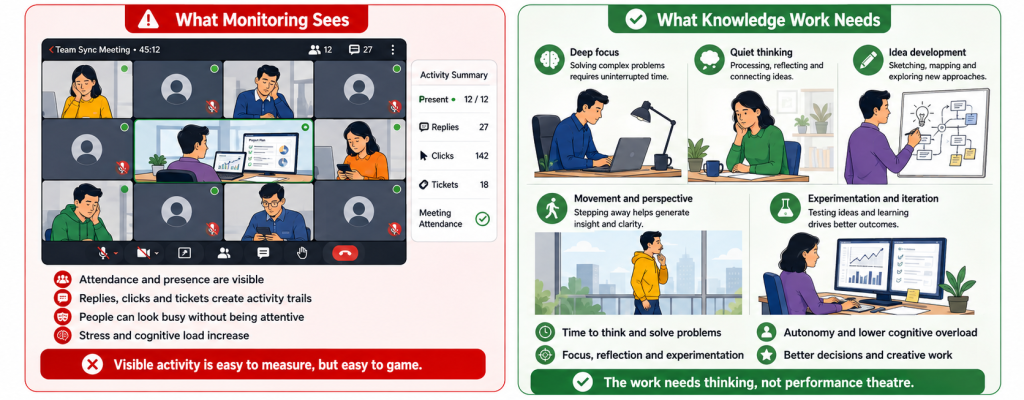
When visible activity becomes the measure, visible activity becomes the behavior the system encourages.
Sitting quietly and thinking can look unproductive. Walking while working through a difficult problem can look unproductive. Reading something apparently unrelated that triggers a new idea can look unproductive. Trying an experiment that ultimately fails can look unproductive.
Meanwhile, replying instantly to messages, attending meetings, moving tickets and constantly interacting with a computer creates an impressive trail of measurable activity.
We can therefore create the absurd situation where an organization discourages some of the very behaviors required to solve difficult problems because those behaviors are difficult to observe.
The Brain Is Not a Production Line
Creative thinking does not happen continuously either.
Sometimes we have to wrestle with a problem, and sometimes we have to stop wrestling with it.
I repair vintage audio as a side hustle. There are times after working for hours to find a fault I am at breaking point. I just have to quit. And the times I’ve gone back the next day and found the problem in 5 minutes are endless. I just need to rest and take stock and come back anew.
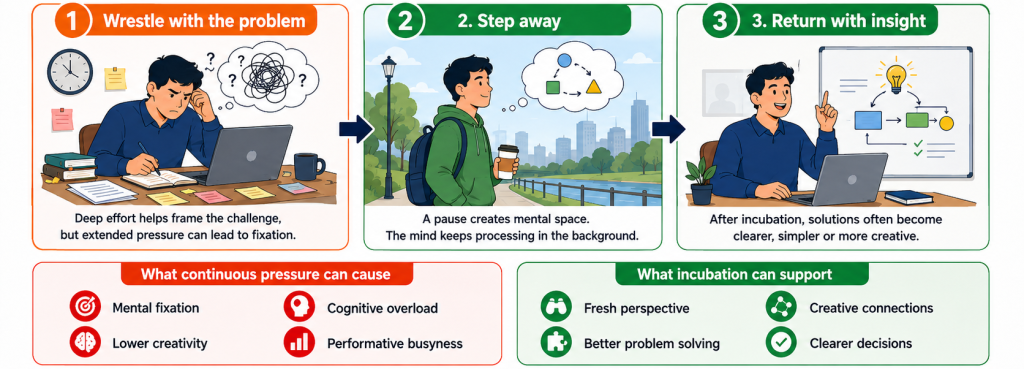
Psychologists have studied what is known as the incubation effect: temporarily setting a problem aside before returning to it can improve subsequent problem solving, particularly where creative or divergent thinking is involved.
Most of us already know this from experience. You spend an hour trying to solve something and get nowhere. You leave it, drive home, take a shower, walk the dog or sleep on it, and the answer suddenly becomes obvious. From a utilization perspective, much of that period looks like inactivity. From the perspective of solving the problem, it may have been part of the process.
Teresa Amabile’s research into creativity inside real organizations points in a similar direction. Persistent time pressure, fragmentation and interruption are poor conditions for creative thought. People need opportunities to concentrate, explore, question assumptions and allow ideas to develop rather than simply moving from one demand to another.
This really matters because knowledge workers are not human versions of machines that should be kept running at maximum utilization. The primary means of production is the human mind. If you insist that a knowledge worker must be visibly productive for every available minute, you may increase their activity utilization while simultaneously reducing their ability to produce their highest-value work.
And that’s not efficiency. It is a failure to understand what the work actually is.
Slack Is Not Waste
This is why high utilization in knowledge work can be so deceptive: apparent efficiency removes the very capacity needed for resilience and thinking.
This is the paradox executives need to understand. We can remove five minutes of apparent idle time from a person which can create five days of waiting somewhere else in the flow of work.
Slack, or idle time, is therefore not simply unused time. In knowledge work, it provides capacity the system needs to function well. It also serves at least two important purposes.
First, it creates operational resilience. Some available capacity allows a team to respond to unexpected problems, changing priorities or new information without destabilizing everything else already in progress. Without that capacity, even relatively small disruptions create queues, expedites and further delays.
Second, it creates cognitive capacity. Knowledge workers need room to:
- Think and question assumptions.
- Experiment and iterate ideas.
- Investigate abnormalities and unexpected results.
- Help others solve difficult problems.
- Learn and develop capability.
- Improve the system rather than simply perform more work inside it.
This cognitive capacity is particularly easy to mistake for underutilization. Time spent thinking, reflecting, experimenting or allowing an idea to develop may produce little visible activity, but it can be where some of the highest-value work occurs.
Slack is therefore not the opposite of productivity. Properly designed, it is part of the capacity that makes productivity, resilience and continuous improvement possible.
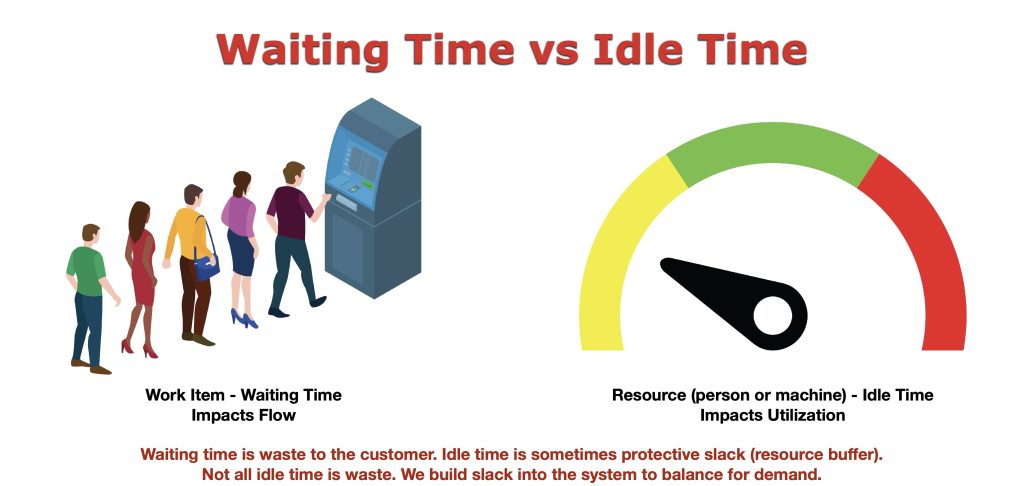
That does not mean every empty calendar is productive or that leaders should become indifferent to performance. It means performance should ultimately be judged by the value people create, the problems they solve, the quality of their decisions and the outcomes they help produce, and not by how convincingly they demonstrate that every minute was occupied.
What Toyota Taught Me About Efficiency
My experience inside Toyota reinforced something that is easily lost when people encounter Lean through books, training courses and lists of tools. The Toyota Production System thinking was never simply about keeping every person busy.
The focus is the performance of the system: creating flow, making abnormalities visible, solving problems and continually improving how the work is performed.
When an abnormal condition occurs, the objective is not to hide it in pursuit of continued utilization. The abnormality needs to become visible so that people can respond to it, understand it and prevent it from simply flowing downstream.
Now consider what that means for capacity.
If every person is already operating at the absolute limit of what they can do, what happens when someone identifies a problem? Who responds? Who investigates? Who helps? And where does the capacity for actually improving the process come from?
A system that removes every ounce of apparent spare capacity may also remove its ability to respond when reality departs from expectations.
This is also when defects start being downgraded to severity 3 or 4, even though they should really be treated as severity 1 or 2. The problem is deferred rather than resolved, and that is how technical debt accumulates. One issue is left for later, then another, then another, until the organization is carrying a backlog of unresolved problems that eventually compound into something far more difficult, expensive and disruptive to fix.
The same applies to continuous improvement. One of the biggest contradictions I see in organizations is the expectation that people should continuously improve their work while simultaneously being loaded to the point where they have no capacity to do so.
Improvement requires time to:
- See and understand problems rather than simply work around them.
- Investigate causes.
- Experiment with different approaches.
- Reflect on what happened.
- Learn from failures and unexpected outcomes.
- Update standards and improve the way the work is performed.
If every available minute must be converted into immediate output, continuous improvement becomes something employees are expected to squeeze into the gaps of a workload deliberately designed to contain no gaps.
Then leaders wonder why improvement never happens.
This is one reason I have always argued that Lean cannot simply be reduced to cost reduction, waste elimination or resource utilization. The objective is to create a system capable of delivering value, exposing problems, learning and continually becoming better at doing so.
And that requires capacity.
What Happens When the Slack Disappears?
An organization becomes overloaded, but work continues entering the system. Because everybody is already committed, queues begin forming and lead times increase. Delivery becomes less predictable and managers respond with expedites, priority changes and more coordination.
The consequences tend to compound:
- More work in progress creates more dependencies and more coordination.
- Expedites interrupt work already underway.
- Task switching increases and concentration decreases.
- Lead times stretch and commitments become harder to meet.
- Quality suffers as people work under increasing pressure.
- Stress rises and trust in plans and estimates begins to fall.
Eventually leadership sees the deteriorating performance and demands more forecasting, reporting, governance and control. Enter Monte Carlo forecasts. I explored the consequences of this in Why Everything Takes Longer: Understanding Variation and Predictability.
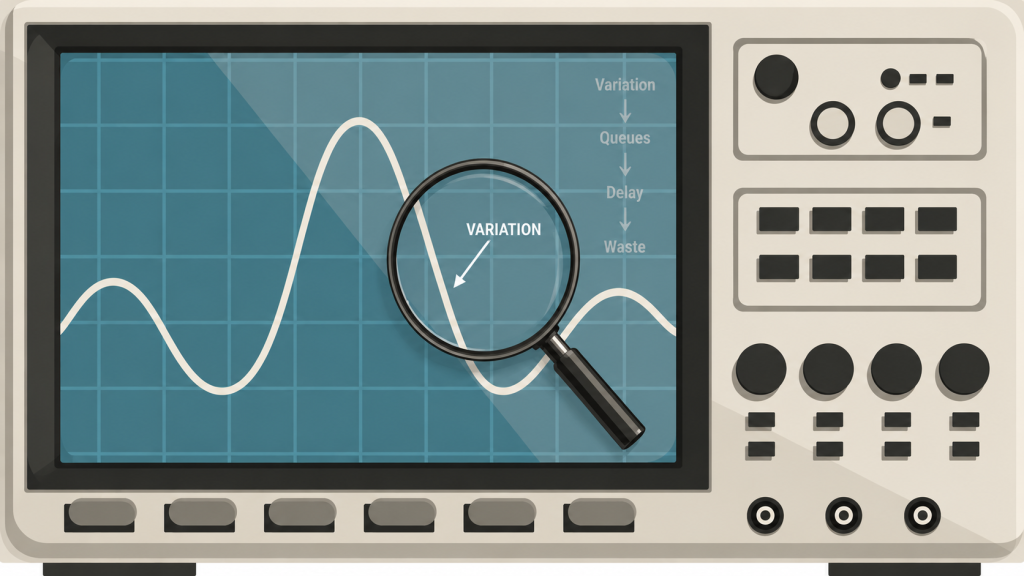
Ironically, the organization responds to an overloaded system by adding even more work to the overloaded system. This is how an organization can become increasingly busy managing its inability to deliver. This is the primary market for consultants. To manage your chaos.
What Executives Should Measure Instead
Executives should therefore treat high utilization in knowledge work as a warning signal, not automatically as evidence of productivity. None of this means utilization is irrelevant.
There is obviously a point at which too much unused capacity becomes economically wasteful. The mistake is treating maximum utilization as the objective rather than one variable within a much larger system.
Executives need to look beyond whether everybody appears occupied and pay much more attention to the movement of work itself.
Useful questions include:
- How much work do we currently have in progress?
- How old is that work?
- Where does it spend most of its time waiting?
- Where do queues repeatedly form?
- Which people or capabilities have become chronic bottlenecks?
- How often does urgent work disrupt work already underway?
- What proportion of total elapsed time is actually spent adding value?
- How long does it take us to move from starting something to delivering something useful to a customer?
- How predictable is that delivery?
These questions shift the management conversation from How busy are the resources? to How well is the system performing? And that’s a much more useful question.
Efficiency ≠ Predictability
The dangerous thing about high utilization is that it often looks good before its consequences become obvious. Organizations overload themselves gradually.
- Another project is approved.
- Another commitment is made.
- Another initiative enters the portfolio.
- Another “small request” is accepted.
Each looks manageable in isolation but eventually the system crosses a threshold. Queues grow, coordination increases, lead times stretch and delivery becomes unreliable.
Management then sees deteriorating performance and often reaches exactly the wrong conclusion: We need to become more efficient.
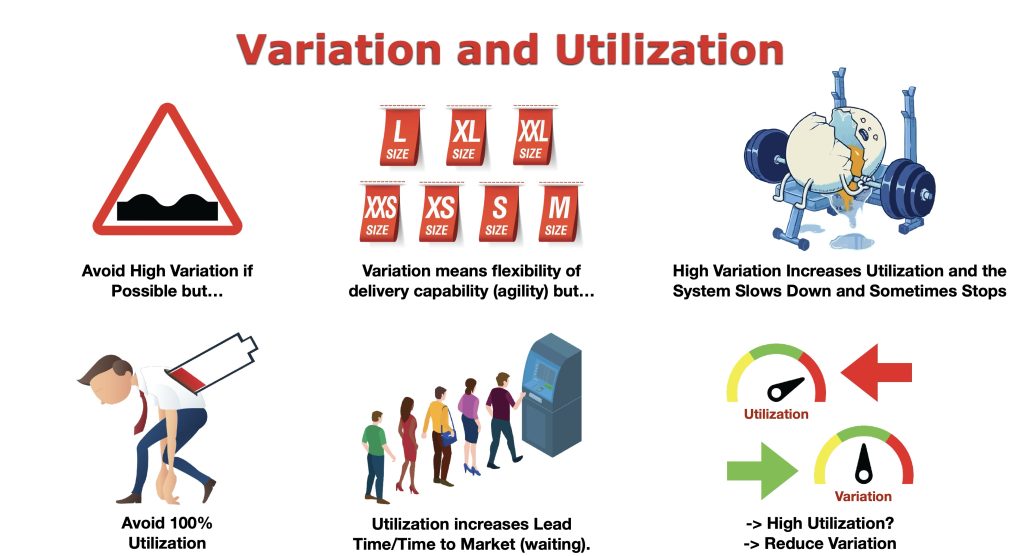
have worked with many executives, and very few have ever learned how to prioritize effectively, let alone developed a reliable way to understand their organization’s true capacity. The result is predictable: more slack is removed, utilization targets rise and more work is squeezed from the same resources.
To be fair, many of those decisions are made under immense pressure to meet financial targets that bear little relationship to the organization’s actual capacity to deliver. The cycle accelerates and breaking that cycle requires executives to stop equating an occupied organization with an effective organization.
Sometimes the fastest system contains people who are momentarily not busy.
Sometimes the most productive organization deliberately leaves some capacity uncommitted.
Sometimes what looks inefficient when viewed through the utilization of one person or team is precisely what makes the overall system efficient, and that’s not waste.
It’s called system design.
In knowledge work, the objective cannot be to eliminate variability because variability comes with the territory. The objective is to design an organization capable of absorbing it. That means protecting capacity, limiting work in progress, solving problems when they occur and giving people enough cognitive space to think, learn, invent and improve. It also means resisting the temptation to measure what is easy to observe and then mistake it for what matters.
In knowledge work, thinking is not an interruption to production. Thinking is the production process.
The goal of leadership is therefore not to create an organization in which everyone is busy all of the time. Instead, it’s to create one capable of delivering value reliably, learning continuously and responding intelligently when reality refuses to follow the plan, because reality will refuse to follow the plan.
The question is whether you left somewhere for the variability, and the thinking, to go.
A Better Way Forward
The challenge is not to eliminate capacity, but to avoid allowing high utilization in knowledge work to become the default operating model.
The goal is not to replace one utilization target with another arbitrary number. Nor is it to declare that idle time is always good. The goal is to manage the organization as a system rather than as a collection of resources that must each be kept permanently occupied.
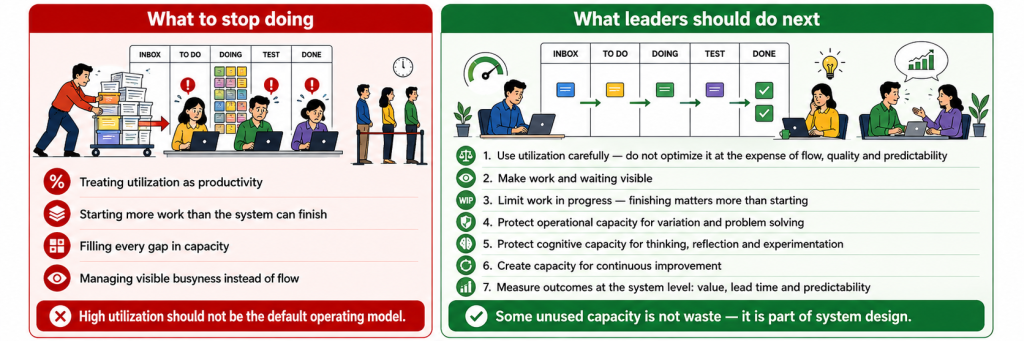
Design the system for flow, resilience and thinking – not maximum occupation.
Moving forward, executives should start doing a few things differently:
- Stop treating utilization as the primary measure of productivity. Understand it, but do not optimize it at the expense of flow, quality and predictability.
- Make work and waiting visible. Measure how much work is in progress, how long it waits, where queues form and how long it actually takes to deliver something of value.
- Limit work in progress. Stop starting more work simply because somebody appears to have capacity. Finishing matters more than starting.
- Protect some capacity deliberately. Give teams room to absorb unexpected work, solve problems and respond to abnormalities without destabilizing everything else.
- Protect cognitive capacity as well as operational capacity. Knowledge workers need time to think, experiment, reflect, learn and develop ideas. Do not mistake the absence of visible activity for the absence of work.
- Create capacity for continuous improvement. If improvement is important, it cannot be something people are expected to squeeze into a workload deliberately designed to consume every available minute.
- Measure outcomes at the system level. Ask whether customers are receiving value faster, whether lead times are improving, whether delivery is becoming more predictable and whether problems are being solved rather than simply worked around.
And perhaps most importantly, leaders need to become comfortable with seeing some unused capacity, and that can be difficult.
- An idle resource is visible.
- A queue is often hidden.
- A person thinking can look unproductive.
- A piece of work waiting silently for three weeks rarely attracts the same attention.
That is why management instinct so often pushes organizations in the wrong direction.
The next time you see apparent spare capacity, resist the immediate urge to fill it. First ask what that capacity is doing for the system.
- Is it allowing people to respond when something unexpected happens?
- Is it enabling a problem to be solved properly?
- Is it creating space for learning and improvement?
- Is it giving someone the time to think through something that matters?
- Is it helping work flow faster overall?
If the answer is yes, that capacity is not being wasted. It’s doing exactly what it was designed to do.
The goal of leadership is not to build an organization in which everyone is busy all of the time. It is to build one capable of delivering value reliably, adapting when circumstances change and continually becoming better at what it does. And that requires a different relationship with capacity.
Stop trying to eliminate every moment of apparent idleness. Start designing enough space into the system for work to flow, problems to be solved, and people to think.
Because in knowledge work, thinking is not an interruption to production.
Thinking is the production process.